Vyacheslav Molotov
TrumanVyacheslav Molotov was one of the Soviet Union’s most senior leaders and a central diplomatic adversary of Harry S. Truman in the first months of Truman’s presidency. Their encounters over Poland made the conflict between Allied agreements and Soviet conduct personal and immediate; later, Molotov’s departure from negotiations over European recovery marked a further hardening of that divide. Across these episodes he appears as a disciplined representative of Soviet policy, while the narrative also records how his controlled manner met Truman’s unusually direct style.
Identity and Political Standing
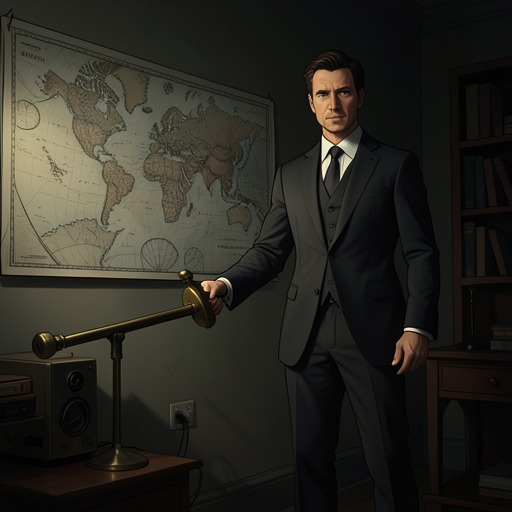
Molotov had survived revolution, Siberian exile, purges, and war, and was one of the few original Bolsheviks still in power. His importance in the Soviet hierarchy was second only to Joseph Stalin’s. The account presents him as tough and painstakingly deliberate, giving little outward sign of emotion or vulnerability apart from a stutter. His dark blue suit, pince-nez, and small mustache completed an appearance likened to that of a self-satisfied English schoolmaster. The physical portrait reinforces the impression of a public figure whose composure was part of his political presence, not evidence of an easy or conciliatory temperament.
Molotov’s conduct in Washington suited that reputation. He spoke for a government that insisted on being treated as an equal, yet he did so in negotiations where the meaning of equality was sharply contested. The United States wanted assurances that the postwar political order would include free elections in Poland; the Soviet government treated the security and political consequences of the Red Army’s wartime role as central. Molotov’s importance lay not only in his seniority but in his position at the point where these incompatible expectations had to be stated face to face.
The Washington Meetings and the Polish Dispute
Molotov arrived in Washington in April 1945, shortly after Truman became president. Their first brief meeting took place over dinner at Blair House, where both men were staying. It was cordial: Truman expressed admiration for Russia’s part in the war and said that he would stand by the commitments made by his predecessor, Franklin D. Roosevelt. For Truman, this first encounter with a Russian had gone smoothly. The cordial beginning, however, could not settle what the agreements meant in practice.
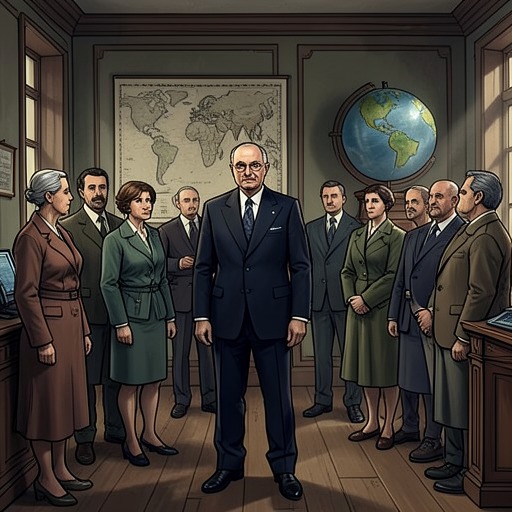
At a White House meeting on April 23, Molotov was expected while Roosevelt’s former advisers assembled with Truman. The gathering included Edward R. Stettinius Jr., Henry L. Stimson, James V. Forrestal, George C. Marshall, Averell Harriman, Charles E. Bohlen, and other senior officials. There was no member of Truman’s old Senate staff or Missouri political circle. The meeting thus put the new president into a discussion conducted largely by Roosevelt’s foreign-policy and military team, while forcing him to decide how firmly to defend the agreements he had inherited.
Stettinius reported that the Soviet government was insisting on its preferred Polish government regardless of American objections. Truman remarked that agreements with the Russians seemed to operate as a one-way street and warned that a refusal to cooperate would have consequences. Stimson urged caution, fearing a sudden break with Russia; Forrestal argued that Poland was part of a broader pattern that also involved Bulgaria and Romania. Harriman framed the issue as whether the United States would accept Soviet domination in Poland. Molotov’s position therefore confronted Truman with more than a disagreement over one government: it raised the question of whether wartime partnership would permit political freedom in the countries under Soviet influence.
When Molotov came to Truman’s office at 5:30, accompanied by interpreter V. N. Pavlov and Soviet ambassador Andrei Gromyko, Truman pressed for progress on Poland. He said the United States would not recognize a Polish government that failed to provide free elections. He also affirmed that the United States would proceed with the United Nations despite disagreements, and reminded Molotov that American foreign policy depended on public support and that postwar economic aid required congressional approval. This made the domestic limits on Truman’s diplomacy part of the exchange: an agreement that could not command public and congressional support would be difficult to sustain.
Molotov answered that cooperation among the Allies required the three governments to deal with one another as equals, and maintained that Poles had worked against the Red Army. Truman cut off that defense, saying he was not interested in propaganda and wanted Stalin told that the Soviet government was failing to honor its agreements. He insisted that the United States would fulfill the Yalta agreements and expected the Soviet government to do the same. In Charles E. Bohlen’s later account, Molotov turned pale and tried to change the subject; the account also records Truman’s wish for friendship with Russia even as he identified Poland as the chief point of conflict.
The ending of the meeting is disputed. Truman later recalled Molotov protesting that he had never been spoken to that way, followed by Truman telling him that keeping the agreements would prevent such treatment. Bohlen’s account says this exchange did not occur: Truman ended the meeting curtly and asked Molotov to transmit his views to Stalin. The accounts differ over the words, but agree on the encounter’s unmistakable force. Harriman later regretted that Truman had pressed the issue so aggressively, while Bohlen thought the substance was close to what Roosevelt would have said, though Roosevelt would have handled it more smoothly. The contrast in their accounts preserves both the confrontation and uncertainty about its exact theatrical climax.
From Moscow to the Paris Conference
Molotov reappeared in the widening postwar dispute in 1947, when George C. Marshall returned from negotiations in Moscow gravely troubled by their lack of progress. Marshall’s meetings with Molotov over the future of Germany had dragged on day after day with little purpose. Marshall hoped a direct appeal to Stalin might break the impasse, but Stalin showed little urgency about reaching agreement. The episode gave Marshall the impression that the Soviet leadership was content to let European uncertainty and disorder continue. Molotov’s prolonged negotiations were thus part of a larger diplomatic failure that changed Marshall’s view of whether a settlement with the Soviet Union was attainable.
The next decisive encounter came at a hastily organized conference in Paris, where Molotov led a sizable Soviet delegation. The proposed recovery program had attracted interest from Czechoslovakia’s provisional, largely Communist-dominated government, as well as from Communist leaders in Poland and Romania. Five days into the conference, after receiving a telegram from Moscow, Molotov stood and announced that the Soviet Union was withdrawing. He denounced the American plan as a scheme to use dollars to gain influence in Europe. His departure turned a negotiation about recovery into a visible division over who would shape Europe’s future.
The Soviet objections centered on two conditions: participating countries would pool resources, including Soviet funds, to rebuild parts of Western and Central Europe, and they would provide open accounts of how American money was spent. Stalin found both unacceptable. Under Soviet pressure, Czechoslovakia, Poland, Romania, and other Eastern European satellite countries did not join the program, while seventeen nations eventually took part. Molotov’s announcement gave public form to the withdrawal, but the evidence locates the decisive rejection in Stalin’s response to the conditions and the pressure exerted on neighboring governments. In the account’s pointed reversal, refusing participation helped secure the recovery plan’s eventual prospects by removing the expectation of Soviet involvement and strengthening the case for American support.
Narrative Role and Significance
Molotov’s appearances trace a shift from strained Allied cooperation to an increasingly divided postwar order. In 1945, the focus was whether the Soviet government would honor the wartime commitments concerning Poland; Truman’s warning combined a defense of those agreements with an appeal to the practical need for American public and congressional backing. In 1947, the dispute concerned the shape and oversight of Europe’s economic recovery. The subjects changed, but the recurring conflict was over political independence, Soviet influence, and the conditions under which cooperation could proceed.
The narrative gives Molotov a distinct role without treating him as the sole author of Soviet policy. He is the formidable, controlled negotiator in the Washington confrontation and the public representative who announces withdrawal in Paris; the decisions behind the latter episode are also attributed to Stalin. That distinction matters. Molotov’s significance comes from carrying Soviet positions into consequential encounters, where his insistence on equality met American demands for electoral commitments and financial transparency. His meetings with Truman and Marshall mark points at which the wartime language of cooperation could no longer conceal the opposing political aims beneath it.