Matthew Ridgway
TrumanMatthew Ridgway became the pivotal field commander in the Korean War’s bleakest retreat, turning the Eighth Army from a force falling back toward the 38th parallel into an army capable of returning to the offensive. His importance lay not only in battlefield recovery: his command gave Washington a dependable military perspective beyond Douglas MacArthur’s increasingly bleak assessments, and his support for the administration’s policy helped distinguish military success from widening the war.
Identity and Military Character
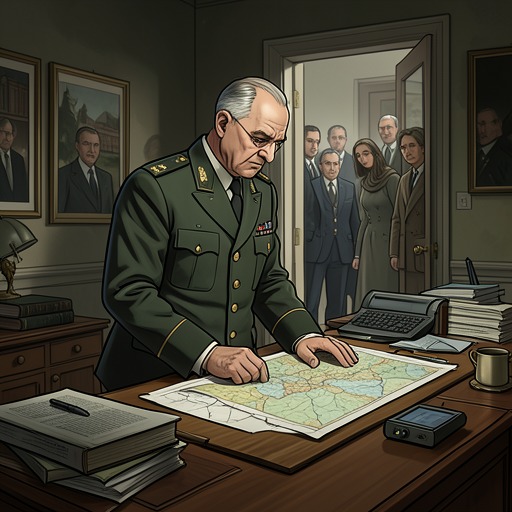
Before taking command in Korea, Ridgway was deputy chief of staff to Omar N. Bradley at the Pentagon. Bradley was plain-mannered and uninclined to exaggerate; his account presents Ridgway as a man of an orderly mind and considerable inner toughness. Ridgway had grown up in Moberly, Missouri, and his reputation rested on both intellectual discipline and direct leadership. He was already known for pioneering airborne assault during World War II, was highly intelligent and austere, and remained in exceptional physical condition at fifty-six.
Those qualities did not make him a distant headquarters commander. In Korea, Ridgway made his presence at the front conspicuous and led by personal example. His approach joined forceful direction with attention to practical needs: he treated the condition of the troops, their communications, and their ability to operate across difficult terrain as part of the work of restoring an army. The account’s emphasis is on an effective commander whose authority came from both operational judgment and visible engagement with the force.
Arrival During the Retreat
Ridgway’s command began in the aftermath of a catastrophe. Two days before Christmas in 1950, Walton Walker, commander of the Eighth Army, was killed in a road collision north of Seoul. MacArthur requested Ridgway as Walker’s replacement, and Harry S. Truman approved the appointment immediately. Ridgway left Washington at once and reached Tokyo on Christmas Day. When MacArthur told him the Eighth Army was his to command and that he should use his own judgment at the front, Ridgway received broad operational discretion at the moment it was most needed.
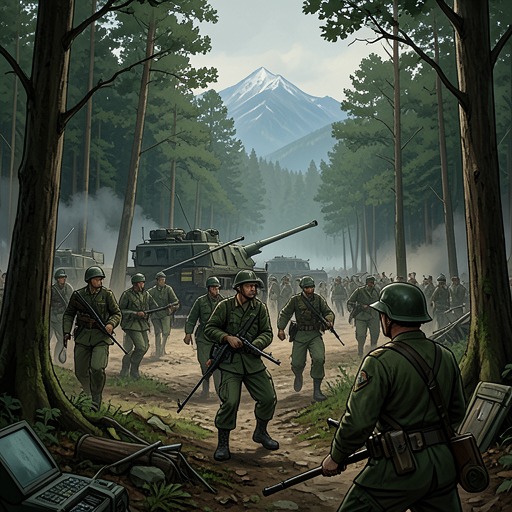
The army he inherited had been driven back nearly 300 miles since the Chinese offensive of November 28. It had retreated to a position just south of the 38th parallel, while United Nations forces continued to withdraw through Seoul and millions of Korean refugees filled the roads. Seoul had once again fallen into flames, and the South Korean government had fled to Pusan. Ridgway had no immediate way to reverse the retreat. He first had to manage a force under pressure and continue withdrawing as necessary; the army pulled back as far as Oswan, near where the first inexperienced American troops had entered combat in July. The conditions had changed from summer heat to severe winter cold, but the urgent problem remained the same: prevent retreat from becoming a rout.
Rebuilding the Eighth Army
After arriving in Korea, Ridgway began a transformation that the account describes as remarkable for its speed and scale. He addressed basic troop needs, including better food, warmer winter clothing, and improved Mobile Army Surgical Hospitals. He stressed closer communications, reduced dependence on roads and highways, and greater attention to holding high ground. He also sought more effective use of airpower and artillery. These measures combined the daily requirements of soldiers with a wider operational change: the army was to become better supplied, better coordinated, and more capable of imposing heavy costs on an advancing enemy.
Ridgway made his leadership visible at the front, setting an example through his presence and vitality. By the morning of January 17, General Joe Collins had reported that the Eighth Army was in good and improving condition under Ridgway, with satisfactory morale and confidence that it could withstand a mass attack. The report, conveyed to Truman by George C. Marshall, undercut MacArthur’s forecasts of imminent disaster. The army’s long retreat—the longest in American military history—was over. On January 25, less than a month after Ridgway’s arrival, the Eighth Army began advancing again.
Relations with Washington and MacArthur
Ridgway’s rise changed the flow of military advice to Washington. Until then, officials had depended heavily on MacArthur’s headquarters for information and on MacArthur’s own strategic judgments. As the Eighth Army recovered, the administration increasingly looked to Ridgway for reliable assessments. MacArthur retained his title and prestige, but his influence over military planning diminished; in the account’s formulation, he became largely a figurehead who had to be tolerated while Ridgway fought the enemy.
The contrast was also political. MacArthur continued to advocate widening the war, including proposals to bomb and blockade China and to use Chiang Kai-shek’s troops. These proposals were rejected. Ridgway, by contrast, understood and approved of the administration’s policy, and he admired Truman. His role therefore joined battlefield command to the larger question of civilian direction: military effectiveness did not require adopting MacArthur’s calls for escalation.
Offensive and Significance
With Ridgway in command, the Eighth Army advanced toward the Han River, Inchon, and Seoul, which it retook on March 15. By the end of March, the army had again reached the 38th parallel after inflicting heavy casualties on the Chinese forces. Ridgway faced a larger enemy force—365,000 men against more than 480,000—but concentrated artillery and the fighting spirit of his army helped offset that numerical disadvantage.
The account presents Ridgway’s arrival as a turning point in both the military situation and Washington’s confidence. His leadership did not erase the losses or resolve the wider conflict, but it ended the immediate sequence of retreat and restored the Eighth Army’s capacity to fight. At the same time, his performance supplied the administration with an alternative to MacArthur’s judgments and demonstrated that a determined field command could pursue the war effectively without endorsing its expansion. Ridgway’s significance rests on that double recovery: he helped turn the army forward while helping keep the limits of the war in view.