Governor Stark
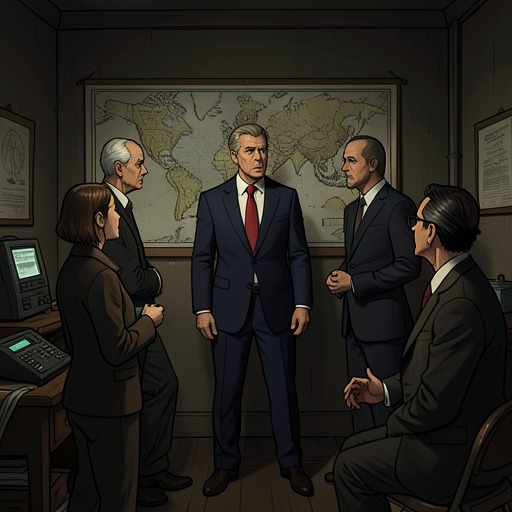
TrumanGovernor Stark was a Missouri apple grower and former artillery officer whose political rise began with Harry S. Truman’s support and Tom Pendergast’s organization. His story turned on a reversal: the network that helped make him governor became the target of his efforts to expose corruption. As he moved from Truman’s ally to Pendergast’s adversary, his loyalty to the organization gave way to a stated loyalty to the people of Missouri.
Identity and Political Introduction
Stark combined a substantial private enterprise with political ambition. He owned the Stark nursery in Pike County, northeastern Missouri, described as the largest in the United States and known for its Stark “Delicious” apple. Like Truman, he had served as an artillery officer in France during the First World War. The two met through the American Legion, and Stark confided his ambitions to Truman as their acquaintance developed.
In 1935, with Governor Park unable under Missouri law to serve another term, Truman suggested Stark as a possible successor. Truman had visited Stark’s estate and, at Stark’s urging, supplied him with a list of influential people across the state and recommended him to Pendergast’s organization at its 1908 Main Street headquarters. Stark was not simply a candidate Truman happened to know: Truman actively helped connect his political aspirations to the state’s governing network.
The Governorship and Its Bargain
Pendergast initially opposed Stark. He and Jim Aylward doubted that the apple grower could be trusted, and Pendergast had already ruled him out as a candidate around the time of Francis Wilson’s death. But when Truman brought Stark and Bennett Clark to a later meeting with Pendergast at the Waldorf, Pendergast consented. Stark would receive the organization’s full support, which in practical terms meant that he could expect to become governor. The arrangement also carried an understood reciprocal expectation: the organization would be able to count on him.
The episode established the political terms of Stark’s ascent without settling what his later conduct would be. On the train back to Washington, he was described as profoundly grateful and promised Truman that he would help whenever asked. That assurance accompanied a rise enabled by a political machine, but it did not prevent Stark from later turning against the machine’s leader. The change would make his governorship more than a reward for a political alliance; it would become the platform from which that alliance was challenged.
Truman, Roosevelt, and a Changing Alliance
Truman’s support initially helped Stark reach the White House. In October 1936, while Stark was running for governor, Truman arranged his first meeting with Franklin D. Roosevelt. Truman urged Roosevelt to invite Stark and his wife aboard the presidential train during the Missouri campaign, recommending them as charming people. Stark later became a frequent White House visitor and spoke warmly of Roosevelt as “the Chief.” He was invited to poker games aboard the President’s yacht, a degree of access that Truman, despite being a senator and Stark’s political sponsor, struggled to obtain.
That contrast sharpened as the relationship between the two Missourians changed. Stark once visited Truman’s Capitol Hill office and said that people in Missouri were urging him to run for the Senate when Truman stood for reelection, while assuring him that he need not worry. After Stark left, Truman told Vic Messall that Stark was preparing to oppose him. The source records Truman’s suspicion, rather than establishing that Stark actually entered the race. It does, however, show how their earlier alliance had become vulnerable to competition, while Stark’s access to Roosevelt placed him in a position Truman resented.
Investigations and the Break with Pendergast
After the 1936 elections, Stark became Maurice Milligan’s chief ally in the assault on Pendergast. Milligan, a federal district attorney appointed through Bennett Clark’s influence, began by investigating vote fraud. Stark’s own rise had depended heavily on Pendergast and the Kansas City organization, making his decision to turn against the machine a consequential break with the political arrangement that had brought him to office. The account identifies his stated principle as loyalty to the people rather than to a machine or its boss.
Milligan’s investigations, supported by FBI agents, documented approximately 60,000 fraudulent “ghost” votes in Kansas City in 1936. In some precincts, registration totals exceeded the known population. The resulting trials lasted nearly two years and produced 279 convictions; Milligan became a local hero. Stark’s role in this campaign linked his political break with a concrete challenge to the organization’s electoral methods.
A more consequential investigation followed Stark and Milligan’s trip to Washington. Bennett Clark alerted Roosevelt that Pendergast had failed to report substantial income on his tax returns. Roosevelt passed the information to the Treasury Department, whose investigators pursued the insurance-bribery allegations first reported in 1935. Stark had already fired Missouri Superintendent of Insurance R. Emmett O’Malley, and rumors were widespread. The investigation expanded to involve five federal agencies. Its findings traced an arrangement in which insurance-company representative Charles Street offered Pendergast money to secure the release of nearly $10 million held up in a dispute over fire-insurance rates. The documented payments included a first $50,000 installment delivered at Pendergast’s office and a later $330,000 delivery to his home in a Gladstone bag.
When Milligan’s term expired in early 1938, Stark and Roosevelt sought his reappointment. Truman could have blocked it by invoking Senate custom, but Roosevelt asked him personally not to do so. Truman instead delivered a bitter Senate attack on Milligan and the federal judges in Kansas City. The episode underscores the political costs and divisions surrounding the investigation; it does not establish that Stark personally controlled the Treasury inquiry or knew what Truman knew about the insurance scheme. Stark’s documented significance lies in his break with Pendergast, his partnership with Milligan, and his part in bringing the machine’s corruption under federal scrutiny.