John Anderson Truman
TrumanJohn Anderson Truman was a Missouri farmer, livestock trader, and inventor whose rise and collapse shaped the circumstances of his family’s life. Industrious and eager to advance, he could judge livestock with an experienced eye and earned a reputation as an honest trader; he was also stubborn, proud of appearances, and, in 1901, lost nearly all of the family’s property through speculation in Wheat futures. His story moves between practical skill and risk, between hard-won prosperity and the consequences of pursuing it too far.
Background and Marriage
John Anderson Truman had little formal education, no known special skills or money when he was young, and few adventures beyond fleeing into a cornfield with Nancy Tyler Holmes during the Civil War. He was, however, ambitious, hardworking, cheerful, and eager to please. He hoped to become a stock trader like Solomon Young, and he made a favorable impression on his neighbors. A county history published in the year of his marriage described him as managing his father’s farm and as an energetic young man likely to succeed.
John married Martha Ellen Truman on December 28, 1881, at the Young homeplace, three days after Christmas. By then the couple had known each other for some time. John’s attention to appearance was already pronounced: for his wedding photograph in Kansas City, Missouri, he wore a black frock coat, white string tie, and kid gloves, with his hair carefully arranged. He chose to sit for the portrait, reportedly because he was sensitive about his height. Martha Ellen stood beside him, her hand on his shoulder. Solomon Young gave her a fine walnut dresser with a marble top, a mirror, and small side shelves—a wedding gift that remained exceptional among the furniture she would own.
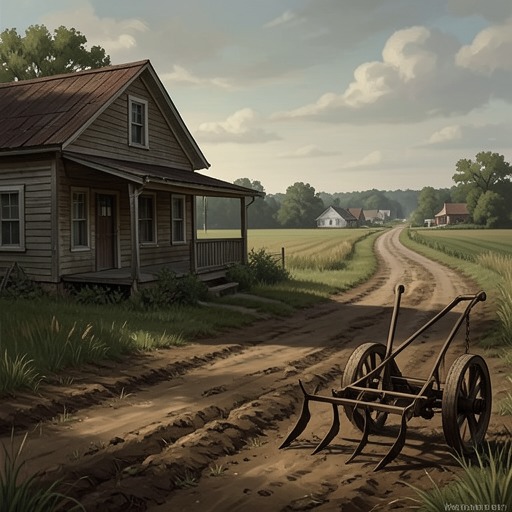
The couple began married life in Lamar, Missouri, where John bought a small white frame house for $685. Measuring twenty by twenty-eight feet, it had six small rooms but no basement, running water, or plumbing. Its newness, snugness, and sunny parlor offered a modest foothold for the young family. For another $200, John bought a barn across the street and began selling mules. His advertisement offered teams for sale at the White Barn on Kentucky Avenue. The business disappointed, and the family’s next move—to a farm in Harrisonville—also proved brief.
Livestock, Invention, and Family Life
In 1887, after the family’s false starts in Lamar and Harrisonville, John moved back to the Young farm and became Solomon Young’s partner. Their return placed the family in a large, multigenerational household where Harry S. Truman spent much of his earliest childhood. John’s father also lived there, along with other relatives, a hired girl, farmhands, and visiting children; the household seldom numbered fewer than fourteen or fifteen people. John’s work and family life were therefore closely joined to the farm and to Solomon’s standing in the community.
As John’s fortunes improved, there was money for servants, books, and studio photographs. He also delighted the children with matched red goats, custom harnesses, and a miniature farm wagon that became a neighborhood talking point. He was an early riser and a persistent worker, and people considered him ingenious. A backyard gas well and several inventions contributed to that reputation. He patented a staple puller for barbed-wire fences and devised an automatic railroad switch.
The switch brought an opportunity that John’s stubbornness helped turn into a loss. The Missouri Pacific reportedly offered an annual royalty of $2,000; the Chicago & Alton offered $2,500. John asked for twice the latter amount, and both railroads rejected the deal and adopted another version of the device. The account of the failed negotiation endured as a family example of his unwillingness to yield: a potentially valuable invention brought him no return.
In livestock trading, by contrast, John’s judgment and reliability served him well. He could estimate the age of a mule or horse at a glance, often without inspecting its teeth, and developed a persuasive manner of talking business. Neighbors remembered him as a good trader who was stubborn but square. These qualities—commercial discernment and a reputation for keeping his word—coexisted with the inflexibility that had cost him the railroad royalties.
Temperament and Influence
John was remembered as having a violent temper, although it had not, up to the period described, brought him into trouble. His pride was also visible in his concern with dress and appearances, and in the difficulty of accepting a reversal of fortune. Yet family and community recollections present him as more than an imprudent or difficult figure: he worked persistently, had inventive ideas, and earned trust in his trading.
His influence on Harry S. Truman was sometimes overshadowed by Harry’s affection for his mother, Martha Ellen. But the family recognized that father and son shared important qualities, even when neither fully understood the resemblance during Harry’s boyhood. John’s industriousness, stubbornness, and practical engagement with work offered a lasting counterpoint to the assumption that Harry was simply his mother’s son.
Financial Collapse
John’s success did not protect the family from financial ruin. In the summer of 1901, his run of luck in Wheat futures ended. He continued risking money in an effort to recover his losses, eventually gambling away nearly everything he and Martha Ellen owned: as much as $40,000 in cash, stocks, and personal property. The losses included 160 acres of valuable land on Blue Ridge that her father had given her.
At fifty-one, John was financially wiped out. The family had to sell its Waldo Avenue house and, after temporarily living elsewhere in Independence while trying to maintain appearances, leave the town. They moved to a modest neighborhood in Kansas City, Missouri, where John took a wage-paying job for the first time in the family’s history. He worked nights as a grain-elevator watchman, at pay comparable to a farmhand’s. The descent from trader and farm partner to night watchman marked a sharp reversal, particularly for a man remembered as fiercely proud. The family did not openly complain about its troubles; the loss instead became a quiet but decisive break in Harry’s boyhood and in the secure life the family had known.