Anderson Shipp Truman
TrumanAnderson Shipp Truman was the first Truman to reach Jackson County, Missouri, arriving from Kentucky on horseback in 1846. A modest farmer whose recorded life stands in marked contrast to the public careers later associated with his family, he married Mary Jane Truman, made a home in Missouri, and kept to his land during the Civil War. In his later years he lived under the same roof as his grandson, Harry S. Truman, whose earliest observations of the world began in a household shared by several generations.
Origins and Marriage
Anderson Shipp Truman, also called Andy, came from a farming family of English and Scotch-Irish background. His father, William Truman, had moved from Virginia into Kentucky around 1800 and was reported to have served in the War of 1812. Andy grew up on the family farm near Christianburg, Kentucky. At thirty, he was described as slight, gentle, and soft-spoken, with few prospects. Mary Jane Holmes, five years younger, nevertheless chose to marry him, defying her mother’s wishes.
The disagreement was recorded in a letter Nancy Tyler Holmes sent from Missouri on July 24, 1846, after hearing of her daughter’s plans. The letter was dictated to another daughter, a circumstance that suggests Nancy may have been unable to write. She expressed distress at Mary Jane’s refusal to follow her advice, but the reason for her objection to Andy remains uncertain. A later explanation was that Nancy considered the match a step downward because the Trumans owned no enslaved people.
The wedding took place in mid-August at the home of Mary Jane’s married sister in Kentucky, a red-brick house with white trim that still stood when the account was written. Afterward, Andy rode to Missouri, intending to remain only until he obtained his new mother-in-law’s approval. His first letter to Mary Jane, sent about a month later, described a welcome that surprised him: Nancy and her daughters embraced him, and the family urged him to stay and make a life on the frontier. He wrote that he believed he could be content in Missouri if Mary Jane joined him. She traveled by steamboat with her mother’s blessing. The couple’s wedding gifts included Hannah, an enslaved woman, and Hannah’s child, whom the Holmes family gave to them.
A Missouri Farmer During the Civil War
Andy and Mary Jane settled on a rented farm belonging to Johnston Lykins, a Baptist missionary who was also a preacher and physician, and who had turned to land speculation. The move placed the couple amid the growth of a frontier community: Lykins and others were founding Kansas City near the meeting of the Kansas and Missouri rivers. The area’s promoters looked toward towns, trade, and river transport, while Andy’s recorded life remained centered on farming and family.
During the Civil War, Andy signed a loyalty oath and favored preserving the Union. His brother John Truman, writing from Shelby County, Kentucky, likewise worried that family members might turn against the Union as communities and households divided over the war. Andy and his family had moved across the Missouri River to Platte County, Missouri, a nearby place that the war affected much less severely. The account characterizes Andy as increasingly religious and unwilling to take part in violence; he kept to his land and labor and lived simply, with little incident.
One nighttime scare brought the conflict briefly close to the family. After Hannah heard shouting and the commotion of horses at a neighboring farm, the household assumed that the Red Legs had arrived. Nancy Tyler Holmes, then in her eighties, fled with the youngest Truman children to hide in a cornfield. The riders turned out to be Confederate cavalry seeking to press a neighbor’s sons into service, not the feared Red Legs. The episode was as close as the war came to the Trumans, while other families in the region faced forced displacement and destruction. Andy’s loyalty oath did not prevent him from remaining comparatively sheltered by the family’s move to Platte County.
The Young Family Household
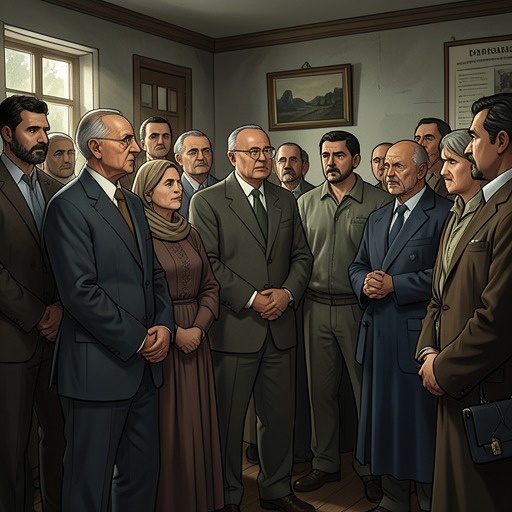
By the time Harry S. Truman was three, the Young homeplace had become the setting for most of his earliest observations. Andy also moved into the house, where he was given a room upstairs. The household included Harry’s parents and siblings, his maternal grandfather Solomon Young, and a fatherless Chiles grandchild, alongside other relatives, a hired girl, workers, and visiting neighbors. It usually held at least fourteen or fifteen people across three generations.
Andy’s place in that household connects the account of the first Truman migration to the younger Harry’s childhood. The grandfather who had arrived from Kentucky with few prospects was present in the busy family home where Harry began to encounter the world. The narrative records little about Andy’s later life or his thoughts, so his significance rests chiefly on these concrete connections: his marriage to Mary Jane, the family’s settlement in Missouri, his quiet course through the Civil War, and his presence in the Young home during his grandson’s early years.