Martha Ellen Truman
TrumanMartha Ellen Truman, known in her youth as Mattie and to her son as Mamma, was more than a presidential mother in Harry S. Truman’s story: she helped shape his early education, carried family responsibilities that constrained her own life, and followed his political career with unusually close attention. Her practical competence, appetite for books, partisan judgments, and unsentimental public remarks made her a distinctive presence in the family history surrounding his rise.
Early Life and Education
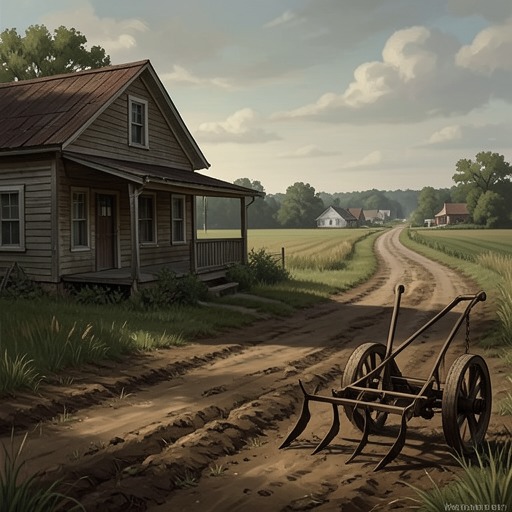
In 1868, the year she turned seventeen, Martha’s family resettled at Blue Ridge farm in a larger house chosen by her mother, Harriet Louisa Young. Martha helped her father plant the double rows of elm trees along the quarter-mile approach. The white, wood-frame house, with green shutters and a broad veranda, stood beyond that drive; at the rear, past the orchard, a large red barn had been built from heavy walnut planks and beams salvaged from the old mill at Hickman's Mills. The account gives her life in this period a material setting shaped by family labor and rebuilding after the war.
Martha’s abilities extended well beyond the household skills expected of her. She learned baking and sewing, but also how to use a rifle as well as a man. Old correspondence remembered her as lively, and the description of her sweeping the veranda says that she made the broom fly. She was sent to Lexington Baptist Female College in Lexington, Missouri, where she spent two years learning to sketch and play the piano. The education also fostered a lasting love of books and the poetry of Alexander Pope. Practical skill and literary interest thus appear together in the portrait, rather than as separate sides of her character.
Motherhood and Family Responsibility
Harry’s account of childhood places his mother at the center of his earliest intellectual and emotional life. He believed she understood him best and cared most about his well-being. Before he was five, she held him in her lap and used the large print in the family Bible to teach him to read. The scene presents literacy not as an abstract family value but as an intimate act of instruction between mother and son.
In the summer of 1889, after Harry’s fifth birthday, Martha surprised him and Vivian Truman with a baby sister, Mary Jane Truman. The boys heard crying upstairs and imagined that a new pet had arrived; the baby was named for John Truman’s mother, whom they had never known. Harry adored his sister. Martha’s decision to keep the birth secret until the baby arrived became one of his vivid childhood memories, and the episode joins his affection for his mother to the expanding family she cared for.
Another change came the following summer, when Martha announced that the family would leave the farm and move to Independence so Harry could receive proper schooling. John Truman used inherited money to buy a house and several lots on South Crysler Avenue, near the Missouri Pacific railroad tracks. He paid $1,000 down and mortgaged a further $3,000, intending to try stock trading again. The move reveals the family’s investment in Harry’s education, while its financial circumstances remained uncertain. After John’s later losses, the Waldo Avenue house was sold; the family moved first within town and then to Kansas City. John took work as a night watchman at a grain elevator, at wages comparable to a farmhand’s. For a family accustomed to trying to maintain appearances, this reversal was painful.
A Life Narrowed by Duty
By the summer Harry left for Camp Doniphan, Martha was twenty-eight, unmarried, popular, and described as an attractive young woman with a bright smile and even disposition. A studio photograph made for Harry to take to war showed her in a large picture hat, with an expression that seemed to combine strength and gentleness. The account stresses the contrast between this image of a woman with her own appeal and the course her life took afterward: she remained without serious marriage prospects, and her social world was largely confined to Grandview.
The burden of the family fell increasingly on her after her father’s death. Responsibilities that had weighed on Harry became hers, and the narrative suggests that Harry eventually understood how alone she was. Her diminished freedom is not presented as a single dramatic rupture, but as the consequence of care work and family obligation accumulating around her. That contrast gives weight to the earlier portrait of the lively young woman who could handle a rifle and had pursued education: the skills and interests remain part of her identity even as circumstances left little room for a life beyond Grandview.
Political Judgment and Public Presence
Martha remained an attentive observer of Harry’s public career. In Missouri, she followed his Senate activity closely through the Congressional Record and was a more committed Democrat than almost anyone he knew. Her political opinions were not merely private encouragement. When Harry’s possible elevation to the vice presidency was under discussion, she followed the convention by radio from the small parlor at Grandview and told reporters she did not want him to become vice president. She believed he should remain in the Senate. Her view placed her in direct contrast with the political momentum carrying her son toward national office, and it showed that maternal pride did not prevent her from making an independent assessment of what his career should be.
When Harry became president after Roosevelt’s death, Martha’s response was equally clear-eyed. Asked by reporters at Grandview, she said she could not truly be glad because she was sorry Roosevelt had died; had Harry been elected, she would have waved a flag, but the circumstances did not seem right for celebration. She added that Harry would get along all right. Harry was proud of her answer and recorded that it was a jewel, observing that even the best public-relations advisers could not have improved it. Her remarks acknowledged the legitimacy of his succession without turning a death into a cause for uncomplicated celebration. They also combined grief, political instinct, and confidence in her son in a few measured sentences.
Martha’s arrival in Washington made her, to Harry’s delight, an immediate subject of press attention. He sent the silver, four-motored C-54 known as The Sacred Cow to bring her. Stepping from the plane, she exclaimed, “Oh, fiddlesticks!” at the number of people who had come to meet her, and said she would not have come had she known there would be such a fuss. Reporters saw a small, bent but chipper woman wearing a dark blue suit, an orchid on its lapel, and a blue spring hat trimmed with a gardenia. The scene translated the familiar Grandview mother into a public figure, while her exclamation punctured the ceremony surrounding her arrival.
The relationship remained close through letters and calls. In a letter to his mother and sister during the Potsdam meetings, Harry offered his blunt comparison of Winston Churchill and Joseph Stalin. On another occasion, Martha took a long-distance call in the other room of her small clapboard house in Grandview. Returning, she said Harry was a wonderful man, that she had known he would call, and that he always called after something had happened. The account does not specify the occasion of that call, but its emphasis is on a recurring habit of contact. Martha’s place in the narrative rests not only on being consulted or celebrated: she watched, judged, and remained part of the private correspondence and calls that linked Harry’s public life to home.