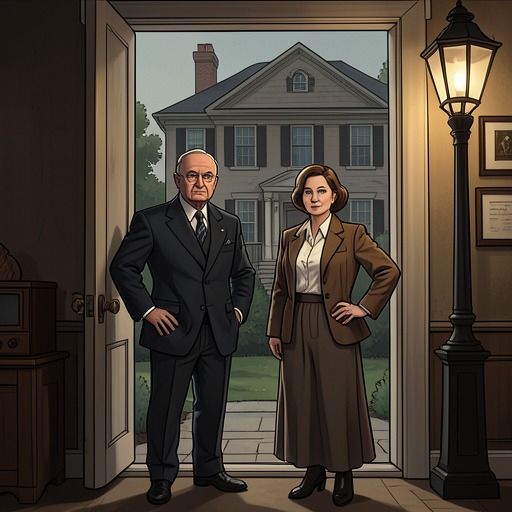
Margaret Wallace Truman
TrumanMargaret Wallace Truman, the only child of Harry S. Truman and Bess Truman, grew up at the center of an extended family household in Independence. Her birth brought new meaning to her father’s life and made her the focus of several generations of relatives. Childhood in this close and carefully ordered home was not untouched by danger: in 1930, a stranger tried to take her from school, prompting her parents to keep her under close watch. As she grew older, she also accompanied her father at moments when his local political career opened onto the national stage.
Birth and Identity
Harry had urged Bess to give birth in a hospital, but she and her mother insisted that the baby be born at home. A superstition against preparing too much in advance, born of earlier disappointment, meant that there was no crib or cradle ready. The newborn would spend her first days on pillows in a bureau drawer. The modest arrangement stood in contrast to the anticipation gathering around the household.
Around noon, Harry called their doctor, Charles E. Krimminger, who arrived covered in snow. Practical nurse Edna Kinnaman came soon afterward. She remembered Bess and Harry waiting in the upstairs hall through the afternoon: Madge Wallace sat on a cedar chest, while Harry remained in a chair, looking composed. The delivery was normal. The baby, a girl weighing seven and a half pounds, announced her arrival with a cry loud enough that her grandmother and father came into the room without being called. Harry told his mother and sister that the child would be named Mary Margaret, after Mary Jane Truman and Mrs. Wallace. A friend’s wife saw him soon afterward, his face beaming.
The Center of a Household
There had not been a baby in the old house since Madge Wallace’s own childhood. Margaret’s arrival brought four generations under one roof for several months, until Mrs. Gates died that spring. Her circle extended beyond her parents: there were her great-grandmother and grandmother, four Wallace aunts and uncles living in adjoining houses who had no children, Uncle Fred, who remained part of the household, and the two Noland sisters across the street. The book describes a family atmosphere transformed by her presence. Harry was nearing forty, and Nurse Kinnaman recalled that his devotion to his daughter was immediate and remarkable.
Margaret later described her childhood as nearly perfect. As an only child among childless aunts and uncles, she received the family’s attention and affection. Her parents occupied different places in her recollections: Bess was the household’s disciplinarian, while Harry did not spank her and, Margaret recalled, was easy for her to persuade. That contrast did not make the home lax. At dinner, the family gathered at 6:30 around a table with linen and good silver; Madge Wallace sat at the head, Harry at the other end, and Margaret beside her mother. Harry carved the meat, and Margaret was expected to have perfect manners. Political talk might draw in her mother, but her grandmother, who disliked politics, remained a commanding presence even when she said little. These routines convey both the affection surrounding Margaret and the formal expectations of the home in which she was raised.
The Attempted Abduction
On the afternoon of November 3, 1930, the day before the election, a stranger appeared at the door of Margaret’s first-grade classroom at Bryant School on River Boulevard, four blocks from home. The middle-aged man kept his hat on and said he had come to collect Judge Truman’s child, Mary Margaret. Her teacher, Madeline Etzenhouser, found the request suspicious: the family called the girl Margaret, not Mary Margaret, and Bess or one of Margaret’s uncles normally picked her up.
Etzenhouser told the man to wait and went to the principal’s office. When she returned, he was gone. Bess arrived a few minutes later, panicked and fearing, the teacher believed, that Margaret might not be there. She was relieved to find her daughter safe. Harry and several deputy sheriffs soon arrived, and the incident caused a considerable stir. The next day, while Harry visited precinct polling places, Margaret and Bess spent election day at a town hotel accompanied by deputy sheriffs. The family could not determine whether the attempt was connected to politics, and nothing further was learned. Afterward, Margaret was watched closely; the Trumans were also deeply affected by the Lindbergh kidnapping two years later.
A Daughter Beside Her Father
Margaret’s appearances at her father’s public milestones reveal a personal dimension of his political ascent. In December 1934, at ten years old, she helped pull the string unveiling Charles Keck’s equestrian bronze of Andrew Jackson at the dedication of the new twenty-one-story courthouse in Kansas City. Harry beamed as she took part. A friend remembered Margaret as tall for her age, skinny, and faded blonde; the account notes that she clearly enjoyed being her father’s daughter.
The following week, Margaret watched with Bess and Jim Pendergast from the visitors’ gallery of the United States Senate as Harry, dressed in morning coat and striped trousers, walked with Senator Clark to take the oath of office. The scene places her at the edge of a change in her father’s public life, but not apart from it: from her first days, Margaret had been a source of personal joy in a household shaped by family ties, and she remained present as Harry moved from county office toward national office. The sources here offer no later account of her life; within this part of the story, her defining role is as a cherished daughter whose safety and presence mattered deeply to her family.