Mary Jane Truman
TrumanMary Jane Truman, born Mary Jane Holmes, was Harry S. Truman’s younger sister and a steady presence in the family life behind his public career. Her life joined two generations of the Truman family: she was named for her paternal grandmother, helped sustain the family farm, and eventually inherited much of the responsibility for it when Harry left for war. Later, she remained at Grandview while his career carried him far away, receiving his letters and hearing about his politics. The record presents her as a capable, affectionate family member whose own choices were often constrained by the work and obligations placed upon her.
Family Origins and Marriage
Mary Jane was one of Nancy Tyler Holmes’s two youngest daughters. Nancy, a widow with ten children, traveled from Shelby County, Kentucky, to Jackson County, Missouri, around 1845, after her sons had established themselves there. She brought tea cakes and her late husband’s beaver hat in a large leather hatbox, traveling with her two youngest daughters and several enslaved people. Mary Jane, meanwhile, was attached to a young man in Kentucky named Anderson Shipp Truman.
Anderson Shipp Truman was slight, gentle, soft-spoken, thirty years old, and without prospects when Mary Jane chose him. He grew up on a Kentucky farm in a family of English and Scotch-Irish farmers. Five years younger than he was, Mary Jane defied her mother’s wishes and returned to Kentucky, ostensibly to visit a married sister, but intending to marry him. Nancy’s letter from Missouri, dated July 24, 1846, conveys her distress: she said she had been unable to sleep or eat since learning of the plan. The reason for her objection is uncertain; a later explanation was that she considered the match a step down because the Trumans owned no enslaved people.
The couple married in Kentucky in mid-August at the home of Mary Jane’s married sister, a red-brick house with white trim. Anderson then rode to Missouri, intending to stay only long enough to secure his new mother-in-law’s blessing. The surviving account gives little more about the first Mary Jane’s adult life. It does establish her as a determined young woman whose marriage ran against her mother’s advice and joined the Holmes family to the Trumans.
A Namesake and a Close Sibling Bond
The later Mary Jane Truman was born in the summer of 1889, after Harry’s fifth birthday. Her mother, Martha Ellen Truman, had not told Harry and his brother Vivian that a baby was expected. Hearing crying upstairs, the boys thought a new pet had arrived. Their mother named the infant Mary Jane after John Truman’s mother, the grandmother the children had never known. Harry regarded his baby sister as a marvel and adored her.
The household helped shape the closeness between the siblings. Caroline Simpson, who lived with her husband and four children in the Truman home, taught Harry to cook on the wood stove and talked with him for hours. He spent long stretches caring for Mary Jane: rocking her, braiding her hair, and singing her to sleep. In later years, Mary Jane remembered that no one had been as kind to her as Harry. He watched over her outdoors, mindful of the time a cellar door had injured his foot when he was a child. Their father, John Truman, favored Mary Jane, just as their mother was especially close to Harry; Harry’s attentiveness to his sister also pleased their father.
As she grew up, Mary Jane was described as attractive, cheerful, and even-tempered. A photograph made for Harry to take to war shows her in a large picture hat. At twenty-eight, she was still unmarried and had no serious marriage prospects, though she was popular. The account places her future increasingly at Grandview rather than in a social life of her own. After Harry left, she took on worries and responsibilities that had weighed on him since their father’s death. He later acknowledged that his departure had been a blow to both his mother and sister.
Work at Grandview and the Family’s Changing Circumstances
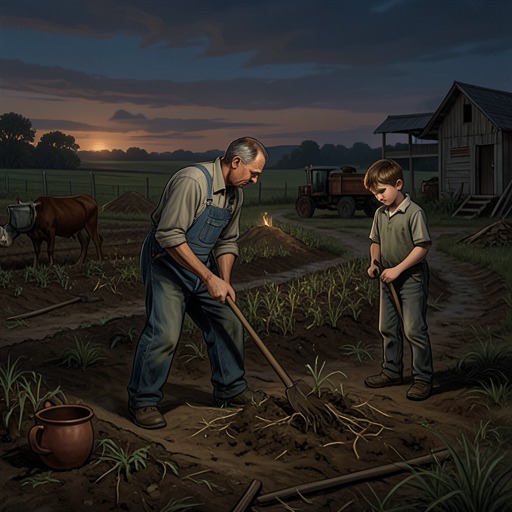
Mary Jane’s contribution to the farm was practical and sustained. In one recollection connected with a family wedding, she described harvesting wheat and cooking the midday meal for twelve farmhands: meat, potatoes, fresh bread, and homemade pies. The account makes clear that domestic work and agricultural labor were interwoven. Preparing food for a dozen workers was part of the day’s farm routine, not an incidental task.
The siblings’ shared responsibilities became more pressing as their father’s health failed. Harry ran the farm, took over road work, and drove John to the doctor as often as four times a week. At the same time, the family needed to get two hundred acres of wheat planted. Mary Jane was part of the household carrying those demands, though the account gives Harry’s efforts more direct attention. A small domestic episode also shows their everyday familiarity: when Mary Jane wanted driving lessons, Harry agreed reluctantly because their mother had paid for the car. When Mary Jane drove into the front gate, he was relieved that she had hit it rather than the stone post.
After Harry returned from military service, he hoped the Grandview farm might continue as before and tried to persuade Mary Jane to keep it operating. She refused to do so unless he returned and shared the work; two years of carrying on had been enough for her. That autumn, they auctioned the horses, hogs, plows, seed drill, and nearly everything else. Harry put fifteen thousand dollars into his store, most of it raised by selling the livestock and machinery, while the land was rented to another farmer. The arrangement was unfair to Mary Jane in light of her labor and pleased no one in the family except Harry. Her refusal was therefore more than a change of plans: it marked a limit on what she was willing to shoulder alone.
Life Beyond Harry’s Departure
Mary Jane remained unmarried and, after Harry left for war, had little life beyond Grandview. The family’s changing circumstances later took Harry and Bess Wallace to Independence, where they lived in the Gates house with Madge Gates Wallace and other members of the Wallace family. Mary Jane, by contrast, remained closely associated with the farm and the responsibilities there. The contrast between Harry’s growing public life and her restricted prospects is especially sharp in the account of the war years: the family burdens that had once fallen heavily on him became hers, and he came to recognize how isolated she had been left.
Her relationship with Harry nevertheless continued through regular contact. After a serious illness in the family, he returned to Washington but called Mary Jane nearly every day, visited again in June, and wrote to her regularly. She read his letters aloud to their mother, Martha Ellen Truman. Harry kept Mary Jane informed about political developments, knowing she liked to follow them. In one letter he criticized Robert Taft and Joseph Hartley and warned that he was preparing to give a speech she would dislike: his address to the National Association for the Advancement of Colored People, in which he planned to quote Abraham Lincoln. These exchanges place Mary Jane within the private audience for his political life, even though she remained far from Washington.
Illness, Distance, and Political Difference
Mary Jane was the person who telephoned Harry from Grandview to report that their mother had pneumonia and might not survive the day. Harry had his plane prepared, but first waited at the airport for the remaining congressional signatures needed on the National Security Act, which he also wanted to sign before Congress recessed. He waited beside the aircraft until the bill reached him; minutes later, he was airborne. Mary Jane’s call brought the family crisis directly into the business of the presidency, while the delay showed the competing obligations surrounding his departure.
In later years, Mary Jane did not share Harry’s understanding of his presidential responsibility to confront racial injustice. After the findings of the Civil Rights Commission, presented in its report To Secure These Rights, Harry concluded that he could not remain inactive in the face of injustice. Mary Jane, like others close to him, failed to understand why he could not simply do nothing. The difference is important without making her a political actor in her own right: the letters show that she followed his public affairs, but the account also records a gap between his developing commitment and her view of what he should do.
Mary Jane’s place in Harry’s story is thus neither merely domestic nor a hidden version of his political career. She was a younger sister cherished in childhood, a worker whose labor helped sustain Grandview, and the family member left with responsibilities when Harry departed. Their later correspondence preserved their closeness, but it could not erase the unequal shape of their lives or their disagreement over civil rights. Her story ends in the account not with an independent public achievement, but with the durable evidence of her work, her care for family, and Harry’s growing recognition of what his absence had asked of her.