George C. Marshall
TrumanGeorge C. Marshall was a senior military leader and statesman whose counsel helped shape the United States’ transition from world war to Cold War. As Army Chief of Staff, Secretary of State, and Secretary of Defense, he advised Harry S. Truman on military preparedness, the atomic bomb, European recovery, Berlin, and the Korean War. His influence came not only from his offices but from a reputation for self-command and professional integrity, and from Truman’s repeated willingness to call him back into service.
Identity and public bearing
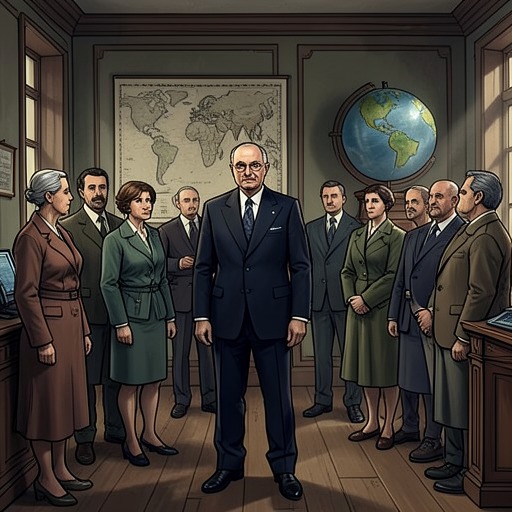
Marshall’s public authority rested on a manner notably free of military display. He was slightly under six feet tall, with sandy-gray close-cropped hair and light blue eyes; age had begun to stoop his shoulders. Observers described a homespun, fatherly quality, but also an intangible force that made him difficult to capture in ordinary terms. Dean Acheson emphasized his lack of pretension, while Winston Churchill compared him to a noble Roman. Truman’s staff spoke of the reverence he inspired, and George F. Kennan associated his composure under pressure with a good conscience.
The qualities that made Marshall influential were also institutional. He was invariably courteous, imperturbable, and without petty vanity or apparent self-seeking ambition. In the book’s account, his authority did not depend on theatrical command: it came from steadiness, judgment, and a sense of duty that allowed him to disagree without turning disagreement into personal combat. That bearing would matter in dealings with both Congress and presidents, as well as in the bitter public attacks he later declined to answer.
Military leadership and civilian authority
By the period of accelerated defense preparation, Marshall was Army Chief of Staff, while Truman served on the Military Affairs Committee and the Military Subcommittee of the Appropriations Committee. Truman had voted for the first peacetime draft in September. By December, more than $10 billion in defense contracts had been awarded even though the country remained officially at peace. Testifying before Congress, Marshall sought a force of two million and another billion dollars for expenses, stressing that this would only begin to meet the need. Asked whether he sought more than the emergency required, he explained that an abundance of resources would ease his concern in a country then relying heavily on patriotism and spirit.
Truman, himself a reserve colonel and conscious of the shortage of qualified officers, went to Marshall’s office in the old Munitions Building to offer his services. Marshall judged him too old to enlist and more useful to the country in the Senate. The exchange captures the practical division of labor between the two men: Truman wanted to serve in uniform, while Marshall redirected him toward the political responsibilities that military mobilization also required.
Their working relationship deepened through the Senate’s examination of national defense. At the first session of the committee hearings on April 15, 1941, Marshall appeared with senior military and civilian officials. When the discussion turned to Army seniority, he argued for selective promotion, distinguishing leadership from mere advancement by rank. Truman later traced the beginning of his respect for Marshall to that hearing. Marshall, for his part, cautioned against Congress being treated with resentment, insisting that legislators should be presumed as patriotic as military officers.
The wartime relationship between military expertise and civilian oversight remained central to Marshall’s public role. In 1942, Truman worried that powerful generals and admirals were extending their influence into industry and agriculture, with consequences for the country’s postwar political and economic structure. In a broadcast, Truman set out the boundary he believed necessary: generals and admirals should fight battles and state what they needed to do so. The principle made Marshall’s own position especially consequential: his advice carried great weight, but military judgment was to inform policy, not displace civilian authority.
In February 1944, Marshall joined Secretary of War Henry Stimson in a private meeting at the Capitol with congressional leaders, including Sam Rayburn. There, for the first and only time on Capitol Hill, Stimson and Marshall disclosed the existence of what they described as the war’s greatest secret. The episode placed Marshall inside the small circle entrusted with extraordinary wartime information while also showing how tightly guarded decisions reached selected civilian leaders.
The atomic bomb and the cost of invasion
After Truman became president, Marshall’s military advice entered decisions whose consequences extended beyond the battlefield. At a major foreign-policy meeting on April 23, 1945, Marshall urged caution about the Soviet Union’s possible entry into the war against Japan. His concern was that the Soviet Union might postpone participation until the United States had borne the heaviest fighting. Two days later, when Stimson brought General Leslie Groves to the White House to brief Truman on the secret project, Marshall stayed away to avoid attracting press attention. His absence was part of the effort to keep the project and its presidential deliberations concealed.
Marshall’s thinking about the new weapon was not presented as a simple, unchanging endorsement of a single target or method. He had initially considered using it against a major military installation and, if necessary, against manufacturing centers, with advance warning to civilians. By the later deliberations, he appears to have changed his view; he was also not formally a member of the advisory committee. A harmless technical demonstration had been considered and rejected because scientists could not identify one likely to produce the shock officials thought necessary. Stimson alone bore responsibility for recommending a course to Truman, but Marshall’s earlier views and subsequent military assessments helped define the choices under consideration.
Marshall’s case for using the bomb was bound to the anticipated cost of invasion. Recalling the costly fighting at Okinawa and other Pacific islands, the heavy losses at Iwo Jima, and the destruction of Tokyo by conventional bombing without an apparent collapse in Japanese morale, he argued that Japan’s resistance could be still more severe on its home islands. The goal, as he saw it, was to end the war and save American lives. The invasion plan he presented began with an assault on Kyushu in November, about 350 miles from Okinawa. He described the operation as comparable in difficulty to Normandy and estimated roughly 31,000 losses in its first thirty days, drawing a comparison with Luzon.
Other estimates recorded in the discussions were much higher, depending on the scope of the invasion being considered. A Pentagon estimate for an operation extending from southern and northern Kyushu to Japan proper put casualties at 220,000. A memorandum by General Thomas Handy suggested that avoiding invasion might save between 500,000 and one million American lives, while Stimson feared the total American dead and wounded could reach one million. These figures were not a single settled forecast; they show the scale of the numbers being weighed by senior officials. Truman later recalled Marshall estimating at least a quarter of a million American casualties for an invasion of the Tokyo plain and other parts of Japan.
The military logic did not erase uncertainty about what the bomb would accomplish. Marshall expected Japan to continue fighting even if the weapon proved effective, and saw it principally as a way to make an invasion less costly rather than as a guarantee that invasion would be unnecessary. Truman later remembered Marshall emphasizing the lives that an invasion might cost, while also recording that he reached his own decision only after long and careful thought and did not like the weapon. The relationship between the two men at this point was therefore one of consequential counsel, not a transfer of responsibility: Marshall supplied military judgment, while Truman retained the final decision.
Secretary of State and postwar recovery
Truman turned to Marshall again when he needed a trusted public figure for a diplomatic assignment. In late 1945, after Secretary of Agriculture Clinton Anderson suggested naming Marshall special ambassador to China, Truman telephoned him at home in Leesburg, Virginia, and asked him to go. Later, as James F. Byrnes’s position became uncertain, Truman privately conveyed through Ike that he wanted Marshall to become Secretary of State. Marshall was already in China when Truman announced the appointment after Byrnes resigned.
Marshall took the oath of office at the White House on January 21, 1947, and began work immediately. The book contrasts his administration of the department with Byrnes’s more independent and mobile style. Marshall gave the Foreign Service a stronger sense of direction, and colleagues recalled greater clarity in its operations. A further difference was his recognition of the president’s authority: Marshall did not forget that Truman was president. His manner thus reinforced a partnership in which a powerful secretary could organize policy while remaining answerable to the elected executive.
The urgency of the emerging international crisis became clear in Marshall’s presentation to congressional leaders on January 27. He warned that the United States faced the first of a series of crises that might extend Soviet domination across Europe, the Middle East, and Asia. In his formulation, delay itself carried a cost: the choice was energetic action or a loss through default. At a Cabinet meeting in March, Dean Acheson described Greece as close to disintegration, while acknowledging both the risk of intervention and the risk of collapse if the United States did not act. Marshall’s warnings helped frame the stakes, but the policy still had to pass through presidential judgment and congressional politics.
Marshall’s influence also worked through the institution he led. He told officers in the State Department that they were responsible for maintaining their own morale, and morale steadily improved. Yet the Moscow diplomatic meetings of 1947 tested both his patience and his hopes for agreement. He sought a settlement on Germany, but discussions with Vyacheslav Molotov dragged on with little progress. In a meeting at the Kremlin, Joseph Stalin brushed aside the urgency of reaching an agreement, suggesting it could come at a later meeting. Marshall returned to Washington gravely worried.
With Truman’s approval, Marshall used a commencement address at Harvard Yard on June 5, 1947, to set out a response to Europe’s crisis. He delivered the speech softly to an audience of seven thousand, without relying on dramatic presentation. Truman later rejected an effort to name the proposal after himself; it would be called the Marshall Plan. The naming mattered to their partnership: Truman held the presidency and approved the initiative, while Marshall’s office, standing, and public argument gave the recovery program its identity. Churchill, writing from Chartwell, later told Truman that he admired what he had done for peace and freedom, evidence of the wider international importance attached to the administration’s course.
Counsel amid Cold War crises
Marshall continued to advise Truman after becoming Secretary of State, including when the president considered proposals that might alter the diplomatic approach to the Soviet Union. During one such episode, Truman informed Marshall by teletype from the Map Room. Marshall objected vehemently, and Truman immediately abandoned the proposal. The incident illustrates the force of Marshall’s counsel, but also Truman’s control of the decision: advice could change the president’s course because Truman chose to act on it.
On Palestine, Marshall’s advice was cautious. In a White House meeting on trusteeship, he reported that he had warned Moshe Shertok of the Jewish Agency that the Jewish community’s military venture in Palestine was highly risky and that assistance could not be guaranteed if the situation turned against it. Truman said he understood the dangers and the political risks to himself; although inclined to agree with Marshall, he wanted the participants to sleep on the matter. The account presents a president weighing an adviser’s assessment, rather than an automatic acceptance of it.
Berlin brought their shared concern into sharper focus. Truman decided that American forces would remain in the city and told Marshall and James Forrestal he would stand by that decision until diplomatic means had been tried. He regarded Berlin as critical to the future of Western Europe and to the welfare of 2.5 million people in the Allied sectors, while recognizing the risk that a show of strength could provoke war. When plans to increase the airlift raised concern that American air strength elsewhere might be dangerously reduced, Truman accepted that risk and ordered a larger effort. More C-54 transports were sent, and 30,000 Berliners helped clear rubble and grade the runways for another airfield. Marshall’s agreement with Truman’s resolve placed him among the advisers supporting firmness while remaining conscious of the danger of escalation.
Marshall’s own career moved between office and service. When his health deteriorated and he wished to retire, Truman chose Dean Acheson to succeed him as Secretary of State. Truman announced the retirement at a news conference on January 7 and soon afterward flew to Pinehurst, North Carolina, to visit Marshall while he convalesced. In September 1950, as the Korean War placed fresh demands on the administration, Truman again asked Marshall to return, this time as Secretary of Defense. Marshall warned that his appointment could expose Truman and his administration to criticism over the fall of Chiang Kai-shek’s government in China, but said he would serve because he wanted to help rather than harm the president.
Marshall’s advice on Korea favored a limited conflict within a United Nations effort. He argued that the United States should not become trapped in the war, should seek a way to leave with honor, and must avoid war with China. He urged the use of political, economic, and psychological measures to limit the conflict, seeing a wider war as a possible Russian trap. This counsel aligned with Truman’s determination to keep the war from escalating into a nuclear catastrophe. It also reflected the balance Marshall repeatedly sought: military operations had to serve a political objective, and military success could not be pursued without regard to the larger risks.
Disagreement, attack, and retirement
Marshall’s support for Truman’s policy did not mean that he simply echoed the president. In April 1951, as Truman considered the conflict with Douglas MacArthur, Marshall joined Dean Acheson, Omar Bradley, and Averell Harriman in a White House meeting. Truman asked for their views without first disclosing his own, and Marshall urged caution. Soon afterward, Marshall appeared before a Senate hearing in direct opposition to many of MacArthur’s views and actions. He began by acknowledging his respect for MacArthur as a fellow Army officer, making clear that the dispute concerned the general’s conduct and authority, not the denial of his professional standing.
The confrontation brought the principle of civilian control into the open. Truman regarded MacArthur’s public statements as defiance of presidential orders and of the United Nations’ policy. Yet he initially issued only a restrained reprimand, concerned about the political response to dismissing a popular commander. When MacArthur’s correspondence with Joseph Martin became public, the dispute intensified. Marshall’s role was to advise caution and then testify for the administration’s position, even while expressing respect for the officer whose actions he opposed. The episode showed both the cost and the necessity of keeping military command within political direction.
Marshall himself became a target of Joseph McCarthy’s attacks. In a speech lasting nearly three hours, McCarthy accused Marshall and Acheson of involvement in a vast Communist conspiracy and blamed Marshall for China policy and the conduct of the Korean War. Almost all senators had left the chamber by the speech’s final hour, and the press condemned the attack. Marshall refused to answer, saying privately that if he had to prove at that stage of his life that he was not a traitor, the effort was hardly worth making. The book leaves uncertain how much the attacks contributed to his decision to retire.
On September 12, Truman announced that Marshall was stepping down as Secretary of Defense for the final time. He described Marshall as a public servant whose distinguished and patriotic service had been exceptional. Earlier, in November 1945, Truman had presented him with the Distinguished Service Medal in the Pentagon courtyard. Marshall had repeatedly declined military honors while men were still dying overseas; the medal was his only American military decoration of the war. Truman called him a tower of strength to two presidents and later said that no decoration could adequately honor him.
Marshall’s relationship with Truman endured beyond their official partnership. When Marshall was dying in October 1959, Truman called his wife in North Carolina and offered to fly to see him. She told him not to come because Marshall would not recognize him. Truman and Marshall’s wife spent much of the call weeping. At Marshall’s brief Episcopal funeral at Fort Myer, Virginia, Truman sat beside Ike in the front pew; their shared grief partly eased the strain between the two men. Marshall’s death was one of a succession of losses Truman felt deeply, and his later letters returned to the importance of having served alongside Marshall and Acheson.
Narrative role and significance
Marshall’s part in the account is defined by the movement between professional advice and civilian decision. He urged preparation before the United States entered the war, supplied military estimates during deliberations over Japan, helped give postwar recovery policy a public form, and argued for restraint when Korea threatened to widen. In each setting, his expertise mattered because it was substantial, but it did not erase the president’s responsibility. Truman could reject a proposal, follow Marshall’s counsel, or summon him back to government; Marshall’s authority operated through advice, service, and the confidence placed in him.
The recurring image is not of a general seeking power, but of a trusted officer who gave presidents a dependable measure of judgment. He could warn Congress against resentment, press for resources, oppose a diplomatic scheme, counsel a limited war, or testify against a celebrated commander without abandoning courtesy or professional respect. Truman’s repeated reliance on him, and his insistence that the Marshall Plan bear Marshall’s name, reveal a partnership in which personal esteem and public authority reinforced one another. The record finally presents Marshall’s restraint not as passivity, but as a disciplined form of leadership: vigorous in counsel, loyal in service, and clear that the ultimate burden of national decisions belonged to civilian government.