Henry A. Wallace
TrumanHenry A. Wallace brought scientific expertise and an expansive reforming vision to national politics, becoming vice president, secretary of commerce, and an independent presidential candidate. His career repeatedly placed him between two political worlds: the mass following attracted to his progressive ideas and the party professionals who regarded him as impractical or politically risky. His disputes with Harry S. Truman over relations with the Soviet Union eventually ended his cabinet service, while his 1948 campaign made him a powerful symbol of an alternative to the major parties and a significant factor in the election’s state-by-state arithmetic.
Identity and Political Appeal
Wallace was a plant geneticist whose work on hybrid corn was connected to the multimillion-dollar Pioneer Hi-Bred Corn Company. He was also an author, lecturer, and social thinker. A firm advocate of civil rights and a thorough New Dealer, he attracted a large and devoted following. In national popularity among Democrats, he stood second only to Franklin D. Roosevelt. Admirers regarded him as one of the few politicians centered on ideas and as a proponent of a more fully democratic America.
That appeal did not make him easy for political professionals to embrace. Wallace could be made an object of ridicule, and party insiders considered him insufficiently grounded in practical politics. They had not wanted him as vice president in 1940; Franklin D. Roosevelt secured his selection by threatening not to run again unless Wallace was on the ticket. The contrast between Wallace’s enthusiastic public following and the doubts of party leaders became a recurring feature of his political life: popular strength could make him difficult to dismiss, but it could not ensure that those controlling nominations would choose him.
Vice-Presidential Ambitions and the 1944 Convention
In early summer 1943, a year before the Democratic National Convention, Wallace’s position as vice president made him a focus of speculation about the next ticket. Senator Joe Guffey raised the possibility that Wallace might not remain the choice if Roosevelt sought a fourth term. When Guffey asked whether he would accept the vice-presidential nomination if needed, Harry S. Truman refused. The episode registered both the uncertainty surrounding Wallace and the effort by influential Democrats to keep him off the ticket. Truman’s name continued to circulate partly because party figures had joined in a pact against Wallace.
By spring 1944, James F. Byrnes appeared to be the White House favorite, although Wallace led in the polls. Harry Hopkins told Byrnes that Roosevelt hoped he would join the ticket. Roosevelt, asked by Hopkins whom he would want to succeed him if the plane carrying them went down, answered Byrnes without hesitation. Yet Wallace remained Roosevelt’s intended running mate. Roosevelt told him that he wanted the fourth term to be progressive and warned him that the convention might subject him to jeers and rejection. Wallace said he was not troubled by the prospect or by the effect it might have on his family.
The convention struggle revealed how much Wallace’s candidacy depended on political organization as well as popular enthusiasm. A letter from Roosevelt supporting Wallace became a Monday sensation when convention chairman Samuel Jackson released it; more than a hundred reporters competed for copies. Meanwhile, Wallace’s appearance on the convention floor brought a roar of approval from the galleries. A vigorous speech on his behalf and a plea not to repudiate the figure most identified with Rooseveltian democracy further strengthened the impression that he could command delegates.
Wallace nevertheless lost the nomination. He responded by declaring his full support for the ticket, without bitterness. His strength had been real: he nearly carried the convention despite the forces organized against him. The result also left a pointed counterfactual. Roosevelt could have secured Wallace’s nomination had he decided to do so, but his intentions and calculations remained difficult for others to read. Wallace’s defeat, then, was not evidence that he lacked support; it showed the difference between a candidate’s popular and delegate appeal and the choices made by the party’s leadership.
Vice President, Cabinet Member, and Dispute over Policy
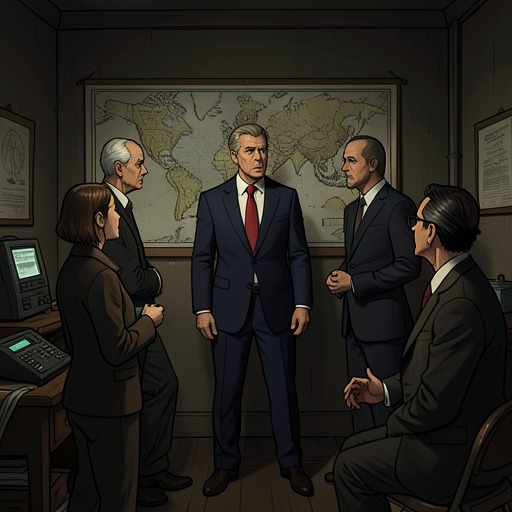
Wallace remained part of the national political establishment after the convention. When Franklin D. Roosevelt’s administration assembled in the Cabinet Room, Wallace was among the senior officials present. After Harry S. Truman became president, Wallace served as secretary of commerce and saw more of Truman during the labor conflicts of the period. Their relationship combined personal candor with a growing disagreement about foreign policy. Wallace believed that Truman reacted too quickly to the Soviet Union and worried that the president was acting without enough information or reflection.
Wallace tried to influence Truman directly. He argued privately for making every effort to get along with the Soviet Union, while recognizing that the president was also hearing opposing views from advisers such as Averell Harriman and William D. Leahy. Wallace suspected that Truman agreed with whichever person was speaking to him, and that his private agreement with Wallace did not necessarily reflect his views when others advised him. This perception made their conversations an uncertain basis for policy: apparent agreement did not resolve the competing counsel surrounding the president.
Their disagreement became especially consequential when Wallace prepared a foreign-policy speech. Wallace’s account was that he and Truman reviewed it page by page and that Truman approved it. Truman’s diary gave a different version: he had only ten or fifteen minutes to look at the text, most of that time occupied by other matters, and had approved a paragraph calling for world peace on an equal basis. Most of the speech, in Wallace’s view, was compatible with administration policy. But it also criticized British imperialism, challenged the idea of competing spheres of influence, and rejected a get-tough approach to the Soviet Union. Wallace argued that tougher American policy would only provoke a tougher Soviet response.
The competing accounts exposed a breakdown in communication as much as a policy dispute. Truman later called his public response a natural misunderstanding, explaining that he had meant to approve Wallace’s right to deliver the speech rather than endorse its arguments. He openly described his handling of the matter as a grave blunder. In a subsequent private meeting, Wallace maintained that public anxiety about a get-tough policy was justified and urged Truman to adopt a more leftward position when Congress was out of session. Truman understood Wallace to be advising him to maneuver politically rather than speak consistently. Even so, he did not immediately fire him. Wallace’s standing among liberal Democrats gave him symbolic importance, and Truman risked appearing to repudiate the Roosevelt succession if he broke with the last surviving New Dealer in the Cabinet.
The immediate settlement was limited: Wallace would say no more on foreign policy until James F. Byrnes returned. The truce did not last. On September 20, at 9:30 in the morning, Truman called Wallace and dismissed him. Wallace was so courteous that Truman nearly reconsidered, but the two men still did not understand each other. The dismissal marked the end of Wallace’s place inside the administration, not the end of his political appeal.
The Progressive Campaign of 1948
Wallace returned to national politics as the presidential candidate of the Progressive Party. On July 27, more than three thousand delegates assembled at Philadelphia Convention Hall to acclaim him as their candidate; they also selected Senator Glen H. Taylor of Idaho as his running mate. Wallace refused to disavow Communist support, saying he would not reject support offered in the name of peace. The question of that support became inseparable from the campaign’s political meaning. Wallace drew young liberals, working people, Black supporters, and members of the American Communist Party, while critics and opponents treated his position as evidence of alignment with Moscow.
His program made the campaign more than a protest against the two major parties. Wallace attacked both parties for what he described as internal decay, proposed transferring American atomic weapons to the United Nations, and called for a large American-funded reconstruction program for the Soviet Union. He opposed the Marshall Plan, advocated nationalization of the coal mines and railroads, and presented the Progressive Party as a peace movement capable of ending the Cold War through direct negotiations with the Soviet Union. In his acceptance speech at Shibe Park, before more than thirty thousand people who had paid for admission, he blamed American policy for much of the world’s tension and did not criticize the Soviet Union. He also attacked the privilege and control he associated with the established parties.
Wallace carried his opposition to segregation into the campaign trail. In August, he traveled through the South denouncing segregation and refusing to stay in hotels that enforced discrimination. In North Carolina, angry crowds pelted him with eggs and rotten tomatoes. He traveled much of the rest of the country by plane and ultimately covered more mileage than Truman. Yet the scale of his travels did not sustain the campaign’s early momentum. Although he drew a larger crowd than Truman at the same Los Angeles stadium, and the audience paid to attend, the overall attendance at rallies and speeches declined. As the campaign wore on, the press increasingly portrayed him as playing Moscow’s game, and the excitement of his Progressive crusade ebbed.
The campaign nevertheless had measurable consequences in the presidential contest. Wallace won about half a million votes in New York, half of his national total. Thomas E. Dewey carried the state by only 61,000 votes, and New York’s 47 electoral votes made the result consequential. Clark Clifford later argued that, without Wallace’s vote, Truman would have carried New York; together with potential losses to Strom Thurmond in the South, Wallace’s candidacy may have cost Truman an even larger electoral margin. Wallace’s political impact thus exceeded his chance of winning the presidency: his support drew voters away from the Democratic coalition in a state where a relatively small shift could have changed the scale of the outcome.
Wallace’s challenge also sharpened the significance of Truman’s civil-rights position. More than two-thirds of Black voters supported Truman, a larger share than Franklin D. Roosevelt had ever received. In states such as Ohio and Illinois, Black voters were described as decisive to Truman’s victory. One Democratic assessment held that the administration’s civil-rights program cost the party three Southern states but helped it win Ohio and Illinois and contributed in California; Wallace’s presence, meanwhile, prevented Truman from carrying New York. The contrast was not simply between two candidates’ policies. Wallace’s campaign pressed a progressive critique of American foreign and domestic conduct, while the election showed how civil rights, regional defections, and third-party voting interacted to shape the Democratic result.
Significance and Legacy
Wallace’s political career was defined by the distance between his public constituency and the institutions that determined whether he could exercise power. He had a national following, a record as a scientist and New Deal official, and the capacity to attract an enthusiastic convention audience. Yet party professionals resisted his leadership, Roosevelt’s support did not secure his 1944 nomination, and his disagreement with Truman over the Soviet Union ended his cabinet service. His trajectory was neither a simple rise followed by political disappearance nor a straightforward story of popular rejection: after losing influence within the administration, he reappeared as the head of an independent movement.
The same qualities that broadened Wallace’s appeal also exposed the limits of that appeal. His commitment to civil rights and international negotiation gave his campaign a distinctive moral and political identity, but his willingness to accept Communist support and his failure to criticize the Soviet Union allowed opponents to frame him as serving Moscow’s interests. His campaign attracted substantial crowds and votes without becoming a plausible route to the presidency. In the 1948 election, he was at once a candidate with his own national constituency and a force whose most consequential effect lay in how his voters altered the contest between Truman and Dewey.