General MacArthur
TrumanGeneral MacArthur is presented as a commander whose influence reached from the final campaigns against Japan into the Korean War, but whose relationship with Harry S. Truman was marked by distrust and a clash over authority. Truman privately disliked him before they had ever met, yet MacArthur’s military standing and public actions repeatedly placed him at the center of decisions about war, surrender, and the limits of command.
Reputation Before Personal Contact
Truman was trying to understand the Pacific war and the senior commander he had never met. His private diary gave MacArthur a sharply dismissive portrait: Truman referred to him as “Mr. Prima Donna, Brass Hat, Five Star MacArthur.” The judgment was not based on a personal encounter; it reflected what Truman had read and heard. In the same entry, Truman contrasted MacArthur and George Patton with commanders he admired, including Robert E. Lee, John J. Pershing, Ike, and General Bradley. The contrast reveals the depth of his private misgivings, but it does not by itself establish how MacArthur performed in the field.
That early suspicion coexisted with MacArthur’s participation in consequential strategic discussion. Before the Potsdam meeting, Truman regarded obtaining Soviet help against Japan as his principal purpose in going. General Marshall and Admiral King had stressed that Soviet action could shorten the war and reduce American casualties; MacArthur, too, had twice insisted that Russian help was needed. Thus the commander Truman privately scorned was also among those whose military judgment reinforced a central argument for seeking Soviet entry into the Pacific war.
Invasion Plans and the Cost of Continuing the War
As American leaders considered an invasion of Japan, MacArthur favored proceeding with it. His staff estimated 50,000 casualties in the initial period of the proposed assault, a figure MacArthur himself considered too high. The estimate belonged to a wider range of projections: General Marshall’s figure was 31,000, Admiral King put the total at 41,000, and Admiral Nimitz estimated 49,000 for the first 30 days. These were forecasts, not results, but their spread showed how uncertain the anticipated cost remained.
The invasion plans also carried much larger potential totals. One Pentagon estimate, covering operations against southern and northern Kyushu as well as Japan proper, reached 220,000 casualties. A memorandum from General Thomas Handy, by contrast, argued that avoiding invasion could save between 500,000 and one million lives. The figures were being considered at the highest levels, while Henry L. Stimson feared that Japanese soldiers and civilians alike would fight with extraordinary determination. MacArthur’s position therefore belonged to a debate in which the military objective of invasion was weighed against grave and uncertain losses, rather than to a settled calculation of what an invasion would cost.
The Surrender of Japan
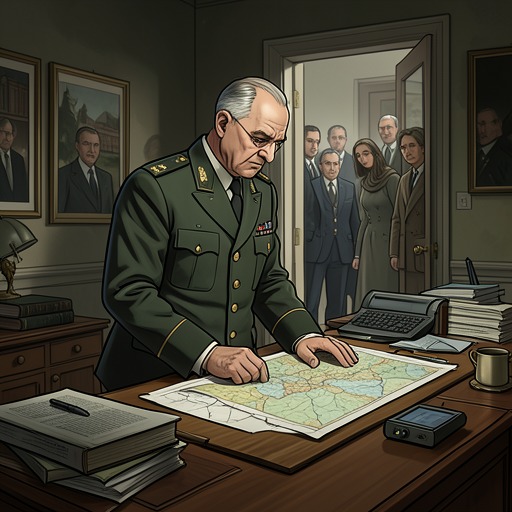
On the evening Harry S. Truman announced that Japan had accepted the Potsdam Declaration, he also named General MacArthur as Supreme Allied Commander to receive the surrender. The announcement placed MacArthur at the formal conclusion of the war with Japan. It also made a striking contrast with Truman’s private contempt: whatever the President thought of the commander personally, MacArthur was assigned a prominent role in receiving Japan’s surrender on behalf of the Allies.
The scene was carefully public. At exactly seven o’clock, in front of reporters gathered in Truman’s office, the President read that the Japanese government’s reply constituted full acceptance of the declaration and that MacArthur would receive the surrender. The appointment is evidence of MacArthur’s position in the Allied command, not of personal warmth between the two men.
The Conflict Over Public Authority
The later confrontation arose when MacArthur made a public declaration on foreign policy despite directives against such statements. In Truman’s account, the act disregarded orders issued to him as President and Commander in Chief and also flouted United Nations policy. Truman understood it as a constitutional challenge: a military commander had publicly advanced a position that the President considered the government’s responsibility to control.
Even in anger, Truman did not immediately dismiss MacArthur. At a meeting the next day with Dean Acheson, Robert A. Lovett, and Dean Rusk, he appeared, according to Acheson, caught between disbelief and controlled fury. Acheson and Lovett were concerned that a confrontation would provoke public backlash: MacArthur had immense prestige, Americans were weary of the war, and he was promising victory. Truman chose instead to dictate a restrained reprimand reminding MacArthur of the December 6 order that public statements had to be cleared with Washington. The choice demonstrates the practical difficulty of enforcing presidential authority when a commander’s reputation gives him considerable public support.
Narrative Significance
MacArthur’s appearances bring two dimensions of military leadership into view. In the planning for Japan, he was a senior commander whose position and staff’s casualty estimate formed part of a debate over how to end the war. In the later dispute, the issue was no longer simply which military course to pursue: it was whether a commander could speak independently on foreign policy in defiance of presidential and United Nations directives. Truman’s private dislike sharpened the personal contrast, but the conflict described in the book turns on institutional responsibility. MacArthur’s prominence made the President’s caution consequential, while the reprimand affirmed that military prestige did not erase the requirement to obey civilian authority.