Georges D’Anjou
SatanGeorges D’Anjou is a senior judge and patriarch of the D’Anjou family, a man accustomed to authority whose efforts to contain a family crisis instead make him its public face. The disappearance of the family cameo and the vanishing of his son-in-law Roger Bolduc bind together a mystery, a longstanding family feud, and the exposure of private grief. In later years, the judge who once managed the crisis through secrecy and carefully controlled disclosure is left to confront the decline of his wife, the suffering of his daughter, and his own isolation.
Judge and Family Patriarch
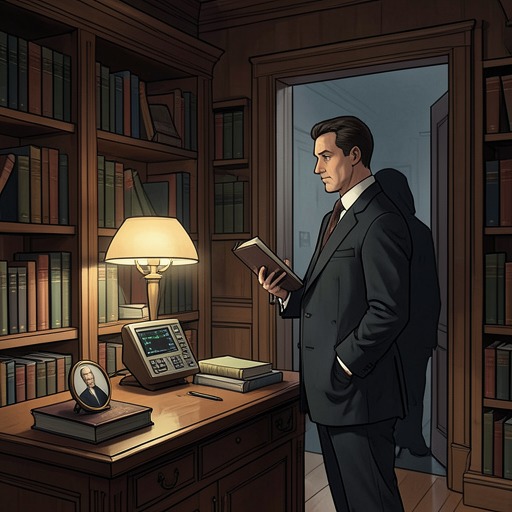
Georges occupies a position of legal and familial authority. He is a judge of the Quebec Superior Court, heads a family rooted on Grande-Allée, and is expected to pass the family law practice to his son Alain as he approaches retirement. Yet neither professional standing nor paternal authority gives him a clear view of what his relatives are hiding. His role repeatedly places him between the D’Anjou family’s public respectability and private uncertainties.
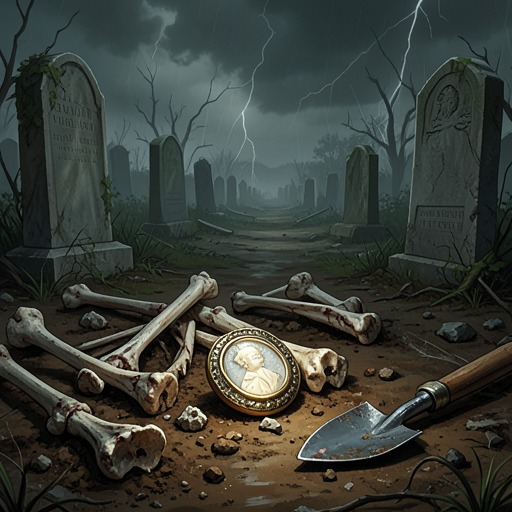
The family’s history of protecting its inheritance reaches back to 1964. After the death of his brother Guillaume, Georges took the family cameo from its safe in Touladi and brought it to Québec City. Loïc, Guillaume’s adopted son and heir in Touladi, experienced the hurried removal as disrespectful to the newly buried man and as another sign that the Quebec family did not regard him as a true D’Anjou. Georges’s act thus had consequences beyond the transfer of an object: it reinforced Loïc’s sense of exclusion and marked a break in the family’s life in Touladi.
Georges had considered such a transfer before. In 1951, after Guillaume suffered a heart attack, Georges’s father, Jean, had obtained Guillaume’s agreement to move the cameo to Québec. Guillaume’s recovery ended that plan. When Georges finally removed the object in 1964, he found a folded extract of a United States birth certificate hidden at the bottom of the safe. He kept the discovery to himself. The document later helped Régis uncover the Founder’s origins, linking Georges’s silence about the paper to a family history that other generations would have to reconstruct.
The Cameo’s Disappearance and Roger’s Vanishing
In September 2001, Georges was drawn into the search for Roger. He telephoned Loïc to report that Isabelle was in no condition to speak: she had learned Roger had been in New York City on the day of the attacks. Roger had been travelling toward Toronto, changed course in Montreal, and taken an overnight bus to New York City. His reason for going was unknown, as was whether he had been at the World Trade Center complex on September 11. Georges insisted that the information remain confidential; Loïc agreed not to repeat it.
Three days after the attacks, on September 14, Georges gathered the family in the salon of his imposing house on Grande-Allée and announced that the cameo had disappeared from its bank safe. He explained that he had changed safe-deposit boxes the previous spring and transferred the piece then; nobody had handled it at that point. Because the substitution might have happened later, the timing did not identify who had taken it. But the family’s attention quickly fixed on Isabelle. Her husband’s secret trip and disappearance made him seem suspect, while Isabelle’s lowered eyes and pallor were read as signs against her.
With police assistance, Georges had Roger’s computer opened. It showed an appointment in New York City for September 11 with a person named Patrice Desbois. The entry gave no meeting place, and a call to the listed number reached an automated message saying the number was no longer in service. Georges could therefore offer the family a concrete lead, but not an explanation: the appointment established a date and a city, not whether Roger met Desbois or went to the World Trade Center complex.
Rumors about Roger circulated through Québec City and beyond. Reports placed him on a bus from Québec the afternoon before the attacks, carrying a briefcase; other talk invented a possible affair in Montreal. Isabelle was shunned in Québec City and harassed by Roger’s siblings, who wanted to know what had happened. Georges feared the story would escape through a local tabloid in the Bas-Saint-Laurent. Rather than wait for an uncontrolled leak, he arranged for Le Soleil to publish a limited account: Roger had been in New York City, was not on the victims list, and was not known to have died there; the family had asked police to investigate.
The statement was a calculated attempt to limit damage, but it also made the family’s uncertainty public. Inside the family, suspicion hardened into a near-verdict: Roger was imagined to have stolen and sold the cameo, then used the attacks to disappear. That theory deepened the conflict between Isabelle and her relatives and revived the old hostility between the D’Anjou and Bolduc families. Georges could control what the newspaper initially disclosed, but he could not control how the public and family filled the gaps.
A Wider Cameo Investigation
The search for the missing piece eventually converged with another claim from France. Charles de Castelmont had claimed a cameo found at Ground Zero; Georges’s claim arrived in New York two days later. A few days earlier, Georges had also sent Roger’s genetic profile to the authorities, believing his son-in-law might have been among the September 11 victims. Officials initially wondered whether the competing claims were a fraud. Identity checks established that Georges was a prominent Quebec judge and that Charles was a prosperous French winemaker, lending credibility to both claimants.
Authorities were preparing to tell the two men that the cameo had been found in the Ground Zero debris, while warning that it had been stolen and the FBI was tracking the thief. The operations chief argued against notifying them before the object was recovered. The parallel claims left a central question unresolved: whether the two parties were claiming the same jewel, and which claim could establish its true ownership. Georges’s actions connected the missing family heirloom to an investigation extending beyond Québec, but did not settle the object’s provenance or Roger’s fate.
Years later, Loïc’s reconstruction of the affair raised further questions about Georges’s knowledge and choices. Régis had discovered the complementary Pollux cameo in Paris and died suddenly in Québec. Loïc wondered whether Georges had searched Régis’s papers, especially his journal, and whether the delay in delivering Régis’s documents to him reflected such an examination. Georges had told Loïc in June 2000 that Régis had left him a small inheritance of document boxes; Loïc waited more than a year for them and did not study them closely until after September 11.
Loïc’s suspicions remain questions rather than established findings. He considered whether Georges had recognized a connection between Régis’s discovery and his death, and why Georges had not used his legal authority and position as executor to investigate Régis’s papers. But the account does not establish that Régis was deliberately poisoned, or that Georges knew who might be responsible. Georges’s place in Loïc’s conjectures underscores how the family’s withheld information leaves even its most powerful members open to interpretation.
Isabelle, Lucille, and the Limits of Paternal Authority
The missing cameo’s consequences reached Georges most painfully through Isabelle. He suspected that Roger’s disappearance was not the only source of her distress, but he could not find a way to release her from what he understood as the burden of a crime. At the same time, his approaching retirement unsettled him. At nearly eighty, he was due to leave the legal practice that had defined his life and hand its leadership to Alain. The crisis made the prospect of retirement seem less like rest than a dangerous emptiness in which regret might take hold.
Isabelle’s difficulties followed their own course. Her longstanding tendency toward alcohol worsened in the autumn of 2001, and she began using cocaine. In early 2002 she nearly died of an overdose and was sent to rehabilitation. Georges understood that her suffering reached beyond the disappearance of her husband, but the evidence does not show him discovering the full extent of her involvement or resolving her predicament. His paternal concern was real, yet his knowledge remained incomplete.
Later, Georges watched Lucille’s memory deteriorate. She began losing keys and a wallet with increasing frequency; he knew alcohol could cause short-lived absences after drinking, but these episodes were different. At more than seventy-five, Lucille failed the required driving assessment and lost her licence. The test made her confusion visible to others, and a doctor diagnosed Alzheimer’s disease. Her prescribed anxiolytics, combined with continued secret drinking, contributed to worsening symptoms. Even familiar outings to the Château Frontenac became difficult as she struggled to take a taxi or risked losing her way on foot.
As confusion and paranoia alternated with periods of lucidity, Lucille accused people close to her of poisoning her and repeatedly said that she wanted to die. Georges had medicines kept from her and controlled their use after her first suicide threats. He initially rejected her pleas for help in ending her life, but her repeated appeals wore down his resistance until the idea became less horrifying to him. When Lucille once tried to enter his office to find the pistol he kept there, he reacted angrily; she wept and begged him to give it to her. He refused. The text presents his growing exhaustion and conflict, but does not make his later responsibility for her death a settled fact.
Public Inquiry and Final Isolation
When Lucille disappeared and was found in a park, Georges himself called the police that morning. Two officers, a man and a woman, came to the Grande-Allée house and questioned him and Clémentine, the two people who had been in the house with Lucille on the night of the tragedy. Police returned repeatedly, recorded statements, and searched the house for fingerprints; investigators also retraced Lucille’s route and estimated the time she had left. Medical staff who had followed her illness were called to testify. What began with official restraint toward a respected family became a national debate over Alzheimer’s disease, suicide assistance, and whether a judge stood above the law.
Alain fought the media’s allegations with legal warnings and threats of defamation suits. Georges, meanwhile, was eighty-five and preparing to retire from the family firm. Though physically vigorous, he was psychologically shaken by Lucille’s condition after the earlier crisis involving Isabelle. He refused to place Lucille in a psychiatric institution even as life in the Grande-Allée house became increasingly difficult. He considered leaving the ancestral residence for a smaller home in Sillery or near the Château Frontenac, but Alain declined to take the old house: he and his wife Julie preferred their home in Sillery, with its view of the river, to the family mansion they found increasingly bleak.
After Lucille’s death, Georges spent much of the winter and spring of 2011 alone in his apartments, with the elderly Clémentine still at her post. The house’s portraits gathered the history that he could no longer command: the Founder, his father Jean in judicial robes, his mother Caroline, his brother Julien, killed at twenty-four on the Normandy beaches, and Régis in his Senate portrait. Georges’s own portrait, in a judge’s wig, placed him among those figures. In his last days, the narrative describes him imagining movement and murmurs around the portraits as sleep gave way to disorientation.
Georges was found one morning folded into his armchair, dead beneath the immense portrait of the Founder. The image brings his life to a stark close: the judge who tried to govern what the family revealed, what the police knew, and what the public heard ends beneath the stern likeness that presides over the family’s past. His death resolves neither the mystery of Roger’s disappearance nor the uncertainties surrounding Lucille’s final night. Instead, it leaves the family’s authority, secrecy, and inherited burden suspended together.