Guillaume D’Anjou
SatanGuillaume D’Anjou is the adoptive father who gives Loïc a home after his mother dies in childbirth, and a guardian whose care is inseparable from the D’Anjou family’s history in Touladi. He holds the child close not through blood alone but through years of responsibility: accepting a frail newborn, protecting him from a custody challenge, and keeping the past from him until he is grown. Guillaume’s own life ends in the forest in 1964, where his solitary death echoes an earlier family loss and leaves Loïc bereaved of both a father and a place within the family that raised him.
Family and the Cameo
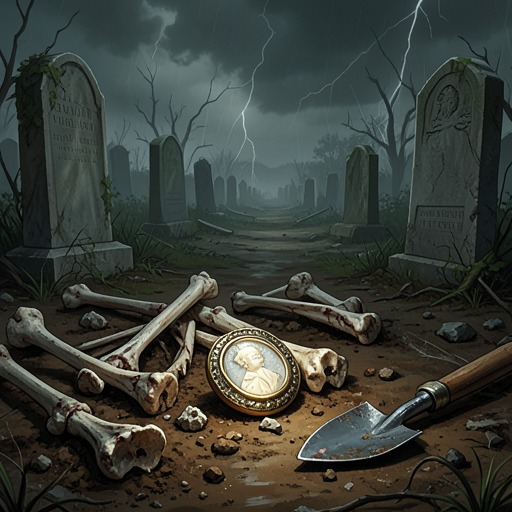
Guillaume is the grandson of the man who founded the village and the brother of Marie-Ange. When the Founder’s remains reappear, Guillaume arrives in a gray felt hat to find the crowd giving way before him. Through the mixed remains—dust, decayed clothing, bones, and wood—something catches the light. He notices it, waits before reaching for it, and handles the object with a mixture of alarm, emotion, filial piety, and religious reverence. It is a cameo set with agate, its pale and dark surfaces emerging as he gently rubs it clean. The discovery places Guillaume at a striking intersection of family devotion and inherited mystery: the object is both a precious relic and something recovered from his grandfather’s grave.
The cameo’s earlier history deepens that association. The Founder had kept a valuable stone in his safe, troubled by its American origin and by what it might mean about his own origins. He feared the object as malign and had sewn it into his scapular and clothing so that he could be buried with it, hoping the matter would end there. Guillaume’s encounter with the cameo therefore takes place against a family secret deliberately carried into the grave. The recovered jewel is not simply an heirloom; it is a remnant of the Founder’s concealed past, brought back into the family’s present.
Taking Responsibility for Loïc
Guillaume’s most consequential act of care begins in grief. After Marie-Ange dies, he remains beside his sister’s body with Laurette and the newborn, whose frailty makes him seem suspended between life and death. Guillaume’s sorrow is overwhelming: he weeps openly and cannot bear to look at the child. His grief is also sharpened by a sense that loss has pursued the family since the Founder established the village. He remembers his father, Égide, killed by a stray bullet in the forest in 1920, only weeks before Marie-Ange was born. Family history does not soften this new death; it makes the arrival of another vulnerable child feel like the next turn in a long procession of bereavements.
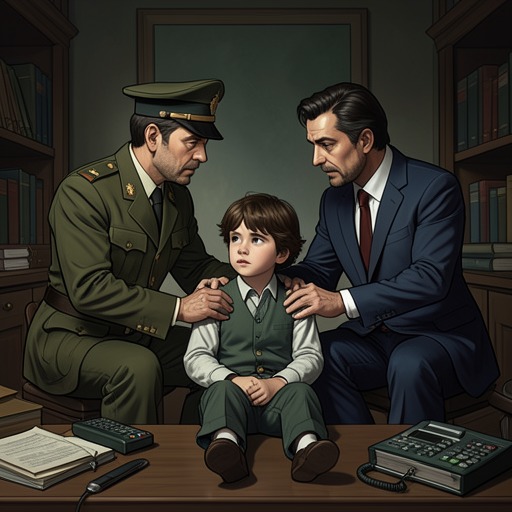
The family decides that Guillaume and Laurette should take the newborn to their home, where he can receive closer care. Guillaume gathers his mother, his wife, and his three daughters and solemnly asks them to look after Marie-Ange’s child. Because the baby appears unlikely to survive, he is baptized without delay by Father Rousseau. Guillaume and Marie-Louise serve as godparents, and, with the agreement of Alcide and the Bolduc family, decide to adopt him. The arrangement turns immediate emergency care into a lasting parent-child bond: the infant is Guillaume’s nephew by birth and his son by adoption.
That bond is tested by rumors that Alcide, the child’s biological father, intends to take Loïc back. The possibility raises tension between the powerful Bolduc and D’Anjou families in Touladi, while Loïc hears from his brother and cousins that a change of home seems inevitable. Guillaume considers the child already in his care and regards the adoption as an obligation he will not surrender. He resents Alcide’s past drinking and his long absences from his children, contrasting those absences with the responsibility Guillaume assumed after Marie-Ange’s death. In the confrontation, he insists that Loïc is in his custody and should have been sent home before nightfall. His position is protective, but it is also a claim about who has actually carried the work of parenthood.
Fatherhood, Knowledge, and Loss
For Loïc, Guillaume’s authority is not abstract. At one fraught moment, Loïc recognizes the familiar figure of his adoptive father by his thick, severe moustache and is about to run toward him, but Alcide stops him with a gesture. Later, Guillaume comes to the door with the child, his head lowered and one hand gripping his chest, struggling to cross the threshold and speak through the pain. These scenes place paternal attachment amid conflict and physical vulnerability: Guillaume is the person Loïc turns toward, even as the adults’ dispute and Guillaume’s failing health constrain what he can do.
Guillaume also gives Loïc a practical inheritance, teaching him how to read the woods. A remembered excursion shows the depth of his knowledge: he follows tracks and pathways with assurance, treating broken branches, torn bark, and crushed twigs as signs in a book he has learned to read through experience. Loïc understands this not merely as expertise but as instinctive attention to the natural world. His father’s forest knowledge becomes one of the clearest forms of instruction and intimacy that survives him.
Guillaume withholds one painful truth until Loïc is an adult: another fetus had been in his mother’s womb. The delay is explained as an attempt to spare a child a shock he was too young to absorb, as well as Guillaume’s own difficulty in bringing himself to tell him. The revelation comes during the wake after Guillaume’s death, when the protective father can no longer mediate its impact. Loïc goes to bed unable to put aside the news of his stillborn twin sister and the horror of the fetus discovered in the grave. In visions approaching sleep, he imagines himself expelled from the womb while his twin remains trapped inside, linking the new knowledge to an older, disturbing image of a child buried alive. Guillaume’s protection had postponed the knowledge, not resolved the grief it would awaken.
Death in the Forest and Its Aftermath
In the autumn of 1964, Guillaume goes alone toward Pain-de-Sucre and does not return. The next day, his jeep is found at the edge of the woods; Guillaume lies in the forest with an old hunting rifle fallen from his hands. A buck, shot through the chest, lies about twenty metres away. The account attributes Guillaume’s death to a heart failure and notes that he had not brought the nitrate capsules he used in case of an attack. Whether that omission was deliberate remains uncertain. His death is private and hidden, in keeping with the forest-dweller’s knowledge of how to die in the wild: silently and out of sight.
The location gives the death a painful family echo. Guillaume dies in the woods, as his father Égide had been killed there forty-four years earlier, almost on the same date. The resemblance suggests a recurrence without proving that Guillaume sought it. The forest that had been his field of knowledge and the setting of his father’s death becomes the place where his own story ends.
At the funeral, Loïc sees how far Guillaume’s reputation extends. People arrive from many places to pay their respects, including senior figures from the Brunswick Company, who travel from Campbellton, Bathurst, and Saint John. They had relied on Guillaume to guide their hunting and fishing expeditions. One of the visitors, Larry Durrell, had also depended on him during episodes of drunkenness: Guillaume would find him deep in the woods and bring him home, or drive his children when their father was too intoxicated to do so. The funeral reveals that Guillaume’s care reached beyond his immediate family, extending to people whose vulnerability he encountered in the woods.
Guillaume’s death closes a formative part of Loïc’s life. He had been both adoptive father and maternal uncle, the person who gently separated the boy from his dead mother’s memory and guarded him against Alcide’s competing claim. With Guillaume gone, Loïc feels the world of his childhood receding and his connection to the D’Anjou family weakening. The loss is compounded by the recent death of his grandmother Élisabeth. Soon after the burial, Georges takes the cameo to Québec. Loïc accepts that it may need to be moved, but experiences the haste, while Guillaume’s body is barely buried, as disrespectful and as a further sign that he has no say in the family’s affairs. Because the D’Anjous do not regard him as a true member of the family, the bereavement also sharpens his uncertainty about where he belongs. Guillaume’s death thus marks more than the end of a loving relationship: it coincides with the transfer of a family relic and the beginning of a decline in the D’Anjou presence in Touladi.