Loïc
SatanLoïc’s life is marked by divided inheritance: he is the biological son of Alcide Bolduc and Marie-Ange D’Anjou, but was raised in the household of the D’Anjou family founder by Guillaume D’Anjou and Marie-Louise D’Anjou. That split makes him both Bolduc and D’Anjou, an intimate participant in a family history he can never inhabit from only one side. In adulthood, the same division recurs in his political loyalties and in his troubled conviction that the D’Anjou family cameo exerts a fatal influence. A nightmare that coincides with the September 11 attacks intensifies these strands, turning him toward the archive left by his cousin Régis D’Anjou and toward a renewed understanding of his own unusual perceptions.
Identity and divided inheritance
Loïc’s identity is shaped from birth by the loss of his mother and his upbringing in the Founder’s House. He belongs by birth to the Bolduc line through Alcide Bolduc and to the D’Anjou family through Marie-Ange D’Anjou; Guillaume D’Anjou, his adoptive father, raises him in the ancestral home. He consequently grows up within the reach of the family cameo, a jewel found in a tomb whose occult magnetism he says he has felt since childhood. In his later understanding, the object is not simply an heirloom: it is a point where family history, personal trauma, and an apprehension of unseen forces converge.
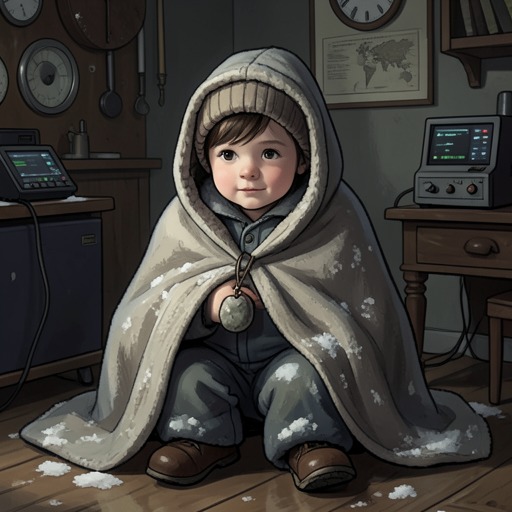
The novel repeatedly places Loïc between competing claims. As a boy, he experiences that division in physical, immediate terms. On his first flight, he sits close to his brother Maurice Bolduc in the cramped cabin of the floatplane, heart beating as it gathers speed across the lake and rises into the air. Maurice asks whether he is afraid with the protective air of an older brother, while their father, Alcide, pilots the plane and turns toward them, proud to display his command. The later image of Loïc taking flight in childhood memory can therefore be read against a real first encounter with aerial freedom and the authority of his biological father.
That pull between homes becomes explicit during the confrontation between Alcide and Guillaume. Guillaume calls Loïc home, while Alcide insists that the boy remain; Loïc is immobilized, afraid of displeasing Alcide and of incurring Guillaume’s anger. He is called by one father and held by the other. Decades later, he interprets the conflict as an early form of the divided loyalties that recur throughout his life: attachment to one side cannot be disclosed without risking injury to the other.
Political allegiance and the second father
Loïc’s professional life carries that private division into public history. After working as a journalist, editor, and translator, he serves as a senior public official and collaborator with Régis, his cousin and confidant. Régis’s position in the prime minister’s office gives their relationship a paternal dimension: Loïc regards him as a nourishing father in intellectual and moral terms, much as Guillaume had been a father in the ordinary, domestic sense.
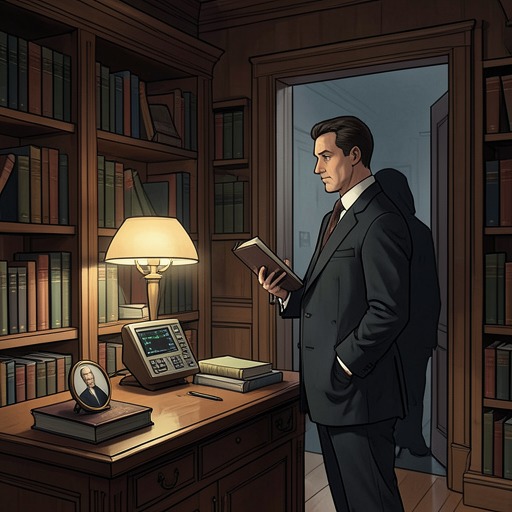
On November 15, 1976, Loïc waits in his office in the Langevin Building in Ottawa as Quebec’s election results approach. The possible victory of the sovereigntist party could change Canada’s future, and he feels caught between his Quebec identity and his loyalty to Régis, who had selected him as a close collaborator in the prime minister’s office. His situation is not an abstract policy dilemma. The political outcome brings personal attachments into collision, and the novel links the suspense of that election night to the earlier experience of being caught between two fathers.
After the sovereigntists win, Loïc sees the federal government preparing to oppose Quebec and understands that he can no longer remain balanced between the camps. His work in the prime minister’s office, which he had accepted as a historical experience, becomes a source of severe strain. He sleeps poorly and writes resignation letters at night, only to tear them up at dawn. His conflict is between fidelity to Régis and fidelity to himself, between friendship and personal integrity. Because Régis has become a father figure, the political rupture revives the older family pattern: Loïc feels compelled to conceal one attachment from the other and to move through public life with his deepest loyalties muted.
The September 2001 nightmare
In September 2001, in Montréal, Loïc goes to bed late after struggling over a translation. In his dream, the computer screen opens into the sky, and he finds himself in his native village before the church. Familiar faces gather around him, waiting for a speech, while the wind lifts and carries off the pages he is trying to collect. The dream then turns into a nightmarish flight through images of a black guillotine, a dark lake crowded with dead heads, and a wild cavalcade disappearing into a forest whose branches reach for him. He wakes, falls asleep again, and remains troubled by the dream.
A phone call about New York prompts him to turn on the television. The World Trade Center complex appears in flames, and footage shows a second plane striking the south tower. The first impact, at 8:46 a.m., corresponds to the moment of the dream. Loïc is shaken less by a general image of catastrophe than by his sense that the nightmare carried the particular, hallucinatory thoughts of another person. He wonders whether his consciousness briefly received the vibration of another mind, perhaps at the moment of death; he also considers whether the scale of the disaster could have generated the images within his own mind.
His cousin Roger Bolduc becomes the troubling focus of that question. Loïc has rarely thought about Roger and has never dreamed of him, yet he wonders whether Roger was in New York. The later knowledge that Roger disappeared there deepens the dream’s personal significance without resolving whether it was telepathy, coincidence, or an event produced by Loïc’s own mind. The uncertainty is central to his character: he is rational enough to resist a supernatural explanation, but cannot dismiss the sense that an unseen connection has been activated.
The papers, the cameo, and family history
The September attacks also draw Loïc toward the family jewel and the papers left by Régis. The cameo, he fears, has cast a fatal radiance over the family and perhaps over him most of all. He is especially vulnerable to that fear because his parentage and upbringing place him on both sides of the family history, and because he believes he has sensed the object’s hidden magnetism since childhood. As the events of September 11 gather around the jewel, he imagines it as a source of misfortune that has weighed on the family for generations.
Régis’s bequest gives that anxiety a practical direction. About a month before the attacks, Loïc received four large cases of documents. Régis’s will asked that the cases be sent unopened to his cousin, a former collaborator and confidant, who could sort through the papers and decide what belonged in the National Archives. Loïc welcomes the inheritance as a gift of memory. Now retired after a career as a journalist, editor, translator, and public official, he approaches the documents as a historian as well as a member of the family.
The research reveals how much Régis had pursued the origins of the D’Anjou family. Loïc wonders whether his cousin’s late-life investigation was also an attempt to reconcile himself with roots he had long tried to set aside, and he sees in that ambivalence a reflection of Quebec identity. The papers also renew the mystery of the cameo. Loïc suspects that the jewel might have remained forgotten in a safe if Roger had not disappeared in New York. He intuits that Roger left with it, although no one has yet told him so, and is reluctant to ask the D’Anjou family directly because he fears that Georges D’Anjou or Isabelle D’Anjou might conceal the truth or exclude him from the matter. Once he learns that Roger did take the cameo, Loïc regrets that he did not examine Régis’s papers sooner; perhaps, he thinks, he might have prevented its removal, though he cannot know whether anything could have changed the course of events.
Recovered perceptions and narrative role
As Loïc revisits the past, childhood experiences acquire a new coherence. After discussing his former night flights with a psychoanalyst, he considers whether the strange episode of the flying worm grew out of his ride in Alcide’s plane: a surreal extension of the aerial view of the village, shaped by his desire to escape the weight of time, space, existence, and destiny. He also associates that childhood episode with the cameo’s baleful influence, while allowing another possibility: that an invisible double had drawn him beyond the ordinary surface of reality. The explanations remain open rather than settling into a single diagnosis.
Loïc eventually understands his sensitivity as an ability to detect the vibratory traces of past events, strong emotions, and tragedies impressed upon places. He becomes conscious of it gradually: first through the recovered memories of childhood flights and invisible presences, then more decisively after a session with a medium in the 1990s. Concentration can bring him into resonance with parallel worlds, but the effort is nervously exhausting and cannot be sustained for long. After September 11 and the inheritance of Régis’s papers, he uses this faculty to follow the cameo through time and space. His impressions arrive as fragments, sometimes in sleep or a meditative, half-conscious state, with indistinct forms and figures becoming more legible.
The discovery of a stillborn sibling gives these perceptions another intimate context. When told that Marie-Ange had delivered a dead fetus in the grave, Loïc is outwardly stunned but inwardly experiences distant sensations, intuitions, and inexplicable phenomena falling into place. He asks the doctor whether the fetus’s sex is known; it is not. Loïc says he is not as surprised as he might have been, because he often felt a presence around him, or even within him, in childhood. The doctor explains that the rare event is known as post-mortem fetal expulsion. The disclosure does not remove the mystery of Loïc’s impressions, but gives his sense of an unseen presence a specific family loss to answer to.
Loïc’s role in the novel is thus neither that of a conventional investigator nor merely a witness to public events. He works through the material record Régis leaves behind while also reading memory, family attachment, and uncanny perception as overlapping forms of evidence. The attacks, Roger’s disappearance, the cameo’s history, and the revelation of the stillborn sibling do not erase uncertainty; they make Loïc’s life seem newly legible as a pattern in which private grief and collective history repeatedly meet. His characteristic position remains that of someone suspended above events and yet bound to them, trying to determine whether what appears to be chance is instead the trace of a deeper design.