Ramondo Cardoso
SatanRamondo Cardoso is a Cuban-born secondhand dealer whose purchase of the cameo carries it from a fugitive in Missouri to Cuba, where Cardoso dies in a fire that consumes his body but leaves the house standing. His brief arc links the criminal trail of the stolen jewel to Rodrigo Lerbier’s Santería practice and turns the cameo’s curse from family history into a present danger.
Identity and Background
Cardoso is a Cuban émigré who spent about twenty years in the United States, arriving during the 1980 Mariel exodus. In Kansas City he ran a bric-a-brac shop on Oak Street and dealt with Tim Jones, a criminal seller who brought him mostly electronic gadgets and only occasionally valuable jewelry. Cardoso knew Jones’s reputation and ingenuity: Jones avoided police by changing hiding places and disguising himself, at times as a trans woman, a cross-dresser, or a businessman in a suit with a briefcase. Their dealings rested on an established but wary familiarity, not trust.
Cardoso also had a life and family in Cuba. His elderly mother remained in Cárdenas, south of Havana, and the prospect of finally having money to indulge her briefly brightened his thoughts after the sale. Rodrigo Lerbier, who later recognized him in death, had been his classmate. These ties make Cardoso’s return more than a change of location: after years in the United States, he goes back to his birthplace with the most dangerous object he has handled.
The Cameo Deal in Kansas City
Jones came to Cardoso’s shop in a February morning after a frightening episode involving the cameo had persuaded him to get rid of it quickly. He had reached the area around Carthage, Missouri, while fleeing after stabbing a man outside a New York City bar, and the Federal Bureau of Investigation was pursuing him. Cardoso was a buyer he expected would take the jewel without asking questions.
Jones arrived in clothes he had apparently stolen from a thrift store, presenting himself as a businessman. The cameo was inside an improvised faux-leather case. Cardoso’s first astonishment lasted only a fraction of a second; he quickly resumed the impassive manner of a shrewd dealer. On closer inspection, he recognized a fine onyx with delicate mounting and expert carving across its layered stone, and judged it potentially extremely valuable. He asked where Jones had obtained it, but Jones refused to explain and pressed him to name a price.
The bargaining exposed the gap between the cameo’s apparent worth and the money Cardoso was willing to risk. Jones demanded one million dollars; Cardoso laughed and offered nine hundred. After further haggling, Cardoso acted reluctant but agreed to pay $4,500 in cash, claiming the amount would empty his till. Inwardly, however, he regarded the transaction as the best deal of his life. That confidence begins to falter when he recalls that Federal Bureau of Investigation agents had visited his shop two months earlier, asked whether he had recently bought precious stones, and inspected the store. Unbeknownst to him, one had planted a listening device behind the shelves.
Flight and Return to Cárdenas
The surveillance made Cardoso’s shop a trap. A camera recorded the transaction, and the Federal Bureau of Investigation’s recording staff discovered it only after more than an hour had passed. Cardoso, meanwhile, felt a vague foreboding and began to think the cameo might bring misfortune. His Yoruba-rooted beliefs allowed that objects could be enchanted or carry curses, and the jewel’s obscure provenance made him uneasy. He did not know that the camera was watching as he watched the stone.
Cardoso acted on the sudden conviction that he had to leave. He brought down some shelving at the back of the shop, lowered the metal shutter, emptied the till, gathered valuables into a travel bag, and kept the cameo separate in his pocket. He left as calmly as he could, then hurried through a nearby alley toward a taxi stand whose drivers he knew. One was a close companion who, like Cardoso, had come to the United States in 1980 during the Mariel exodus. The Federal Bureau of Investigation sent agents racing through Kansas City, but Cardoso was already gone.
By August 18, 2002, Cardoso was back in Cárdenas, apparently after returning to Cuba clandestinely. The narrative does not establish how he carried the cameo from Kansas City to the island. His former classmate Lerbier later understood that Cardoso had probably acquired the jewel in the United States, where he had worked as a dealer, and suspected that the purchase had been illicit. Cardoso’s return thus reconnects a hidden American transaction with the Cuban home he had left decades earlier.
Death and the Cameo’s Passage to Lerbier
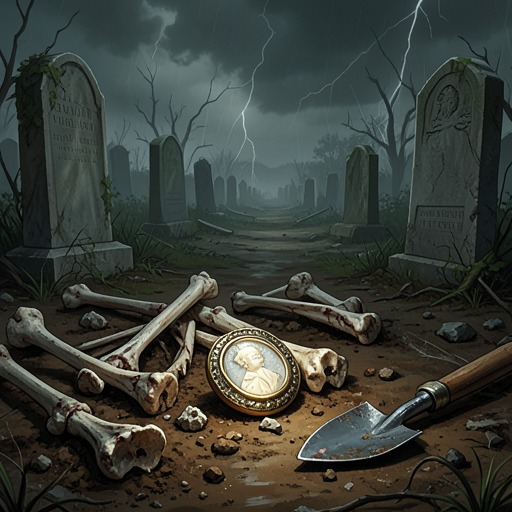
On August 18, Cardoso’s mother, Ana Maria Gomez Cardoso, returned from Mass and found a man at the doorway of her unlocked home. The ensuing discovery in her son’s room was stark: a chair had been reduced to its blackened wooden frame, scraps of padding, and springs; ashes lay on the floor, with a remnant of a leg and part of a head visible. A broad soot mark crossed the ceiling above the chair. Beside the charred remains, the cameo emitted a sinister glow. The priest who entered the room made the sign of the cross, faced with what appeared to be an intense but brief fire that had destroyed a human body without setting the house alight.
Ler bier—Cardoso’s old classmate—arrived by chance while visiting his sick mother. He recognized the fixed eye in the remains as Cardoso’s and recalled a Yoruba warning about carrying fire in one’s hands. The priest noted that there had been no storm, although Lerbier compared the death to a lightning strike and associated it with Chango, the divinity of thunder and war. The characters interpret the death through religious and supernatural frameworks; the narrative offers no ordinary explanation for the fire.
Ler bier took the cameo, wrapping it in a handkerchief. He felt its negative energy and used formulas intended to calm disturbed spirits. He considered whether Santería could harness the stone’s exceptional energy as Ashé, but sought guidance before placing it in a Yoruba shrine. Cardoso’s death therefore does more than end his own journey: it transfers the jewel to Lerbier and brings it into a sacred setting, where it becomes the focus of divination and further danger.
Narrative Role
Cardoso occupies a short but decisive link in the cameo’s chain of custody. He does not uncover its history or understand the larger conflict around it; he recognizes its market value, purchases it from Jones, and tries to escape the consequences when fear overtakes his confidence. The contrast between the dealer’s practiced composure during the bargain and his hurried flight afterward marks the moment when the jewel ceases to be merely a commodity in his eyes.
His ending also leaves the object’s movement only partly explained. Lerbier can recount what happened from Cardoso’s death in Cárdenas onward, but cannot account for how the cameo reached the island from Ground Zero. Much later, he shows Loïc a photograph of the jewel and describes Cardoso’s return, his strange death, and the cameo’s subsequent appearances. Cardoso’s place in the plot is thus both concrete and limited: his sale and death advance the physical trail, while the unexplained gap before his possession preserves the larger mystery.