Laurence d’Albignac
SatanLaurence d’Albignac is a French-born writer whose relationship with Loïc becomes both an unexpected emotional homecoming and a point of entry into the history surrounding the family cameo. Warm, playful, and deeply empathetic, she meets his guardedness with an openness that unsettles him; her old family connections, meanwhile, help draw his investigation toward the Castelmonts of France.
Identity and Background
Of an old French noble family, Laurence had chosen to live in Quebec for several years by the time she met Loïc. She wrote books for children, bringing humor, whimsy, and poetry to her work. At forty-six, she appeared younger than her age: a tall, slender brunette with a quick step, a charming smile, and hazel eyes. Loïc, ten years older, likewise seemed younger than his years.
Her past had made the prospect of love complicated. She had experienced several relationships that were painful to varying degrees, and had struggled through a devastating separation from her great love of youth in France. The loss of a young child and a miscarriage had helped fracture that couple and bring their relationship to an end. Like Loïc, she feared being consumed by a new love, even when her feelings were powerful.
Meeting and Courtship
The two met at a June book launch at the Maison des écrivains on rue Laval. Loïc had gone out of social politeness rather than particular interest in the event. In the gathering near the bar, he first noticed Laurence’s clear, apparently unshadowed gaze. Their exchange of looks struck him with an immediate familiarity, as if he had known her for a long time. The force of that recognition frightened him: he felt his established sense of self threatened by the possibility of being absorbed into an intimacy he could not control.
His instinct was to retreat to the familiar. In the days after their meeting, he considered seeing Claudine, his former partner, with whom he had not entirely severed contact. That possibility offered the safety of a known relationship, though little beyond repetition. Instead, after putting his doubts and hesitations on paper in his journal, Loïc wrote to Laurence. He had found her address in the directory of the Union des écrivains and sent an email colored by humor. Her reply came immediately and was warmly humorous in turn. Their quick exchange of wit established laughter, joy, and literary conversation as the first language of their courtship.
Intimacy and Shared Temperament
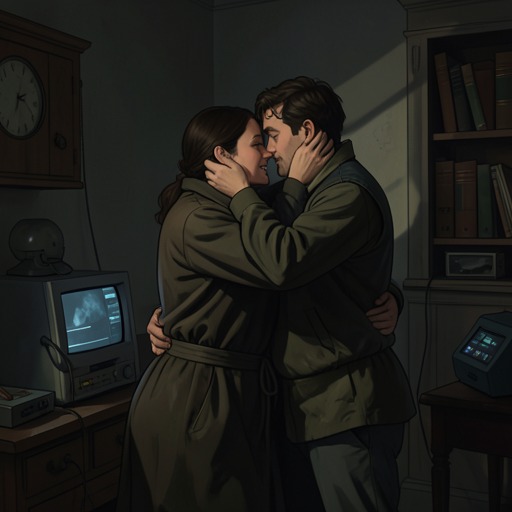
Laurence was cheerful, warm, spontaneous, sincere, and upright; Loïc saw in her no deceit or falseness. She had a quick mind and enjoyed playing with words, as he did. Their attraction was intense, but their physical approach remained careful and gradual. Both knew the fear of being hurt again, and neither rushed past it. Their tenderness became a way to let desire grow without frightening it away.
With Laurence, Loïc felt, for the first time in his life, that he was not alone. The idea of a soulmate disturbed him because it seemed to explain their unusual communion: they sometimes found themselves thinking the same thing at the same moment, even arriving at the same phrase or expression. Their connection was made of exchange, shared thought, and small recognitions. Loïc wondered whether she might be the reincarnation of the twin sister who had remained in their mother’s womb, linking his love for Laurence to the absence that had shaped his sense of himself.
Her empathy extended beyond their relationship. Loïc had never known anyone so receptive to the suffering of living things—people, animals, and even plants. He understood her compassion as an openness to other beings, an ability to feel for every heart that beat and suffered. This capacity distinguished her from the guardedness that defined his own response to intimacy, while giving their closeness a moral as well as romantic dimension.
The Cameo and the Castelmont Connection
For a time, the unexpected love distracted Loïc from the family cameo mystery that had occupied him for nearly a year. Their relationship did not, however, remain separate from his search. At the end of the summer, he took Laurence to the Bas-Saint-Laurent to show her the landscape of his childhood. The trip deepened their intimacy, and, during an evening together at their inn in Notre-Dame-du-Lac, overlooking Lake Témiscouata in moonlight, he finally told her the story of the cameo.
Loïc described research by his cousin Régis into the origins of the Founder. A Society of Jesus manuscript recounted finding a young woman frozen to death with a living infant in her arms; she had stripped off her own clothing to wrap the baby warmly. A cameo had been attached to the child’s swaddling. The discovery was dated to late November 1842, consistent with the Founder’s age, and had taken place near Saint Louis, Missouri, where a childless French-Canadian couple named D’Anjou had recently settled. They adopted the infant, who was baptized a few days later. A baptismal register found among Loïc’s ancestor’s papers had helped confirm the identification.
When Loïc connected the name in an American account of a ranch belonging to Mr. Castlemount with the French surname Castelmont, Laurence recognized the family as one known in the Southwest of France. She thought her parents might know them. The count of Castelmont, Loïc added, was a producer of renowned pomerol; Laurence believed that either the count himself or members of his family were familiar to her parents. Her response did not solve the mystery, but it turned her aristocratic background into a concrete link between Loïc’s Quebec family history and the European line he was tracing.
Narrative Role
Laurence brings emotional reprieve without closing the plot’s older wounds. Her love briefly lifts Loïc out of his obsession with the cameo, but her family history draws the mystery back into their shared life. The movement is characteristic of her role: intimacy and investigation do not cancel each other out. Their journey from the literary gathering to the lakeside confession joins the private story of two people wary of love to a much longer chain of family histories, documents, and discoveries.