Élie D’Anjou
SatanÉlie D’Anjou, known in Touladi as the Founder, stands at the center of a family legend that his own secrecy makes impossible to settle. Remembered as a formidable pioneer, he is also an adopted man of unknown birth who concealed a troubling stone until it went with him into the grave. When a 1944 landslide exposes his remains and the cameo he had hidden, the village’s heroic account of its origins gives way to questions about ancestry, memory, and the cost of keeping a past secret.
Identity and Origins
The family learns that Élie was adopted and knew nothing of his birth family. His American country of origin was known to him, but his ancestry remained a blank: even his descendants had heard only rumors that he was not a D’Anjou by birth. That uncertainty matters because his standing as the family’s founding ancestor had become part of the local order. His descendants had ruled Touladi from its beginnings, and the Founder’s authority lent a history of inheritance and belonging to their place in the village.
The legend surrounding him was far less certain than that authority suggested. Stories circulated about his hardness, despotism, and debauchery, as well as about the violence and excess attributed to his father, Égide D’Anjou. Guillaume D’Anjou regarded these accounts as a black legend spread by envious people and malicious tongues to discredit his family. The book does not establish the rumors as truth; instead, their persistence shows how little could be known about a man who had left so much of his life unspoken.
The Grave and the Cameo
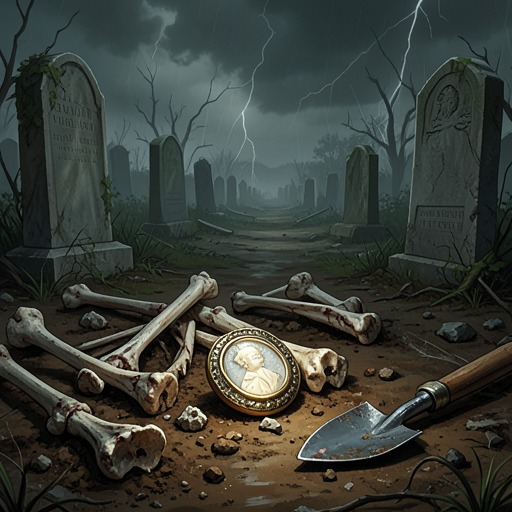
During a violent storm in November 1944, an earthquake triggered a landslide at the cemetery on the clay rise above the river. Several graves were torn open. Among the exposed remains was Élie, rising from the broken pieces of his coffin in a mass of snow and mud. To the shaken beadle, Lazare Moreau, the upright figure with empty eye sockets first seemed like a specter; only then did he recognize the Founder. The scene turns a celebrated ancestor into a physical discovery: no longer a distant name in family lore, but a body returned abruptly to public view.
The grave also yielded a mysterious cameo. On November 18, Guillaume carefully took the jewel from an improvised wooden case and displayed it to a gathering of about twenty D’Anjous, including the young Georges. The family’s attention settled on the object as both an inheritance and a riddle. Why had Élie kept it secret and taken it to the grave? Could it bear on the persistent claims that the Founder’s origins were unknown? His sudden emergence from the earth, with the stone, broke the aura of a heroic pioneer and made the family’s origin story newly uncertain.
What Élie Told Marthe
Before Marthe D’Anjou left on a mission to China, Élie confided a small part of the secret and made her promise not to reveal it. He told her that he kept a valuable stone in his safe, that it came from the United States, and that it troubled him. He also disclosed that he had been adopted, while insisting that he knew nothing about his original family and did not want his adoption made public. When Marthe asked whether the stone was connected to his origins, he did not answer. His silence leaves the possible connection open rather than confirming it.
He did, however, describe his fear of the object. He had come to regard it as malignant, and so he sewed it into his scapular and clothing, intending to be buried with it and to have the matter forgotten. This concealment explains how the cameo reached the grave, but not what it meant to him or why it had tormented him. The stone survives as the material trace of a secret he tried to contain; the burial was not simply a hiding place, but the final form of his wish that the family never speak of it.
The Founder as Story and Historical Trace
The family’s account of Élie contains both a near-epic portrait and gaps that resist explanation. Moïse Dubois begins his tale with the Founder traveling by canoe through a vast wooded country, rowing across Lake Témiscouata amid wildlife and morning mist. Élie appears as a giant figure of physical strength, and reports that visions guided him to the site where he founded Touladi lend the settlement’s beginnings a mythic cast. That image of the pioneer, however, sits uneasily beside the exposed corpse and the concealed stone: the landscape’s founding story cannot explain the private history he buried with himself.
A photograph offers one rare, concrete glimpse of Élie in a life outside the family legend. It shows him young, in a Union army uniform during the American Civil War, standing behind two fellow soldiers in front of a tent. He appears to be about twenty, identifiable by his broad jaw, somber expression, unusual height, and the fact that he alone is clean-shaven. Régis D’Anjou preserved the photograph as the only evidence that his grandfather had enlisted in the Union army, like hundreds of French Canadians of the period. Yet no record under the name D’Anjou had been found in the extensive war archives. Régis wondered whether Élie had anglicized his name and considered a possible listing as Eliah Dan Jow in the 20th Maine Regiment, but neither identification nor service in any particular battle is established. A scar between Élie’s ear and jaw is another possible trace of a wound, though its cause remains unknown.
Legacy and Narrative Significance
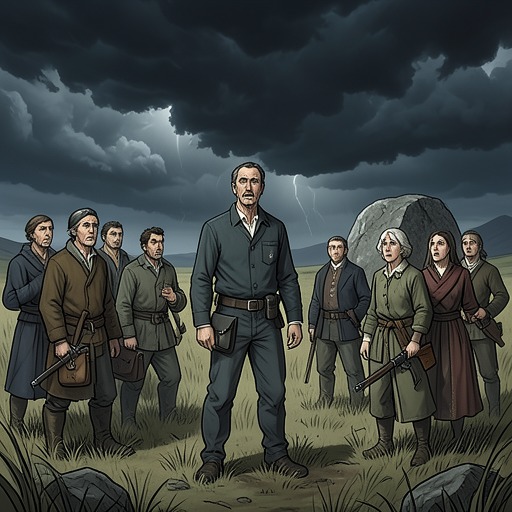
The storm and the grave’s opening shake Guillaume deeply. The phrase the Devil’s stone continues to recur in his thoughts, disturbing his sleep, while the object intensifies the questions already attached to Élie’s adoption and unknown origins. Guillaume reads the storm and the uncanny exhumation as a message from beyond and another sign of a family curse. His response does not resolve the cameo’s nature; it shows how the discovery enters a family already interpreting misfortune through inherited stories and suspicions.
The revelation also arrives amid a shift in Touladi’s balance of power. The D’Anjous’ long dominance was being challenged by the rising Bolduc family, whose political fortunes were strengthened by the Union nationale government of Maurice Duplessis. Against that backdrop, the Founder’s disputed origins are more than a private family mystery: they unsettle the authority of the lineage whose local standing rested on its inherited past. Élie remains influential not because the novel supplies a complete biography, but because his omissions persist. The grave yields his body and the cameo, while the central questions—where he came from, what the stone meant to him, and what his hidden history might reveal—remain open.