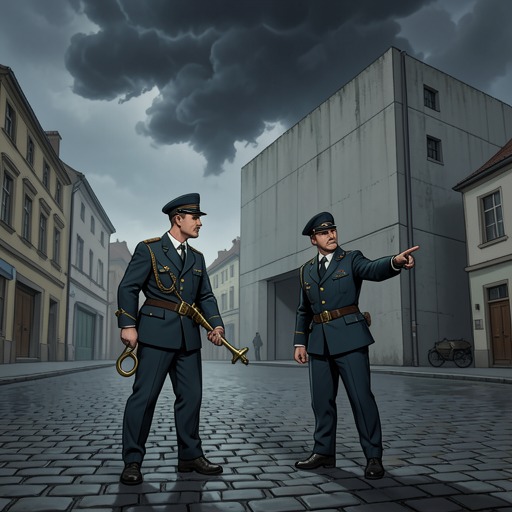
Roland Bolduc
SatanRoland Bolduc is a prominent Blue partisan in Touladi and a local power broker whose political authority is backed by family allies, intimidation, and ties to Premier Maurice Duplessis’s patronage system. During the 1952 election campaign, his effort to keep the village under Blue control brings him into direct conflict with the young Red organizer Clovis Lacroix. Their confrontation turns a contest for influence into a violent episode with lasting consequences for Clovis.
Political Power in Touladi
At the end of May, Maurice Duplessis launched the provincial campaign with a speech at the Château Frontenac, presenting himself as a defender of Quebec against Ottawa and a guardian of its people, language, and faith. Roland, his brother Romuald, and their associates immediately campaigned for the Blues. Their activity placed Roland within a local political structure in which family loyalty and party organization reinforced one another.
Clovis Lacroix, whose mother belonged to the D’Anjou family, had been teaching in Touladi for a year when he began organizing Red supporters, most of them young men. Roland publicly belittled the group and predicted that they would be crushed. His contemptuous response made the disagreement more than a difference of party allegiance: Clovis’s organizing challenged the authority Roland expected his faction to exercise without resistance.
Threats and Electoral Control
The conflict put Clovis’s teaching post at risk. The school-board president, described as a creature of the Bolducs, warned him that continued political activity could cost him his position. The warning followed indirect pressure from the priest and more explicit threats from Roland. Clovis resigned rather than allow the threat to limit his political work, turning an attempt to suppress the Red organization into a direct confrontation between the two men.
On election day, Roland had spent a troubled night after the young Reds repeatedly followed and obstructed him and his men. He was determined not to yield to them and considered using a gun to drive them off. The account also makes clear what was at stake in his control of the election: the Reds barricaded themselves inside his garage to prevent the Blues from getting voters drunk and steering their votes. They planned to cast their ballots late in the day, after that opportunity for manipulation had passed.
The Garage Confrontation
Roland found the young men occupying the garage and could not get through its main entrance. He left to summon his supporters. Gilbert Rougeau and other men associated with Roland arrived, and the group entered through a small window after avoiding a larger one obstructed by crates of alcohol. Roland followed them inside. The confrontation between the Blue men and the Red organizers became a fight, with Clovis among those caught inside.
When Roland called for Clovis to be beaten, Clovis charged at him and knocked him headfirst against a large grindstone. Roland lost consciousness. The sudden injury halted the brawl; Clovis, stunned by what had happened, fled with the other young men. La Grébiche arrived and stopped the bleeding from Roland’s head, an intervention that left his men astonished. Roland survived the incident, but his injuries were serious: after a brief hospital stay, he returned with a dislocated shoulder and a fractured skull.
Retribution and Lasting Consequences
Roland’s recovery did not end the conflict. He was known for holding grudges, and his connections extended to Duplessis, of whose regional patronage system he was one of many pillars. The day after the election, the sheriff arrested Clovis, accompanied by Gilbert Rougeau, who served as a constable in Touladi. Clovis was charged with attempted murder and imprisoned for several months at the penitentiary in Rimouski. The narrative links Roland’s influence and the arrest closely, though it does not describe him personally carrying it out.
The consequences outlasted the immediate legal case. Although Clovis’s cousin, a prominent lawyer from Québec City, defended him and helped prevent him from carrying a criminal record for life, Clovis missed the start of the 1952 school year and could no longer find work as a teacher despite his diploma. He moved into other employment, first in Québec City and later in Montreal. Roland’s clash with Clovis thus marks a point at which local political power reaches beyond the election itself: the attempt to contain a challenger becomes an episode that reshapes the challenger’s livelihood and future.