Marie-Ange D’Anjou
SatanMarie-Ange D’Anjou is the young mother whose death in childbirth shapes Loïc’s life before he is old enough to know her. A granddaughter of the Founder and the beloved younger sister of Guillaume D’Anjou, she dies on the night of Japan’s surrender, leaving a dangerously frail newborn and a family to decide who will raise him. The novel makes her brief presence an enduring absence: her death binds Loïc to a history of grief, adoption, and secrets, while the stillborn twin whose existence was concealed becomes an intimate mystery that follows him into adulthood.
Family Position and Marriage
Marie-Ange belongs to the D’Anjou family as a granddaughter of its Founder and a sister of Guillaume. The narrative remembers her as the youngest in her family and as someone Guillaume cherished deeply. Before her child was born, she and her husband, Alcide Bolduc, had a sufficiently close relationship with Guillaume for him to be chosen as the expected child’s godfather. Her connection to the Bolducs and D’Anjous would later make the fate of her surviving child a matter of both kinship and contested guardianship.
The account of her marriage is conveyed largely through other people’s judgments and recollections, not through Marie-Ange’s own voice. Guillaume believes Alcide’s drinking had caused her much sorrow before her death, and resents Alcide’s later claim to parental rights. The novel also notes that Alcide had himself chosen Guillaume to adopt the baby after Marie-Ange died. These details place her marriage in a painful family context, but do not reduce her to the later conflict: in the immediate aftermath, the family’s attention is fixed on the young woman who has died and the child who may not survive.
The Night of Her Death
Marie-Ange goes into labor on a night of celebration. News of Japan’s surrender has reached Touladi through crackling radios; people gather at the hotel, drinking and celebrating the end of the war. Then a rumor moves through the village that Alcide’s wife is giving birth and is in danger. The celebration breaks apart as people search for the doctor. Against this public rejoicing, the birth scene is framed as a private catastrophe unfolding largely unnoticed.
The attending doctor, Pierre Saindon, struggles to help. Marie-Ange is under chloroform when, in the novel’s stark and ominous imagery, an unseen killer attacks her. The priest does not arrive in time. She briefly opens her turquoise-blue eyes, her expression caught between astonishment and anxiety, and moves her lips; Berthe cannot understand what she is trying to say. Then she dies, at twenty-four, in her twenty-fifth year. The narrative gives no final words that can explain or settle the moment. Her death is instead registered in the failed effort to save her and in the silence left afterward.
The baby beside her is unnamed and nearly breathless, bluish and exsanguinated, suspended between life and death. Pierre Saindon has also detected another fetus, already dead, but does not disclose it at the time. That concealed fact later changes the meaning of Loïc’s birth: Marie-Ange did not leave one child behind, but a surviving twin whose sister’s death was kept from him. In Loïc’s later understanding, the loss is not an incidental medical detail but part of the hidden beginning of his identity.
Loïc’s Adoption and the Family’s Grief
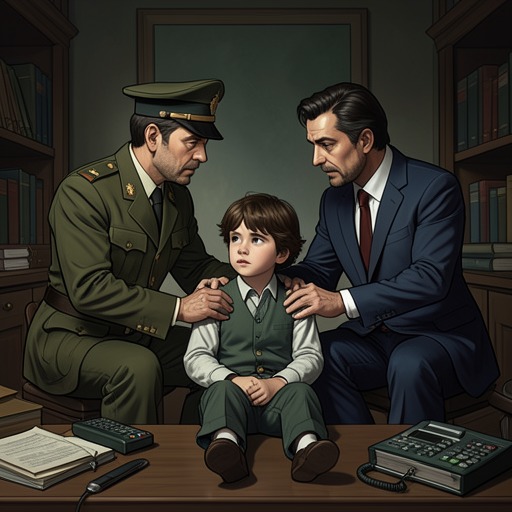
Guillaume stays beside his dead sister and the newborn. His grief is expressed in tears and anger, and he sees Marie-Ange’s death against a longer sequence of family losses, including deaths in childhood, his brother Maurice’s recent fatal car accident, and his son Élias’s death at Dieppe. The discovery of a jewel in a grave the previous autumn crosses his mind as he wonders whether something evil is pursuing the family. The thought registers his desperation rather than establishing a cause for Marie-Ange’s death.
As relatives gather at the small house, they agree that Guillaume and his daughter Laurette should take the infant home, where he can be cared for more closely. Guillaume then summons his mother, his wife, and his three daughters and solemnly asks them to look after his sister’s child. Because the baby seems unlikely to live, the family takes him to be baptized without delay. Guillaume and Marie-Louise D’Anjou serve as godparents and decide to adopt him, with Alcide’s agreement and the broader Bolduc family’s consent; the other two children are divided among the Bolducs. Marie-Ange’s death thus leads directly to the adoption that gives Loïc a home, while leaving his parentage and family belonging entangled across two households.
The child’s first days remain bound to his mother’s funeral. While Marie-Ange’s body lies in the family’s modest house, the German shepherd Prince howls, and the infant seems to stir from his lethargy whenever he hears the dog. The scene gives the household’s mourning a physical, recurring sound: the mother is gone, the child is barely alive, and the animal’s cries seem to reach between them. This is not a memory Loïc can consciously possess, but the book later connects his life to the night’s atmosphere of loss and to an origin story he was not told.
Silence, Twin Loss, and Narrative Significance
For years, Marie-Ange’s death remains a family taboo, discussed with pain and alarm but never fully explained. The silence conceals both the dead twin and the circumstances of Loïc’s birth. When the doctor eventually tells Loïc that there had been another fetus in his mother’s womb and that it was stillborn, he admits that he withheld the information because the family was already enduring such a terrible loss. His delayed disclosure turns an old act of concealment into a decisive revelation about Loïc’s beginnings.
Loïc comes to call the night of his birth the night of the black iceberg. He understands the lost twin as part of himself and imagines her presence as a bridge between him and Marie-Ange. The novel does not present this as a fact available to the family at the time; it is Loïc’s later, deeply felt interpretation of an absence that the adults could neither name nor explain. Marie-Ange therefore remains central not through a developed adult life on the page, but through the consequences of her death: the adoption that saves and rehomes her son, the secret that divides his knowledge of himself, and the grief that continues to reverberate through the family.