Romuald Bolduc
SatanRomuald Bolduc is a wealthy industrialist whose political influence helps secure his family’s hold over Touladi. His conflict with Grébiche makes that local power struggle personal: she regards his methods as a threat to the legacy of Le Fondateur, while he tries to evade or discredit her. Their public feud culminates in a curse against his family, later remembered by Loïc as an unsettling possible prophecy.
Power in Touladi
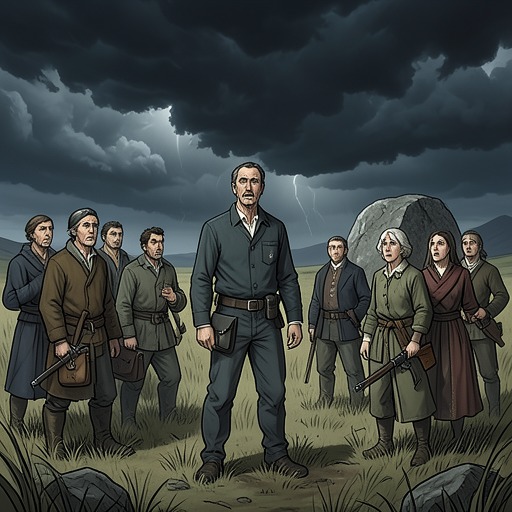
Romuald and his older brother seek to establish their family’s control over Touladi. Romuald is described as even more brutal and aggressive than his elder sibling. His wealth and local influence have a political foundation: Maurice Duplessis’s government awarded him lucrative rural-electrification contracts, which built his fortune and helped secure his power in the community.
Grébiche’s loyalty to Le Fondateur and his inheritance makes her a determined opponent of the Bolduc brothers’ efforts. She confronts Romuald openly, addressing him with insults and calling him the Antichrist. He avoids her whenever he can; at public meetings, where avoidance is difficult, he attempts to make her an object of ridicule. His efforts to undermine her—including attempts to use physical force—repeatedly turn against him, strengthening her reputation in Touladi as untouchable.
The feud and the curse
The hostility sharpened after Duplessis died on September 7. Romuald was a fervent supporter of the premier, whose government contracts had benefited him. In a heated public altercation, Grébiche told him that Duplessis’s death marked the beginning of his own decline. Romuald flew into a rage and nearly attacked her, hurling insults and profanity. Their confrontation drew on the same village accusations about Grébiche’s past, her association with Le Fondateur, and her supposed practices of magic and witchcraft.
Grébiche answered by declaring Romuald and his family cursed, extending the curse to the last of his descendants. His youngest son had been born two days earlier, and people present connected her words to the newborn. The confrontation and its curse remained in local memory, not merely as another exchange in the feud but as a warning attached to the Bolduc family’s future.
Grébiche’s death and local suspicion
Grébiche later died in a fire at her home. The civil authorities’ brief, unpublished report, preserved in the archives, recorded that she had been found burned beyond identification and attributed the fire, without further detail, to an apparent accident. A common explanation in the village was that she had accidentally overturned an oil lamp; without electricity, she still used one, and stored petroleum in an outbuilding. The authorities had her remains exhumed for further examination, after which what became of them was never established.
The official account did not accuse Romuald. Nevertheless, a persistent local rumor claimed that Grébiche had been killed and her body burned to conceal the crime, and named him as the person with both a motive and the power to arrange it. The rumor drew force from his long-standing hatred of her and from their recent public confrontation, but the text presents it as village speculation, not a proven account of her death.
Retrospective meaning
In autumn 2001, Loïc recalls Grébiche and her curse after a Bolduc son disappears in the collapse of the World Trade Center complex. To him, the family’s misfortune gives her words a prophetic resonance. His recollection makes Romuald’s feud with Grébiche part of a longer narrative of inherited consequence: the curse persists in local memory even when the circumstances surrounding Grébiche’s death remain unresolved.