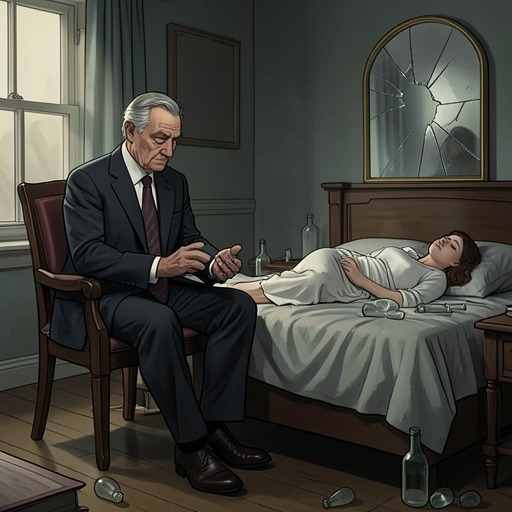
Lucille D’Anjou
SatanLucille D’Anjou’s importance to the cameo crisis lies in the intimate breach through which it becomes possible: Isabelle D’Anjou takes advantage of her mother’s drunkenness to obtain the combination to Georges D’Anjou’s safe, then denies that Lucille ever gave it to her. Lucille is not shown as a knowing accomplice. Instead, her frequent drinking, her closeness to her daughter, and the secrets carried within their family make her trust both the means of the theft and one of its casualties.
Family Position and Private History
Lucille’s family life is presented through the circumstances of Isabelle, the youngest of the children, who remained at home longer than the others. Lucille especially cherished her, transferring to her daughter affection that her own life had frustrated. Isabelle, more withdrawn than her three older brothers and her sister Juliette, often felt overshadowed by their forceful personalities. Lucille’s particular attachment to her youngest daughter helps explain the closeness between them, but it also makes the later deception more painful: the relationship that had offered Isabelle special attention becomes the channel through which she takes the safe’s secret.
Lucille’s past suggests a life divided between bourgeois respectability and a desire for release from its confines. In the 1950s, she had affairs aboard The Rapido, the train between Quebec City and Montreal, during weekends when Quebec’s bourgeoisie went in search of diversion. She grew close to her sister-in-law Victoria, a wealthy widow who took lovers, and to Georges’s sister Georgia, known as Georgie, an unconventional artist living a bohemian life in Montreal. The narrative presents those friendships as a vital breath of oxygen from repetitive motherhood and the performance of virtue, as well as a way of tending an old wound that had never healed. It does not explain that wound, leaving the account of Lucille’s inner life suggestive rather than complete.
The same past gives context to a rumor about Isabelle’s parentage. In Quebec City’s affluent circles, people speculated that Isabelle was the child of an adulterous relationship, pointing to Lucille’s earlier affairs and the fact that Isabelle did not resemble the rest of the family. The narrative identifies this as gossip, not as an established truth. Its significance is the atmosphere of suspicion surrounding Isabelle: long before the stolen cameo, her place in the family had been shadowed by doubts others attached to her mother’s history.
The Safe Combination and the Cameo
When Georges discusses how the safe might have been opened, he privately recognizes that only Lucille besides himself knew the combination. He suspects that she may have revealed it to Isabelle while drunk, since Lucille drank heavily and spoke with her daughter for hours by telephone; the two also sometimes went for drinks at the Château Frontenac. At this stage, Georges’s suspicion is not something he says aloud. He is left to consider the possibility while outwardly dismissing the idea that Roger Bolduc could have learned to crack a safe.
The later account clarifies what happened: Isabelle deliberately used her mother’s intoxication to draw the combination from her, enabling Roger to take the cameo. Isabelle had accepted Roger’s promise that the object could make their fortune. The theft thus depended not on Lucille knowingly helping the plot but on Isabelle exploiting a confidence made possible by their closeness and by Lucille’s impaired state. The distinction matters: the safe’s combination passes from mother to daughter, but Lucille does not understand that she has supplied it for a crime.
After Roger and the cameo disappear together, the family tries to make sense of their absence. Lucille reacts with alarm, interpreting the situation as evidence of something diabolical. The family has little to go on beyond the simultaneous disappearance, and Georges does not reveal his private suspicion about the combination. Lucille’s exclamation registers the mystery as more than a straightforward theft, while the underlying human explanation—the secret she unknowingly gave Isabelle—remains concealed from her.
Motherhood, Denial, and Isabelle’s Decline
Isabelle’s complicity traps Lucille in a painful form of unknowing. Isabelle cannot admit that she took advantage of her mother’s drunkenness without risking the loss of both her mother and her father. Lucille remains her daughter’s closest confidante, yet Isabelle cannot use that intimacy to confess. She knows that Lucille believes she never gave away the combination, and the lie therefore protects their bond on the surface while making an honest appeal to that bond impossible.
The burden of concealment contributes to Isabelle’s worsening condition. Already inclined toward alcohol, she drinks more heavily in the autumn of 2001 and then turns to cocaine. At the beginning of 2002, she nearly dies from an overdose and is sent to rehabilitation. Georges suspects that more than Roger’s disappearance is driving his daughter into this state, but he cannot find a way to release her from the guilt of the crime. Lucille’s role in this deterioration is indirect but central: the secret extracted from her becomes one of the facts Isabelle cannot confess, and the person she most wants to hide it from is also the person she had once been able to confide in.
Characterization and Narrative Significance
Lucille’s portrayal brings together genuine maternal tenderness, a painful history, and a destructive vulnerability. Her affection for Isabelle is established through years of particular closeness; the theft does not erase that attachment, but reveals how it can be manipulated. Her drinking is both a persistent feature of her daily life and the concrete circumstance that makes the safe combination accessible. The plot turns on that ordinary domestic weakness rather than on Lucille’s conscious choice to betray the family.
The account also resists reducing Lucille to the scandal attached to her past. Her affairs and unconventional friendships are described against the constraint of bourgeois motherhood and respectability, while the rumor about Isabelle’s birth remains unverified. In the cameo story, meanwhile, Lucille’s ignorance is consequential: she is not the thief, but the secret passes through her; she remains a confidante, but cannot be told the truth. That unresolved divide between intimacy and concealment makes her a quiet center of the family’s crisis.