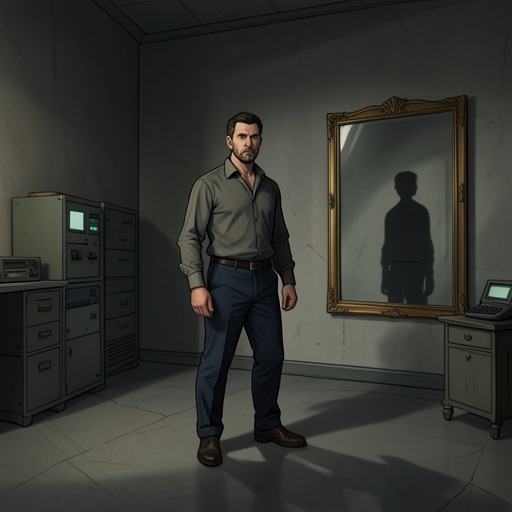
Pierre Saindon
SatanPierre Saindon is the physician who attended Loïc’s birth and later disclosed that Loïc had a stillborn twin sister. His return to Touladi during the final evening of Guillaume D’Anjou’s wake turns a private medical secret into a revelation that reshapes Loïc’s understanding of his birth and of the uncanny presence he had sensed throughout his life.
Identity and Background
Saindon had left Touladi less than a year after Loïc’s traumatic delivery to practise in the Québec region. At the wake, he appears as a prosperous, distinguished man, with a fine mustache and silvering temples. People recognize him and greet him before he approaches Loïc. He is not a stranger to the family’s history: he had been present at the moment Loïc’s mother was dying, and the knowledge he carries has remained with him ever since.
The Disclosure at the Wake
Saindon draws Loïc aside and struggles to begin. His face tightens as he tries to contain his emotion; he explains that his silence has weighed on him since the birth. He then tells Loïc that there had been another fetus in his mother’s womb. The disclosure shocks Loïc, who asks whether Saindon is certain. Saindon confirms that he recognized the second fetus during the delivery, but that it was already dead.
The news gives shape to sensations and intuitions Loïc had experienced without being able to explain them. Yet the knowledge arrives entangled with a gruesome image: the dead twin, a girl, was later found in the grave beside their mother, still joined to her by a dried umbilical cord. Guillaume D’Anjou and Saindon had witnessed the discovery. They saw the shrunken body between the dead woman’s legs and could establish that the child was female, though they could not then understand how it had come to be there. Saindon’s disclosure therefore links the hidden fact of the twin’s existence to the disturbing circumstances of her posthumous emergence.
Guilt and Medical Explanation
Saindon says he kept the discovery from the family because Loïc’s mother had already died and he did not want to add another burden to their grief. He recognizes that this decision did not end his responsibility: he could have told them later, but instead carried the secret for years. He also blames himself for failing to save the young mother and wonders whether he should have anesthetized her with chloroform. His admission does not establish that the chloroform caused her death; it shows the uncertainty and self-reproach that have persisted in his account of the delivery.
Saindon explains that he discovered the second fetus while trying for a long time to stop the hemorrhage. By then, he says, blood had moved the dead fetus downward, and he palpated enough to know it had died. When Loïc asks how the body could have left the womb after burial, Saindon recalls an old medical treatise and identifies the rare process as postmortem fetal expulsion: gases accumulating in the mother’s body can push a fetus out of the uterus. The explanation offers a physical account of the grave’s horror, even as it confirms the reality of the twin whose presence had remained unknown to Loïc.
Narrative Role and Consequences
Saindon’s return makes him both the keeper of the secret and the person who finally breaks its silence. His confession brings relief on one point: after hearing the explanation, Loïc no longer holds Guillaume responsible for withholding the discovery. But the medical account cannot dissolve the image that now occupies Loïc’s mind. At the end of the wake, he carries the twin’s story upstairs, where it feeds visions of himself escaping the womb while his sister remains trapped inside it. Saindon’s disclosure thus resolves a factual mystery while intensifying the emotional and imaginative force of Loïc’s lost twin.