Élias D’Anjou
SatanÉlias D’Anjou is Guillaume D’Anjou’s eldest son, a young corporal killed by German machine-gun fire during the Dieppe Raid. Though he appears only through family memories, a surviving letter, and his portrait, his death joins the family’s grief to the story’s ominous jewel: before he died, he dreamed of an ancestor showing him a disturbing, darkly radiant object.
Identity and Death
Élias served as a corporal and died during the disastrous Dieppe Raid in 1942. The loss placed him among the dead whose memory weighs on Guillaume: in the course of a family catastrophe, Guillaume recalls his son alongside siblings who died young and his brother Maurice, killed in a car accident earlier that year. Élias’s death is not an isolated sorrow in this account; it belongs to a succession of losses that makes Guillaume feel his family is under a curse.
The Last Letter and the Dream
In his last letter to his family, dated August 18, 1942, on the eve of his death, Élias recounted a dream about his grandfather Égide, whom he had never met. Égide had died two years before Élias was born. In the dream, he beckoned Élias toward an object that gave off a sinister radiance, appearing mauve and black and leaving the young corporal frightened and inwardly wounded.
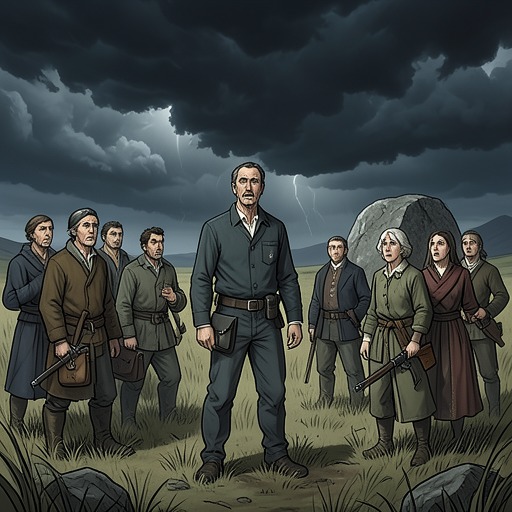
The dream gives Élias’s brief appearance an uncanny connection to the family’s history. When a storm later accompanies the near-supernatural exhumation of a skeleton bearing a mysterious jewel, Guillaume recalls the letter and wonders whether the Devil is assailing his family. The vision does not establish what Élias understood about the object; instead, its return through Guillaume’s memory makes the letter an unsettling anticipation of the jewel’s place in the family’s misfortunes.
Family Memory and the Portrait
After the earthquake, the family portraits hang askew. Élias’s image, identified with the young soldier who died on the beach at Dieppe, is among those tilted by the shaking. It appears beside portraits of Guillaume and Marie-Louise as young newlyweds and of Marie-Ange, Loïc’s dead mother. The physical disturbance turns the gallery into an image of a family shaken at its roots, while Élias’s portrait preserves him as an eternally young soldier.
Narrative Significance
Élias links wartime death to the book’s recurring conjunction of bereavement, inheritance, and supernatural fear. His dream brings the mysterious object into the family’s story before Guillaume connects the jewel to the calamities around him. At the same time, Élias is one of the losses through which Guillaume measures the family’s suffering: the dead son returns not as a speaking presence, but through a letter, a remembered vision, and a portrait unsettled in its frame.