René Lévesque
SatanRené Lévesque is the novel’s emblematic champion of Quebec sovereignty, first seen at the height of a movement’s triumph and later amid the unraveling of his leadership and party. Through Loïc’s distant but attentive perspective, Lévesque’s changing fortunes register not only as an individual political decline but as a crisis in the collective hope he had helped bring into public life.
Emergence as a Sovereignty Leader
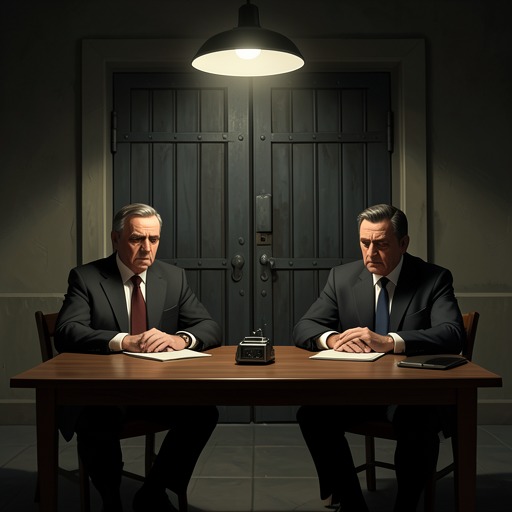
In the weeks before the 1976 Quebec election, a poll put the separatists near half the vote, unsettling the political establishment in Ottawa. At Pierre Elliott Trudeau’s Langevin office, Lévesque’s Parti québécois was treated by some as a threat to the Canadian federation. Trudeau agreed with Régis’s description of its secessionist program as treasonous, then asked Régis and Loïc to prepare a telegram for the event of a Parti québécois victory. The wording was to avoid both barbs and congratulations, offering instead a cool acknowledgment that a sovereignist government had been legitimately elected.
The task exposed the opposing loyalties within Trudeau’s own staff. Régis saw recognition of the result as an acceptance of evil; Loïc, by contrast, understood the moment as emancipation. Their disagreement remained unspoken, but it made their shared work increasingly difficult. The election was therefore more than a change of government: even before the votes were counted, it tested whether political duty could coexist with private allegiance to Quebec’s independence.
When victory was confirmed, Lévesque addressed his jubilant supporters at the Centre Paul-Sauvé in Montréal. His declaration that he had never been prouder to be Québécois set off an immense celebration. For Loïc, watching from the federal side, the scene produced estrangement rather than uncomplicated solidarity. He felt remote from the young people celebrating in Montréal and across Quebec, as if he belonged to another place, time, and generation. His former sense of joining a collective “we” had separated from his individual self. Lévesque’s triumph thus marks both a national political breakthrough and a personal turning point for Loïc, whose relationship to the cause could no longer be taken for granted.
Triumph and Its Federal Aftermath
The victory shook the Langevin office. Staff watched the results with disbelief as the Parti québécois lead grew, and the atmosphere became one of confusion and dread. The government settled on a statement recognizing the legitimacy of the newly elected sovereignist administration. Some employees, like Régis and Loïc, were caught between federal service and family or political ties that crossed the Quebec–Ottawa divide.
Lévesque’s public success also unsettled Trudeau. In front of reporters, the prime minister misspoke and said he would continue to preach separatism in Quebec before correcting himself to call it an error. The novel presents the slip as a possible momentary return to an earlier self: the young Brébeuf student who had imagined an independent Quebec republic. In that juxtaposition, the political divide is not simply between two leaders. It runs through their changing identities and the histories they carry.
Loïc later saw Trudeau hurry toward Parliament with his usual entourage, his expression now hard and sombre. The victorious Lévesque whom Loïc had watched address the crowd had become, in the federal building, the “enemy brother” whose achievement had unsettled the government. These contrasting scenes frame Lévesque as a force whose victory could not be contained within the province: it altered the mood of Ottawa and made private divisions visible even among people tasked with speaking for the federal government.
Return to the Assembly and a Changing Image
In the spring of 1985, Loïc found himself at the Assemblée nationale du Québec as a communications adviser, attending a meeting before the parliamentary session resumed. Lévesque, by then burdened by a persistent cough, rose to pour coffee. A coughing fit made the coffee spill from a cup his trembling hand could barely manage. The moment gathers several losses into one small action: the party, political power, and health all seemed to be slipping beyond his control.
As he approached Loïc, Lévesque made a rueful remark about the treacherous weather and the winter that would not end. Loïc answered with an ironic Shakespearean allusion to a winter of discontent. Their brief exchange is casual in form, but its context gives it weight: the former triumphant leader and the adviser who had once watched that triumph now met in a season of exhaustion.
Loïc contrasted the man before him with the resplendent figure he had seen less than a decade earlier in Ottawa, after the sovereigntists’ victory. The novel describes Lévesque’s later appearance as a visible accumulation of political blows and humiliations. It likens him not to a scheming Richard III but to Hamlet, caught in painful hesitation between action and inaction. The comparison links his halting public manner to the political question at the heart of his project: a people’s desire to be a nation, and the difficulty of turning that desire into a decisive course.
Leadership Under Pressure
During the late winter and spring of 1985, Loïc watched Lévesque’s leadership decline while drafting speeches and other remarks for him. The work continued, but Loïc doubted that polished language could right a party adrift or restore a leader whose authority was also weakening. Inside the party, an atmosphere of intrigue spread. Two factions gathered behind rival succession candidates, each seeking support among ministers and members of the legislature. One faction’s organizer, a former college acquaintance of Loïc who had welcomed his arrival at the Assembly, tried to recruit him to a meeting.
By May, press speculation and leaks about Lévesque’s health and impending resignation had become persistent. Some legislators privately maneuvered over succession while publicly praising their leader and proclaiming loyalty. Lévesque eventually rebuked those he believed were feeding reporters stories from caucus discussions. He insisted that he might leave one day but would not be driven out. His anger was directed at a party he had founded, which now seemed to be turning against him and making him the object of its own condemnation. The novel gives this reversal a forceful image: the political movement returning upon its founder like a boomerang.
Loïc experiences this confrontation as the struggle of a mythic father resisting an inevitable ritual overthrow. His sadness is not presented as simple nostalgia for a leader; he recognizes how a magnetic personality can gather and focus collective will, and how, when that figure falters, the surrounding political world can darken with him. The party’s internal conflict therefore becomes inseparable from Lévesque’s personal decline, without being reducible to it.
Resignation and Narrative Significance
Near the end of the spring session, Loïc was drinking with political staff at the Chalet suisse when a journalist arrived with a printed announcement. Her question made clear that she expected him, as a communications adviser, to have known already. The document announced Lévesque’s resignation and came from the premier’s office. Loïc learned the news from the press rather than delivering it to the press, a reversal that left him feeling professionally exposed.
The announcement brought confusion, emotion, and anger within the party. Some members gathered in a discreet bar on rue Saint-Jean, feeling like political orphans after their leader’s abrupt departure. In retrospect, Loïc understood the spring of 1985 as the final act of a decline that had begun earlier in the decade, ending in political casualties and broken dreams. The contrast with the 1976 celebration is stark: the leader who had once embodied a collective possibility now left behind a divided party and a cause Loïc saw as disintegrating.
Lévesque’s narrative role lies in this movement from public triumph to private and institutional exhaustion. His rise and decline let the novel examine how a political leader can gather a people’s aspirations, and how the failure of a party or its central figure can make those aspirations seem to contract. Loïc remains an observer more than an actor in the major historical events around him, but Lévesque’s two appearances at opposite ends of his political arc give that observation a human measure: the distance between the jubilant crowd of 1976 and the faltering leadership of 1985 is also the distance between a once-vivid collective “we” and the uncertain aftermath of its hopes.