Louis de Castelmont
SatanLouis de Castelmont is the American exile at the center of a contested family history that reaches from revolutionary France to a Missouri ranch and, possibly, to the origins of the D’Anjou family. Reconstructed by Loïc from scattered archives and newspaper reports, Louis’s story is one of divided inheritance and uncertain identity: the record places him at the ranch destroyed in 1842, but does not establish what became of him or whether he was the father of the infant later adopted by the D’Anjous.
Identity and the Castelmont twins
Louis was one of twin sons born to the Castelmont family in 1782. He and his brother Charles de Castelmont were in Paris with their mother when their father, sisters, and younger brother were killed at Château de Barzac during the French Revolution in 1794. The twins were already hostile to one another, and their mother was the one person able to restrain their bitter rivalry.
Before her arrest, their mother entrusted the twins with a pair of cameos associated with Louis XVI. She gave Louis the Castor cameo and Charles the Pollux cameo, sewing each into its recipient’s clothing and requiring them to keep the stones. The objects therefore joined family identity to a promise of loyalty, while becoming the material focus of a conflict that would outlast the twins’ childhood. The account Loïc assembles attributes the cameos’ origin to Louis XVI’s gift to their mother, Delphine de Castelmont, and describes the distribution as an act undertaken when she feared she would soon be arrested.
The boys escaped the authorities separately. Their mother was later guillotined, and the twins began years of concealment and flight. Louis made his way to England shortly before the fall of Robespierre in July 1794; Charles, with help from a paternal cousin, joined the émigrés in Germany. Their separation did not resolve their conflict. It carried the rivalry into adulthood, first through their different fortunes abroad and later through a prolonged struggle over family property and status.
Exile and the inheritance dispute
Louis eventually sailed for America, reaching Louisiana. He survived there through small thefts and a succession of precarious occupations before establishing a modest business. Shortly before the Louisiana Purchase in 1802, he acquired land. He then followed westward settlement, spending time in Texas before making his home near Carthage, Missouri, where he became a prosperous farmer. Loïc identifies this American settler as the likely Louis de Castelmont mentioned in the record as Castlemount.
During the Bourbon Restoration, Charles returned to France and recovered the Castelmont estates, apparently believing his absent twin permanently gone. Louis returned to Europe to claim his title and share of the inheritance. By birth, he had a claim to seniority: the record cited by Loïc placed him a few minutes ahead of Charles. But the formal claim did not translate into power. Louis had been away for years and was little known in Europe, while Charles had cultivated influential political connections. Charles refused to meet him and treated his claim as fraudulent; Loïc’s account also reports repeated attempts by Charles to have his brother killed.
Louis pursued his claim through several channels. He sought help from the United States government, met the French ambassador, wrote to Charles V, and tried to interest the writer Chateaubriand, whom he had encountered in America. These efforts came to little while Charles retained strong support, including ties to the royalist secret society known as the Knights of the Faith. After the Bourbons fell in 1830, Charles’s political backing weakened and Louis found a more receptive climate under Louis-Philippe. He was approaching success after years of legal and political pressure when the Missouri disaster intervened.
The Missouri ranch and the uncertain record
A scene Loïc reconstructs places Louis at his ranch south of Carthage in 1842. At daybreak, after beginning work with two enslaved Black people, the ranch owner reached for the carbine he kept close at hand. The account describes him ordering his workers to bring out the available firearms, release the livestock as a barrier, and get the women and children into the house. He then defended the property as the attackers entered. In Loïc’s reconstruction, the rancher fought until he was overwhelmed.
The surviving newspaper evidence is less conclusive than the dramatic reconstruction. A Bowling Green report said that Indians had attacked Castlemount’s ranch, burned the house and barns, and were presumed to have killed the owner, his wife, children, and at least six other people, mostly Black. It also reported that horses and cattle had been taken and that thirty dragoons were sent in pursuit. The report did not confirm the deaths, and it noted no return from the pursuit.
A later Saint-Louis item complicated that first account: investigators had found no bodies in the completely burned buildings, leaving open whether the ranch had been occupied during the raid. A subsequent correction in the Bowling Green paper said an Indian attack had not been proved, that the fire might have had natural causes, and that no bodies had been found. For Loïc, these inconsistencies suggested deliberate suppression, but they do not establish what happened to Louis. He considers the possibility that Charles arranged the attack through intermediaries and paid Sioux fighters, while acknowledging that the theory rests on circumstantial evidence and unanswered questions.
The cameo and the rescued infant
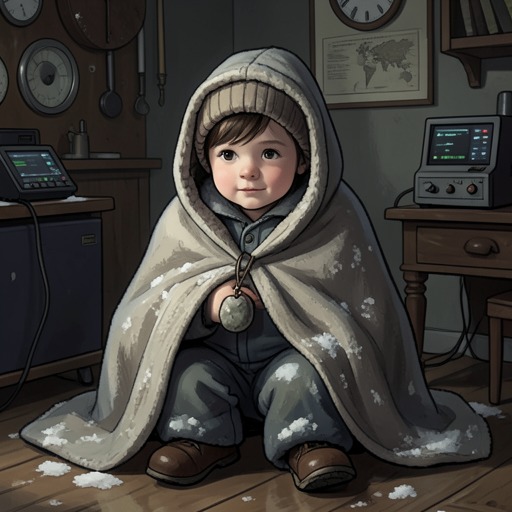
The uncertain fate of Louis’s ranch matters because another strand of Loïc’s research links the disaster to a baby found near Florissant weeks later. A Jesuit account describes a surviving woman who had brought an infant through hardship and sought refuge with the Church. A well-made jewel was concealed in a torn silk purse pinned to the child’s swaddling. The woman, whose name was not recorded, was buried in the parish cemetery as an unknown benefactor; the child was to be baptized and placed with adoptive parents.
Loïc connects the jewel to the Castor cameo and sees a possible line from Louis to the rescued baby, later adopted by a young French-Canadian couple named D’Anjou. The baptismal record gives the infant the name Éloi, which Loïc believes was later read as Élie because the handwriting was unclear. This proposed chain makes Louis a possible ancestor of the Founder, but it is not a confirmed genealogy: the baby’s parentage and the cameo’s route to the child remain matters of inference.
That uncertainty echoes an earlier family secret. The Founder had told Marthe that he was adopted and knew nothing of his birth family. He had also spoken of a valuable stone from the United States that troubled him, feared it as malign, and hid it in his scapular and clothing so that he could be buried with it. His account does not prove that the stone was Louis’s cameo. Read beside the records of the infant and the ranch, however, it makes the jewel a possible link between Louis’s unresolved history and the Founder’s concealed origins.
Narrative role and unresolved fate
Louis enters the novel not through a secure biography but through Loïc’s work of comparison: a family recollection, an old baptismal register, accounts of the cameos, and newspaper reports that contradict one another. Each source offers a fragment, while the gaps—the missing bodies, the corrected report, the unknown woman, and the infant’s uncertain parentage—prevent the fragments from becoming definitive proof.
His life also makes inheritance more than a matter of land or title. Louis’s claim rests on birth order and family identity, yet years of exile leave Charles better placed to control the estate. The cameo, passed from a mother to twin sons and possibly carried away from the burning ranch with a baby, offers a parallel form of inheritance: intimate, portable, and difficult to verify. Louis’s ultimate fate remains unresolved. The record supports neither a confirmed death at the ranch nor a conclusive escape, leaving his possible connection to the D’Anjou line suspended between historical evidence and Loïc’s reconstruction.