Aurelio
SatanAurelio is a Cuban Santería initiate whose theft of a cameo carries him from religious apprenticeship into a clandestine Masonic network and a violent occult sect. His story turns on a reversal: recruited to retrieve an object supposedly dangerous to the world, he becomes an agent of the very evil he was told he must contain. A sudden appeal to Jesus-Christ breaks that allegiance, but escape brings him home only briefly; in Havana, he is killed before he can rebuild his life with his former mentor, Rodrigo Lerbier.
Identity and Spiritual Formation
Before his disappearance, Aurelio was an aspiring babalao training as a Yoruba officiant at a temple in Havana. Rodrigo, his spiritual mentor, felt a special affection for him, almost as if he were a son. He remembered Aurelio as taciturn and reflective, not given to expansive speech, with a muscular, compact build that suggested concentrated strength. The young man had worked for a year at a hotel in Varadero and had previously worked with his parents on Cayo Largo, near Isla de la Juventud, where he was born. Rodrigo did not know Aurelio’s family personally, a gap that later complicated his effort to find him.
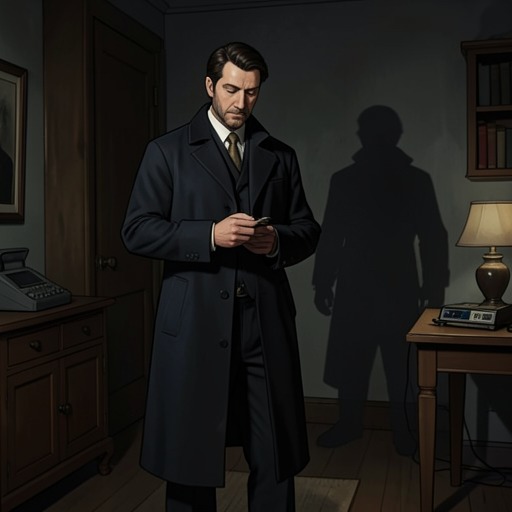
In a later encounter, Aurelio appears so ragged, dazed, and ill that Rodrigo initially recoils, mistaking him for something like a diabolical apparition. The stranger does not identify himself at first; Rodrigo can barely make out his features in the dimness and hesitates to open the door of his home and workshop. Only when the visitor names himself does the mentor recognize the missing initiate. Aurelio wears a bandage over one eye and describes the injury as an accident, saying he has lost an eye or nearly so and may lose it if an operation fails. His damaged appearance makes visible, without explaining, the ordeal he has survived.
The Cameo and the Disappearance
Aurelio’s disappearance follows the theft of a cameo from a modest Yoruba temple in Cárdenas. Years later, Rodrigo reconstructs the opportunity: in March 2003 he had brought the jewel from the capital and placed it in the temple before dawn, then went to sleep for a few hours at his mother’s home. Someone who knew his routine could have followed him and entered the temple while the streets were still empty and darkness had not fully lifted. Rodrigo suspected Aurelio because the young initiate had attended a public ceremony and then vanished; no one among the Yoruba worshippers he questioned knew where he had gone. Rodrigo even feared the political police might have arrested him in the large mid-March roundup, though he could not reconcile that possibility with the quiet, thoughtful young man he knew.
Aurelio eventually admits that he took the cameo on behalf of a newly founded Masonic lodge in Cuba. Its founders, who appeared to have protection within the Castro regime, pressed him increasingly insistently, at times threateningly, to join. They dangled the possibility of leaving Cuba and travelling to the United States or elsewhere. They also assured him that service as a Yoruba officiant was compatible with Freemasonry, claiming that some Masons, even at the highest levels, practised both. That reassurance helped win his consent. The lodge’s initiation test was to steal the cameo and deliver it to its masters.
The recruiters presented the theft as a rescue mission. They told Aurelio that the jewel was bewitched by malevolent powers and could harm society and the world unless the collective spiritual force of the Masonic brothers neutralized or redirected it. In that account, he was entrusted with a crucial task for humanity’s salvation. The promise of travel, the pressure to join, and the supposed sacred purpose together turned a criminal act into an initiation he could regard as service.
From Initiate to Escapee
Through a more or less clandestine Masonic route, Aurelio crossed into the United States and was gradually drawn into a group whose members practised strange rituals. He underwent what the account describes as brainwashing. His religious path shifted from Santería to Palo Mayombe, a practice invoking the dead and forces of nature, and manipulating forces of light and, especially, darkness for specific ends. As his influence grew, he became a sorcerer who sought human blood for rituals; he was increasingly respected and feared. In his later understanding, he had surrendered his will to the devil and committed vile acts in the service of a sect. He also recognized his own responsibility: he had helped place Satan, as it were, inside the onyx cameo.
The break begins when Aurelio overhears a conversation between a leader of the Satanist sect and a high-ranking Masonic initiate. The words themselves tell him nothing new; for years he had accepted and shared the beliefs behind them. What changes is his apprehension: for the first time, he seems fully to hear and understand what he has been serving. Something clicks, and he instinctively calls on Jesus-Christ. He concludes that he must escape at any cost. The change is not a gradual reconciliation with his former life but a decisive rejection of it, prompted by a sudden recognition of the system in which he has been participating.
He uses subterfuge to get out of the sect’s installations near Miami one night, choosing flight over any return. For days and nights he avoids the main roads and eventually reaches Key West, where he finds an abandoned boat. Pleasure boaters spot him adrift and tow his craft to the boundary between the United States and Cuba. He reaches a deserted shore near Varadero exhausted but alive. During the crossing, the sea becomes an image of his battered soul: he reviews his fate through the night, then finds himself at dawn surrounded by water, with no land in sight and the wind fallen. His relief at seeing the first light gives way to the fear of being abandoned in an immense emptiness. He attributes his deliverance from the sect to divine help and to his mother’s prayers to the Virgin and the saints.
Return, Murder, and Narrative Role
After returning to Cuba, Aurelio wants to find Rodrigo in Havana and ask his forgiveness. He believes that Rodrigo first deserves an account of what happened, because it was Rodrigo who introduced him to Santería. His return therefore carries the possibility of confession and repair: the former initiate seeks out the mentor he left behind, not merely a route back to safety. But when he reappears one September evening, eleven years after disappearing, Rodrigo can scarcely recognize him. Aurelio’s abrupt arrival makes the reunion uncertain before he has even told his story.
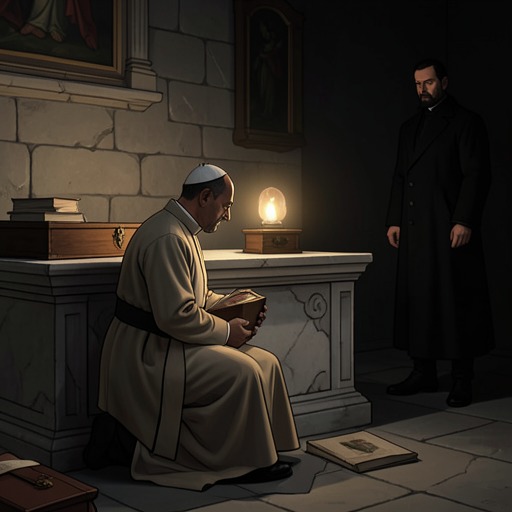
On February 10, 2016, Aurelio leaves a Havana cathedral after Ash Wednesday services. He has been thinking about a fervent, early-Christian faith, and about believers who might one day need new catacombs in which to practise. As he enters an arcade, he senses danger and turns back toward the lit square. Shadows rise behind him; a powerful arm seizes him, and a thin blade cuts his throat. He falls without a cry, while the assailant escapes through the dark streets behind the baroque church. The scene makes his attempted return starkly incomplete: after escaping one hidden network of violence, he is killed in the city where he hoped to seek forgiveness.
Rodrigo, who knows Aurelio went to the service, grows anxious when he does not return. The two have recently felt watched, and distant police sirens deepen Rodrigo’s foreboding. At the cathedral he reaches a crowd and a police cordon, sees the old paving stones reddened with blood, and learns that a young man has been killed with his throat cut. Still trying to discover whether the victim is his friend, he is asked to identify the body at the hospital morgue. Aurelio’s arc thus links a stolen object, an initiated passage into occult power, a religious awakening, and a return that ends in murder. His escape is real, but it does not restore the life or relationships from which he departed.