Laurette
SatanLaurette is Guillaume D’Anjou’s daughter and Loïc’s adoptive sister, but her importance to him rests above all on the care she gives: she helps receive him into the family as a fragile newborn, comforts him through childhood terrors, and remains a loving presence until her own final illness. After her death, Loïc loses the last surviving member of the D’Anjou family that adopted him, and the family’s home in Touladi soon disappears as well.
Identity and Family Position
Laurette belongs to the household of Guillaume D’Anjou and Marie-Louise D’Anjou. When Marie-Ange D’Anjou dies in childbirth, Guillaume and Marie-Louise adopt the surviving infant, Loïc. Laurette is among the family members entrusted with his care and grows into the role of his sister. The story presents that kinship not as a formality but as a bond made through repeated acts of attention: she is there when he is most vulnerable, and later becomes the person he seeks when fear overwhelms him.
She was born with albinism, which impaired her sight and prevented her from pursuing the studies her intelligence and remarkable memory might otherwise have allowed. Her vision remains limited in the dim light, and she has to strain to make out a distant figure in the street. Yet the narrative repeatedly places her perceptiveness elsewhere: in her patient attention to Loïc and in the knowledge she retains of the people and events of Touladi. Her physical limitations do not diminish her practical importance within the family.
Care for Loïc and Life in Touladi
After Marie-Ange’s death, the newborn Loïc is so frail that the family fears he may not survive. Guillaume brings him to the family home and asks his relatives to care for him. Laurette takes a particularly active part, joining her mother and grandmother in the shifts of care that continue through day and night. The narrative links her attentiveness to her own experience of disability, suggesting that her albinism gives her a special sensitivity to the infant’s guarded, withdrawn state. In this first family crisis, she becomes one of the people who keep the child alive and help make a place for him in the household.
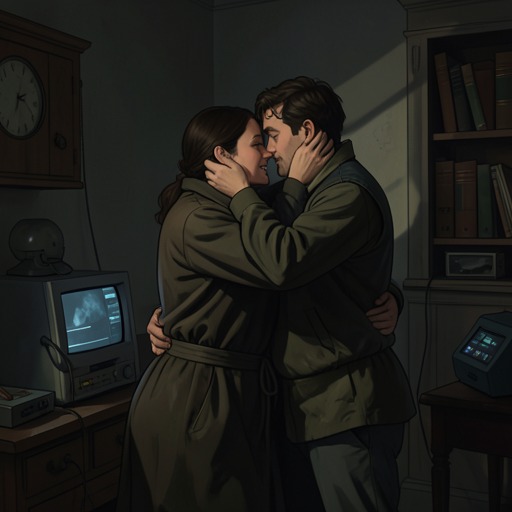
That early caregiving becomes an enduring pattern. During Loïc’s frightening childhood nights, when he imagines a threatening presence and calls for help, Laurette comes to him, reassures him, turns on the corridor light, and leaves his bedroom door ajar. Her response is concrete and unshowy: she does not need to resolve the source of his fear to ease it. The small allowance of light and the open door give him the reassurance he asks for, and establish her as a dependable protector in the family home.
Laurette is also present in the shared life of the household. During the earthquake that shakes the house, the family gathers downstairs in alarm, and Marie-Louise receives the frightened Loïc. In the aftermath, the family portraits have been thrown crooked; Laurette promptly sets the portrait of Le Fondateur straight. The gesture reflects her care for the family’s home and its inherited symbols. The disturbance has unsettled not just the room but the family’s foundations, and Laurette’s attention to the portrait is a small act of restoring order.
Family Loss and Her Place in the Household
The D’Anjou household is marked by successive deaths, and Laurette’s role becomes especially visible when Guillaume collapses. She is among the women gathered around him, trying to speak to him and revive him, while the rest of the household reacts in alarm. La Grébiche’s forceful intervention is followed by signs that Guillaume is breathing again, but Laurette’s presence in the crisis belongs to the broader pattern of family care she has sustained throughout her life.
At Guillaume’s funeral, his body lies in the family salon for three days beneath the imposing portrait of Le Fondateur. Marie-Louise sits in mourning, and Laurette sits beside her. The narration identifies Laurette as Guillaume’s favorite, while showing the visible toll of grief on her. The scene places her not at the margin of the family’s mourning but at its center: she is the daughter beside the widow, sharing the public work of receiving condolences and the private loss of a father.
Her devotion extends beyond immediate care. Laurette remains unmarried and gives her life to her parents and family, including Loïc, the child who came into the household after his birth mother’s death. She rarely travels beyond Touladi; the farthest journey described is an ambulance trip to Rivière-du-Loup. Television offers her a mediated view of places she has never visited. This limited geographical life contrasts with the breadth of the family history she carries in memory, and with the affection Loïc feels for her.
Illness, Death, and Farewell
Years later, while Loïc and Brigitte are preparing to go out, a cousin telephones to report that Laurette has been taken to hospital after a sudden illness and diagnosed with advanced cancer. The news reaches Loïc at a moment also associated with the beginning of a pregnancy that will end in abortion. The narrative sets the emergence of a possible new life beside Laurette’s rapidly advancing illness, making the timing part of Loïc’s later reflections without making Laurette responsible for the events around it.
When Loïc visits her in hospital, he finds her much thinner than the rounded figure he has always known. Her eyesight has deteriorated, but she recognizes his voice and turns toward him, her gaze searching until it settles on his face. She tells him she knows she has little time left. He holds her hand and tries to comfort her, while privately understanding that the promise he wants to make is not that she will remain alive, but that she will remain with him in memory. The visit makes clear how much his security has depended on the person who once came to his room and left a light on.
Laurette dies less than a month later. Loïc returns to Touladi to empty her apartment in the village housing complex, sorting the furniture and smaller belongings she had to leave behind when she was taken to hospital. He gives much of it to neighbors. The objects serve as traces of a life she can no longer continue, and the task brings back the fact that she was the first to care for him after his mother died. His grief is inseparable from that history of care.
Her funeral is modest, held under a veiled sun with only a small group of elderly people present. Relatives from Québec City do not attend, a fact that disappoints Loïc. Régis D’Anjou, away on a senatorial mission in Australia, sends a large floral arrangement and a tribute that the priest reads from the pulpit. The ceremony marks more than Laurette’s death: with her gone, the adoptive family that had raised Loïc has no remaining presence in Touladi. The family home is already empty and deteriorating, and the portrait of Le Fondateur has been moved to Québec City.
Narrative Role and Legacy
Laurette’s story is built less around independent public action than around the labor of staying close to others. She helps care for an endangered infant, answers a child’s nighttime fear, stands beside her family through crises, and gives Loïc a lasting model of tenderness and reliability. The novel makes these acts consequential through their recurrence: the light left on in the corridor anticipates the emotional shelter she provides throughout his life, and her death exposes how much of that shelter has depended on her.
Her memory also gives the narrative a measure of life beyond travel, status, and spectacle. Laurette’s world remains largely within Touladi, and her impaired sight limits her movement and education, yet Loïc remembers her as intelligent, unusually gifted in memory, and generous in her devotion. After her death, he is left with the village, some relatives and friendships, and the memories that connect the dead to the living. Laurette’s lasting significance lies in that connection: she is both the person who first helps Loïc belong to the D’Anjou household and the final loss that makes its disappearance in Touladi complete.