Rodrigo Lerbier
SatanRodrigo Lerbier is a babalao in Havana whose life becomes entangled with the D’Anjou family cameo, an object he first hopes to harness and later fears as a source of spiritual corruption and violence. His story joins ritual authority to personal doubt: the man who consults the orishas for guidance eventually wonders whether the voices he has trusted were Satan’s, even as the cameo’s return and disappearance bring danger close to him and those he loves.
Identity and First Encounters with the Cameo
Rodrigo is introduced as a babalao, a Yoruba religious officiant whose standing gives him authority within his community. At a ceremony attended by Loïc and Laurence d’Albignac, he sits in white at the center of a vividly decorated space, among drummers and singers. The dancers represent orishas associated with the elements: Yemaya with water, Oya with air and wind, Chango with fire, lightning, and war, and Oshun with the earth, female sexuality, and fertility. Manuel identifies Rodrigo as his cousin. The spectacle interests Loïc, who connects its elemental imagery with his earlier reading of Bachelard, while Rodrigo’s presence places the religious world of the ceremony at the center of the story’s developing encounter with the cameo.
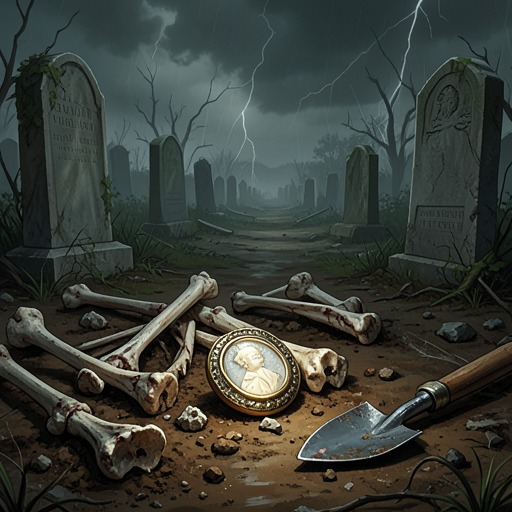
Rodrigo’s relation to the stone begins with a physical shock. When he sees the cameo on the ground and bends to pick it up, its heat makes him cry out and drop it. The priest with him explains that Ana Maria fears it as the devil’s eye and wants it thrown into the sea. Rodrigo wraps the jewel in a handkerchief, but even as it cools in his pocket he senses what he understands as its powerful negative energies. He murmurs cabalistic formulas intended to calm agitated spirits, treating the object as both a danger and a force that might be controlled.
His first response is also ambitious. Rodrigo imagines that the stone could bring extraordinary power if he learned how to master it. He considers displaying it as an ex-voto in his Havana temple and performs divination with palm nuts, asking the oracle of Ifa for a verdict. In the vision, Chango appears amid infernal flames and identifies the stone with evil and Hell. The vision presents the cameo as capable of transforming reality for someone who can use it, or destroying someone who cannot. Chango warns that a Yoruba place of worship holding it would need constant offerings, ideally human and at least animal, to satisfy the spiritual force within the stone. The encounter thus overturns Rodrigo’s hopes of safe possession: the object he had considered a source of power is revealed, in his vision, as an appetite that demands sacrifice.
A Chance Meeting and a Disclosed Kinship
Rodrigo and Loïc meet again after the ceremony, when Manuel brings Loïc and Laurence to meet him. Rodrigo is in Havana by chance: he lives there, but has returned temporarily to his hometown to attend to his sick mother. As the group walks toward the bus for Varadero, Rodrigo and Loïc begin talking. Rodrigo speaks French well, having worked for years in shops and hotels in Varadero, and Loïc asks him about Yoruba religion before suddenly asking whether some stones can contain curses.
The question unsettles Rodrigo. He wonders whether Loïc might be an agent of the Central Intelligence Agency or the Federal Bureau of Investigation, or whether he somehow knows about the cameo in Cárdenas. Loïc partly explains the family history without naming the object as a cameo: a jewel of unknown provenance belonged to his great-grandfather and had brought harmful effects upon the family. He gives examples but withholds that the jewel disappeared in New York on September 11, 2001. Rodrigo’s caution and Loïc’s partial disclosure make their conversation a meeting between two people who each know something about the stone, but neither yet knows the full extent of the other’s connection to it.
Their relationship changes when Loïc recounts how Mathilde fled to the United States and met a man who brought her to Cuba, probably before 1900. Rodrigo embraces him in recognition of their kinship, calling him his cousin. The reunion is abruptly interrupted: Manuel signals that the bus to Varadero is waiting, and Loïc has to leave. They promise to keep in contact and meet again. Their brief parting turns Rodrigo’s encounter with the cameo into a family connection as well as a religious and supernatural problem.
The Theft and Rodrigo’s Search for Aurelio
After Rodrigo provisionally hangs the cameo on the wall of a Yoruba place of worship in Cárdenas, someone breaks in for the sole purpose of taking it. Nothing else is stolen or damaged. Rodrigo recognizes the loss at once, and tells the bewildered Loïc that the cameo has disappeared again. The precise selectivity of the burglary leaves little doubt that the stone itself was the target.
In reconsidering the theft, Rodrigo recalls that he brought the cameo from the capital early in the morning and left it at the temple before dawn. He then went to sleep for a few hours at his mother’s home. The darkness and empty streets would have allowed someone who followed him to enter the temple unseen. The possibility gains force when Rodrigo realizes that Aurelio, a young man nearing the end of his babalao initiation, has not returned to the Havana temple since the cameo vanished. Rodrigo had mentored him and felt a special affection for him, almost as for a son.
Rodrigo searches among worshippers and other people who knew Aurelio, and tries to reach Aurelio’s parents, who came from Isla de la Juventud. Aurelio had worked at a Varadero hotel for a year and, before that, apparently with his parents on Cayo Largo; Rodrigo travels to Cayo Largo under the pretext of meeting another Yoruba officiant but finds no answer. He fears that Aurelio may have been arrested in a political-police roundup, though this seems incompatible with the reserved, thoughtful young man he knew. At the same time, the unanswered questions leave Rodrigo increasingly unable to dismiss the suspicion that his former student stole the cameo.
Aurelio’s Return and Rodrigo’s Crisis of Faith
In 2015, while Loïc and Laurence are visiting Cayo Largo, Rodrigo appears suddenly at their hotel in civilian clothes, wearing an opaque black covering over one eye. He asks to meet them that evening because he has something important to tell them about the cameo. When they meet, he explains that he lost an eye, or nearly so, in what he describes as an accident, then begins recounting what happened to Aurelio. The missing initiate had reappeared the previous summer after eleven years, arriving at Rodrigo’s Havana home in a ragged, feverish, almost zombie-like state. Rodrigo initially recoils, struggling to recognize the face in the dim light, until the visitor identifies himself.
Aurelio admits that he stole the cameo for a newly established Masonic lodge in Cuba. Its founders, who apparently had protection within the Castro regime, pressured him to join and promised benefits, including the possibility of leaving Cuba and traveling to the United States or elsewhere. They told him that Santería and Freemasonry were compatible, and described the theft as his initiation’s great test: the supposedly evil jewel had to be brought to the lodge’s masters so the collective spiritual power of the Masons could neutralize or redirect it for the world’s good. The lodge was connected to the Gran Loggia cubana en exil in Miami.
After reaching the United States through this Masonic network, Aurelio was gradually drawn into a group whose strange rituals and methods, as Rodrigo recounts them, amounted to brainwashing. He moved from Santería into Palo Mayombe, a practice involving the invocation of the dead and forces of nature, and became a sorcerer seeking human blood for rituals. The more power he acquired, the more he was respected and feared. His history makes him, for Rodrigo, more than a suspected thief: Aurelio becomes someone who has passed through the spiritual danger that Rodrigo is only beginning to recognize in himself.
Rodrigo says that his conversations with Aurelio have shaken him deeply and forced him to question his life and his adherence to Santería. He has held important positions for many years and is widely known, followed, and listened to. In Cuba, he explains, a babalao is an institution, surrounded by respect and fear, and can command a kind of reverence exceeding that accorded to a Catholic priest. Leaving that position would mean a wrenching personal and public change. Yet Rodrigo has come to believe that, without realizing it, he became a servant of the devil, and that what he took for Yoruba oracles was the voice of Satan. He credits Aurelio’s suffering, return to joy, and love of Jésus-Christ with revealing this to him. Rodrigo is visibly close to tears; his confession does not establish that he has fully left Santería, but shows him caught between a faith and status he cannot easily abandon and a newly awakened conviction that they have led him toward evil.
Aurelio’s Death and the Continuing Danger
Rodrigo’s anxiety over Aurelio becomes immediate when the young man fails to return one evening after attending Ash Wednesday service at the cathedral. Rodrigo and Aurelio have both felt watched and followed, and distant police sirens deepen his foreboding. Rodrigo hurries toward the cathedral, where a crowd has gathered and security officers are trying to hold people back. He catches fragments of Spanish identifying a killing, a cut throat, and a death at the scene. The old paving stones beneath the arcades appear wet, then red with blood.
Rodrigo tells an officer that he fears the victim may be his friend. Although the officer acknowledges Rodrigo’s standing as a babalao, he is asked to identify the body at the hospital morgue. The narrative gives Aurelio’s killing a brutal, abrupt finality: he is seized from behind and his throat is cut, while the attacker escapes into the streets behind the church. Rodrigo later informs Loïc by email. They suspect revenge by the sect, and Rodrigo is nearly certain that it is responsible. He fears for his own life, while Loïc, who never knew Aurelio, mourns him as another victim in the growing list associated with the cursed stone and prays that Rodrigo will not suffer the same fate. Rodrigo’s arc therefore ends not with certainty or safety, but with a painful spiritual reappraisal shadowed by an unresolved threat.