Mathieu D’Anjou
SatanMathieu D’Anjou is a lawyer in the younger generation of the D’Anjou family who takes up the question of its origins and presses for a test of its claimed descent from the Castelmonts. His research turns a family secret into a practical legal proposal: compare DNA, using the Founder’s history and the cameo as evidence. Yet the object at the center of his case is revealed to be a counterfeit, and the ancestry he hopes to verify remains unsettled.
Family and Background
Mathieu is the son of Alain D’Anjou and the grandson of Georges D’Anjou. In the aftermath of the public scandal that damaged the family’s standing, Georges suffered a heart attack and was left profoundly weakened. He remained at the family home on Grande-Allée, where Clémentine cared for him; Mathieu soon moved in permanently with his wife and their two young children. His presence in the household places him not only among the next generation but also within the family’s immediate circle of care during Georges’s final decline.
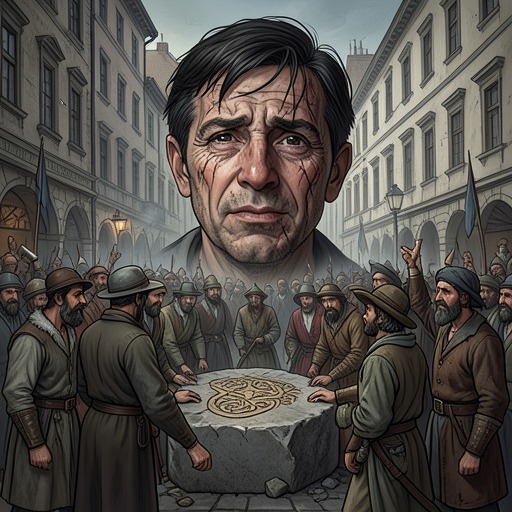
At Georges’s funeral, Mathieu is described as a moustached young man in his early thirties, at least two metres tall, and a lawyer like his father. He approaches Loïc at the reception specifically to ask about the search for the Founder’s origins. His aunt Isabelle D’Anjou has told him about the investigation, so he arrives already aware of its central problem rather than encountering the family history by chance.
The genealogical claim he pursues concerns Élie D’Anjou, whom Mathieu identifies as his ancestor and whose name he carries. Élie was born in the United States in 1842 and adopted by a French-Canadian couple. The historical account Loïc found describes a baby rescued after violence, with a cameo pinned to his swaddling clothes; the child was baptized as Éloi, a name that appears to have shifted in the records to Élie. The adoption and the uncertainty of the name make the family’s documentary trail essential: descent cannot simply be assumed from the surname or tradition.
The DNA Proposal
When Mathieu seeks him out, Loïc explains that his research has reached an impasse. He has considered comparative DNA analysis as the clearest way to establish whether the D’Anjous descend from a French noble family, but obtaining biological samples from the Castelmonts has seemed insurmountable. Mathieu does not treat that obstacle as decisive. As a lawyer, he believes he can make representations directly to the Castelmonts in France, and he is willing to pay for the analysis himself.
Mathieu’s approach gives the inquiry a new advocate and a defined next step. He sees the recovered cameo as a useful advantage in making the case, while Loïc remains doubtful that Charles de Castelmont will cooperate. Loïc has already considered ways around Charles’s opposition and abandoned them, judging that a title from an aristocracy abolished two centuries earlier would offer little beyond vanity. The contrast is telling: Mathieu is ready to pursue formal verification, whereas Loïc questions what the result would change even if it confirmed their descent.
The Letter to Charles de Castelmont
In October 2016, Mathieu acts on his plan. He sends Charles a registered letter proposing comparative DNA analysis and setting out the evidence for the claim that Élie was a Castelmont. He identifies Élie’s American birth in 1842 and subsequent adoption by French Canadians, and presents the cameo attached to the baby’s swaddling clothes as the principal material clue.
The letter is carefully assembled rather than relying on family lore alone. Mathieu includes a copy of the Jesuit account discovered by Régis, Élie’s baptismal record, and a close-up photograph of the cameo said to have been recovered from the rubble in New York City. He also supplies a USB drive containing newer, high-resolution photographs that can be enlarged for inspection. He specifies that the testing could take place in France and, as he had proposed to Loïc, that he would cover the cost.
Charles is furious at the suggestion that he submit to DNA testing, but the documents unsettle him. The photographs make the cameo difficult to dismiss outright, even as close inspection shows that the pictured stone carries a recently imitated scratch. Charles concludes that the D’Anjous have received the same counterfeit cameo that reached him from New York City. Mathieu’s evidence therefore provokes a fresh examination of the claim without settling it: the photographs do not establish that the family possesses the authentic heirloom, and the proposed test is not shown to have taken place.
Unresolved Evidence and Narrative Role
The uncertainty follows Mathieu’s case into the later account of the fire at Barzac Castle. Loïc sees a newspaper photograph of Charles displaying both cameos and wonders whether the Castor stone in the image could be the Founder’s. He knows that Mathieu had not concealed his correspondence with Charles or the latter’s categorical assertion that the D’Anjou cameo was a counterfeit. The photograph thus sharpens, rather than resolves, the discrepancy between the supposed recovery and the claim of forgery.
Mathieu’s importance lies in converting inheritance into a question that can, in principle, be tested. He brings together family memory, an archival account, a baptismal record, photographs, and the authority of legal procedure, while distinguishing a proposed biological test from proof already obtained. His effort also exposes how fragile the case remains: the D’Anjous’ story depends on a foundling’s uncertain identity and an object whose authenticity is disputed. Mathieu pushes the inquiry forward, but the surviving evidence in the narrative leaves the central kinship claim open.