Marie-Louise D’Anjou
SatanMarie-Louise D’Anjou is Guillaume D’Anjou’s wife and the adoptive mother of Loïc, whose life begins amid maternal death, medical uncertainty, and a contested division of family responsibilities. She enters the story not through a claim of blood descent but through the work of receiving and raising a dangerously frail newborn. Later, when Loïc is frightened and exposed during an earthquake, her lap and shawl become the immediate shelter that reunites him with his family.
Arrival and adoption
Marie-Louise arrives with Guillaume at the home of Marie-Ange D’Anjou during the birth that leaves the young mother dying. The household waits anxiously as the doctor struggles in the adjoining room; the radio in the kitchen continues murmuring news while the family listens for word. The scene places Marie-Louise within a family emergency before it establishes her as a parent: she and Guillaume have come together, as relatives, to a house overwhelmed by childbirth and its consequences.
With Marie-Ange dead and the baby’s survival uncertain, the family agrees that Guillaume and his daughter Laurette will take the newborn home so he can receive better care. When they arrive at the Founder’s House, Guillaume gathers his mother, wife, and three daughters and urges them, tearfully, to care for Marie-Ange’s child. Marie-Louise’s place in that appeal is practical and intimate: the infant is to become part of the household whose members have just been asked to protect him.
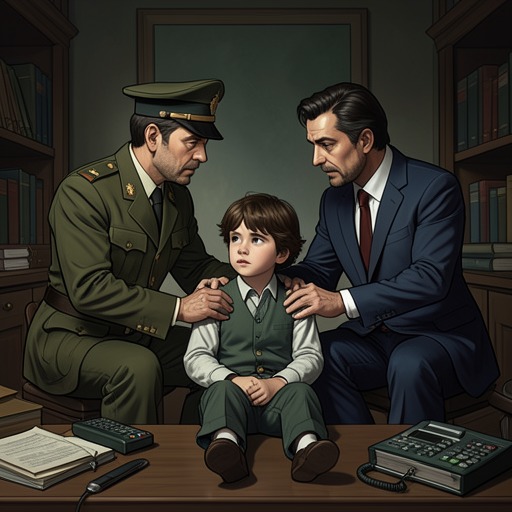
The child is taken promptly to the church for baptism because he appears suspended between life and death. Father Rousseau baptizes him before Guillaume and Marie-Louise, who serve as his godparents. They decide to adopt him with the consent of Alcide Bolduc, the child’s father, and the wider Bolduc family, which takes responsibility for Marie-Ange’s two other children. Adoption here is both a family bond and an arrangement for care: Loïc is raised by the D’Anjous, while his siblings remain with their paternal relatives.
Motherhood amid a custody dispute
The adoption does not erase Loïc’s connection to Alcide. Some days after the arrangement, rumors circulate through Touladi that the boy may change homes and that his father, an aviator, intends to take him back. Loïc hears the claim from his brother and cousins, who regard it as certain. The rumor raises the stakes of Marie-Louise and Guillaume’s parental role: the home that has taken in a vulnerable child may not be able to keep him.
The narration describes tension between the Bolduc and D’Anjou families as the rumor spreads. It does not recount Marie-Louise arguing her case or specify how she responds to the prospect of losing Loïc. Her significance in this conflict is instead established by the relationship already made visible: she is among the parents who adopted him, and the threatened change of household concerns the family that has taken responsibility for his care. The text leaves her private reaction unstated rather than turning her into a spokesperson for the dispute.
Shelter during the earthquake
During the earthquake, Loïc is alone upstairs in the bathroom while the adults’ discussion downstairs has quieted. The tremor shakes the house; startled and panicking, he rushes down the stairs. The scene brings the adoptive family’s earlier promise of care into a brief, physical encounter. At the bottom, everyone is waiting, including the father and mother, the grandmother, the older girls, and the frightened cats. Marie-Louise immediately receives Loïc into her lap, covers him with her shawl, and reassures him.
He is conscious of his nakedness, but fear outweighs his shame. The contrast makes her gesture more than a general response to the earthquake: she offers bodily shelter to a child who feels exposed and overwhelmed. Around them, the adults and children are shaken by the tremor and by rumors that the old house stands above a buried, uncanny past. Marie-Louise’s response remains direct and domestic, a mother taking a frightened child into her arms while the house itself seems to tremble beneath the family.
Family bonds and the limits of the record
Much later, a doctor tells Loïc that another fetus had been present in his mother’s womb and was stillborn. The revelation changes the story of his birth, but the account does not say whether Marie-Louise knew of the second fetus while raising him. Her documented role is therefore anchored in the child who survived: she and Guillaume adopted him, stood as his godparents, and received him into their household when his life was precarious.
Marie-Louise’s characterization is brief and grounded in acts of care rather than in an extended account of her thoughts or independent actions. The adoption connects two powerful Touladi families through a child whose paternity remains consequential; the earthquake scene gives that formal bond its clearest emotional image. The family’s promise is not abstract: in the moment of panic, Marie-Louise’s lap and shawl make a place for Loïc in the home that has become his.