Alcide Bolduc
SatanAlcide Bolduc is Loïc’s biological father, an itinerant pilot whose bereavement and absences shape the child’s divided sense of family. He once entrusted Loïc to Guillaume D’Anjou after Marie-Ange D’Anjou died in childbirth; later, the same decision becomes a source of regret and a struggle over blood, guardianship, and belonging. Alcide’s own life follows a parallel movement: grief drives him from home, flight offers escape, and the northern wilderness finally conceals his fate for more than twenty years.
Identity and Background
Alcide is a pilot and mechanic, but in Touladi he is also known for drinking, hunting, and disappearing into the air or woods. Guillaume, his brother-in-law, regards him as unreliable and fears that he may be drunk when he flies. Alcide’s absences leave his children in Guillaume’s care, while his occasional returns revive the question of whether he will reclaim them. To Loïc, the distinction between the adoptive father on the ground and the biological father in an airplane is difficult to make sense of: each belongs to a different part of the child’s world, and neither relationship simply cancels the other.
Alcide’s connection to the D’Anjou family begins in love. Marie-Ange is the great love of his life, and Guillaume was close enough to him that Alcide chose him as the child’s godfather before the birth. After Marie-Ange dies, Alcide himself designates Guillaume to adopt Loïc. Yet the arrangement he once authorized later feels to him like the surrender of his bloodline to a rival clan. His grief does not resolve into acceptance; it changes form, becoming a claim of fatherhood and a grievance against the family he had once trusted.
Bereavement and Flight
When Alcide reaches the house after Marie-Ange’s death, he is so drunk that he fails to recognize Guillaume and reacts as though he has found an intruder. Once told that his wife is gone, he struggles to comprehend the news. When the situation finally registers, he cries out that her death is his fault. The loss is presented not as a private sorrow that he can contain, but as a force that sends him out of the house and into the dark fields.
He runs blindly past fences, banks, stones, and scraps of wood, crying and swearing until he collapses in a hollow, weeping. His flight turns grief into physical disorientation: unable to remain among the people trying to hold him, he moves through the landscape without knowing where he is going. The following morning, the village prepares Marie-Ange’s body for burial and takes the frail newborn to the D’Anjou home. That separation becomes the foundation of Alcide’s later paternal conflict, even though he had initially appointed Guillaume to care for the child.
Over the following years Alcide does not recover from the loss of his wife or the dispersal of his children. He drinks, feels embittered by his misfortunes, and withdraws from religious practice, attending church only formally while his mother, Élise, continues to pray for him. The narrative connects his anger at those who oppose him to the accumulated weight of bereavement and disappointment. His hostility is therefore both personal and displaced: the argument with Guillaume is charged with years of grief that the immediate dispute cannot explain on its own.
The Custody Conflict in Touladi
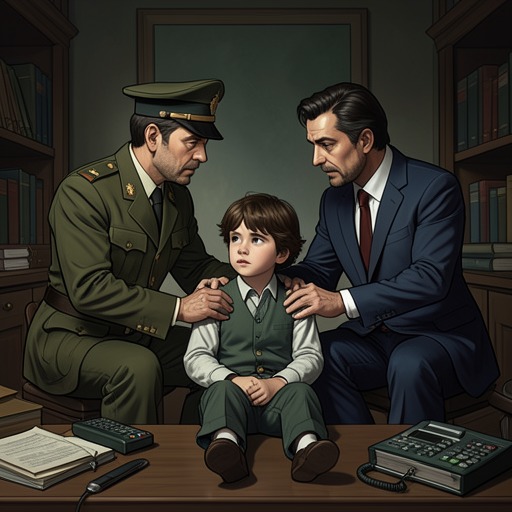
The question of whether Alcide will take his children back recurs whenever he returns to Touladi. Guillaume’s opposition rests on his view that Alcide cannot provide a stable home, given the combination of alcohol, hunting, and flight from responsibility. On one Saturday, Loïc is eager to go up in his father’s airplane. Guillaume offers the child a trip through the forest in his jeep instead, but recognizes the strength of Loïc’s wish and does not press him to choose.
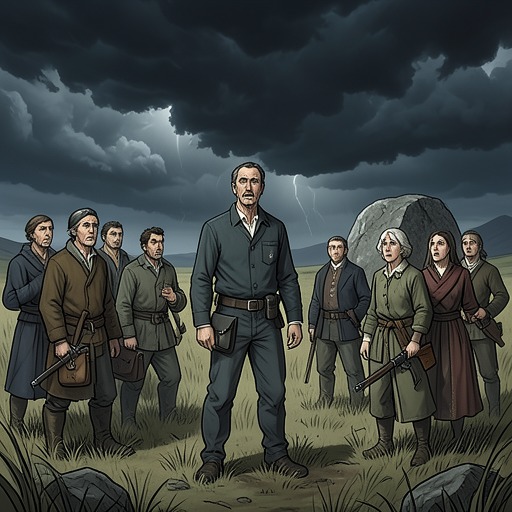
Later that day, Alcide is preparing a bonfire behind his garage with Clément Paquette. Loïc and the other children gather branches and scraps for the fire, and Alcide welcomes their help. The ordinary pleasure of the gathering gives way to a confrontation when Guillaume insists that Loïc must come home because it is getting dark and he has custody. Alcide answers that the child is his son and that he can keep him when he chooses. Guillaume calls Loïc away in a hard, commanding voice; the frightened child runs to him, seeing the severe face and trembling moustache while the rest of the field blurs around them.
The quarrel draws the village into what is at once a family dispute and a contest between powerful local families. Alcide understands the issue as a father’s right by blood, a right he believes will always remain his. He has come to regret entrusting Loïc to the D’Anjous, as though he had given his inheritance to an enemy clan, though the woman he loved was herself a D’Anjou. The dispute over the child’s lateness at the bonfire is only the spark; beneath it lie his resentment, his bereavement, and the years in which he imagined that he would reclaim his children but did not act.
Work in the North and Disappearance
After the confrontation, Alcide leaves for work in the North. Johnny Parent, a flight dispatcher for Hollinger Ungava Transport, had hired him at Mont-Joli in the autumn of 1951. Alcide had first offered his services as a mechanic to the Iron Ore Company of Canada, which was building a railway through northern Quebec and Labrador. His piloting experience soon brought him into the air service operating between Sept-Îles and Schefferville, connecting communities along the railway route.
The work gives him long hours away from Touladi and its domestic losses. He flies over the desolate northern landscape, finding in the job an escape from the deaths, disappointments, and sense of failure that have accumulated at home. In February 1953, he takes a DC-3 from Sept-Îles toward Schefferville with a copilot. The aircraft is loaded with cement bags, mechanical parts, and food supplies. Bad weather is expected in the region; the outbound trip is to be made by day and the return by night. The plane never comes back, and radio contact is lost as it is apparently caught in a storm.
After several weeks of searching, the company reports that the aircraft has disappeared in the frozen North, perhaps having crashed into a remote lake or the ocean. It provides a pension for Alcide’s children, which helps pay for Loïc’s education. For years, Alcide and his copilot remain the subject of conjecture. More than twenty years later, during searches for the Titanic wreck off Newfoundland, the plane’s remains are located on an isolated Labrador peak near the ocean, along with scattered bones belonging to the two men.
Legacy and Narrative Role
Loïc learns of his father’s disappearance while ill with measles, mumps, and jaundice. Confined at home, he imagines Alcide trapped inside the flying machine as it rises, falls, and turns through snow gusts. The boy’s feverish vision gives emotional shape to what the adults cannot yet confirm: his father has vanished into the same sky that had made him seem distant and almost unknowable. The later discovery of the wreck establishes Alcide’s death, but it does not erase the formative uncertainty of those years.
Alcide’s story binds together the novel’s recurring contrasts between earth and sky, custody and kinship, and escape and responsibility. To Loïc, the adoptive father represents solid ground, while the biological father is associated with the airplane and a threatening distance. Alcide is neither simply absent nor wholly relinquished: his return repeatedly unsettles the family arrangement, and his claim to his son persists even after he has left Touladi. His disappearance makes that claim impossible to settle in person, leaving Loïc to grow up with both the material consequence of his father’s absence and the unresolved memory of a man who seemed always to be taking flight.