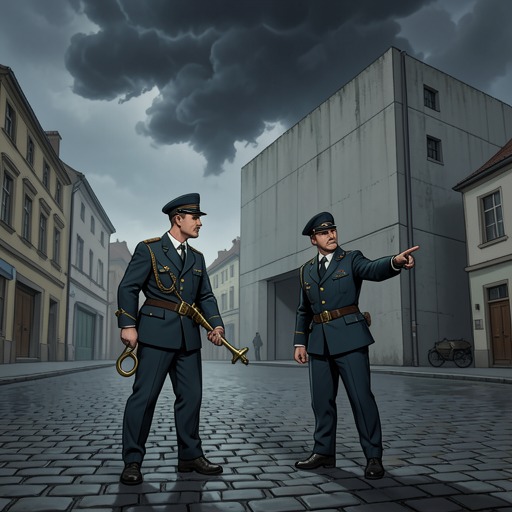
Gilbert Rougeau
SatanGilbert Rougeau is Roland Bolduc’s formidable henchman, a figure whose political force is made visible in two starkly different settings: a barricaded garage where he helps break a Red youth group’s resistance, and the smoking ruins of Grébiche’s home, where he acts as a municipal policeman. His appearances link coercive factional power to the village’s official machinery, without establishing where one role ends and the other begins.
Enforcer for the Blue faction
During the political campaign, Gilbert serves the Blue faction led by Roland Bolduc. When Roland publicly threatens to crush the young Reds who have begun organizing against him, Gilbert laughs and agrees that they will be easy to defeat. The brief exchange presents him not as an independent political voice but as a man who reinforces Roland’s confidence and helps make intimidation sound like a practical certainty.
The threat is not merely rhetorical. Clovis Lacroix, a young teacher organizing Red supporters, is warned that he may lose his job if he continues to involve himself in politics. The pressure comes through the school commission as well as through warnings associated with the priest and Roland; Gilbert’s role belongs to the same atmosphere of local control, though the evidence does not assign him the employment threat itself. His later arrival at the garage shows what the campaign’s menace can become when words give way to force.
The garage assault
On election day, the young militants barricade themselves inside a garage to stop the Blues from getting voters drunk and steering their votes. They intend to cast their ballots late, after Roland’s opportunity for alcohol-fueled manipulation has passed. When Roland withdraws, a truck and an automobile soon arrive carrying his customary strongmen: Gilbert, Conrad Dumais, Émile Meloche, and Alexis Lepage. Roland greets them and leads them to the garage.
The youths have fortified the building with crossed iron bars, a heavy beam, and planks. They have also stacked crates of beer and liquor in front of the large side window, creating a defensive obstacle whose breakage would destroy Roland’s valuable stock. Gilbert knows the small window facing the fields, the opening the defenders overlooked. He breaks its glass and climbs inside; the other men follow, and Roland enters as well. The young Reds are trapped without time to make an exit, and the encounter turns into a brawl.
Clovis, pushed violently, surges into the fight with accumulated anger against the Bolducs’ domination of the village. When Roland calls for him to be beaten, Clovis charges and knocks Roland headfirst against a large grindstone. Roland collapses unconscious, blood running from his head, and the sudden apparent possibility that he is dead halts the struggle. Dumais takes up an iron bar, the young militants flee, and Clovis leaves with them in a stunned state. Gilbert is part of the force that has entered the garage, but the account does not specify his individual blows or what he does after Roland falls. The scene’s consequence is nevertheless decisive for Clovis, who senses that the collision has changed the course of his life.
Policeman at Grébiche’s burning home
In a separate episode, Gilbert appears not as an arriving enforcer but as the municipal policeman. Before dawn, a fierce fire consumes Grébiche’s cabin and adjoining shed. Neighbours reach the scene with buckets, but the blaze is too intense for them to approach safely. Gilbert arrives in a truck with two other men, hoses, and a pump. He orders the onlookers away and marks out a perimeter with stakes while his companions hurry to douse the flames.
As daylight reveals the charred remains, Gilbert and the two men enter the smoking debris. The crowd, held back at a distance, tries to watch them search. After concentrating on one spot and rummaging there, the men fetch a wooden chest and appear to place things inside it. The observers can only infer what has happened: the group quickly carries the chest back to the truck, leaves one man to guard the site, and drives toward the village. The account does not identify the objects collected or establish Grébiche’s fate from what is found.
Power and ambiguity
Gilbert’s two appearances give him a structural role rather than a developed private history. At the garage, his familiarity with the overlooked window helps the Blue faction penetrate a makeshift stronghold; at the fire, his authority to exclude witnesses and control the ruins gives him command of the scene’s boundary and of the information the crowd can see. The contrast is pointed: in one episode he helps force entry, while in the other he restricts everyone else’s access.
The narrative does not explain his motives, inner life, or the contents of the chest. It instead makes his physical presence and practical authority legible through action: a laughing ally behind Roland’s threats, one of the men entering a room full of barricaded opponents, and the policeman managing a suspiciously consequential search after a devastating fire. Gilbert remains a minor character, but his repeated proximity to force and restricted knowledge ties the village’s political intimidation to its uneasy public order.