Pierre Elliott Trudeau
SatanPierre Elliott Trudeau is depicted as a forceful federal prime minister whose response to Quebec sovereignty is shadowed by political memory and personal contradiction. In 1976, as the Parti Québécois won power, he had to acknowledge a sovereignist government’s democratic legitimacy even as he and his closest advisers regarded its program as a grave challenge to Canada. The novel makes that conflict visible not only in the government’s crisis rooms but in Trudeau’s own history, and in the divided allegiance of the speechwriter Loïc and Trudeau’s adviser Régis D’Anjou.
Political identity and federal authority
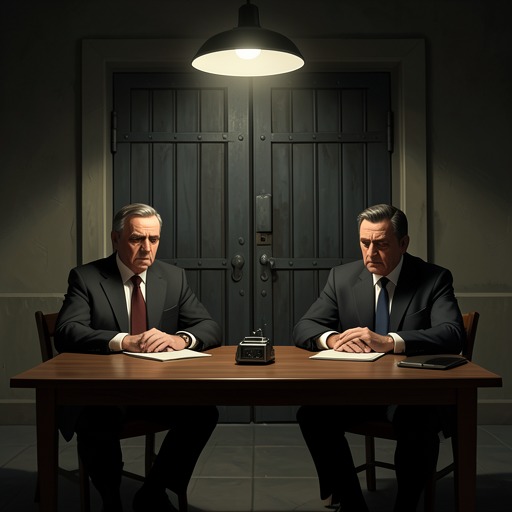
Trudeau appears at the center of Ottawa’s response to a provincial election that federal political circles had scarcely anticipated. A poll had recently put Quebec independence supporters near half the vote, and the prospect of a Parti Québécois victory unsettled the prime minister’s advisers and the broader federal establishment. As the result became increasingly clear, Trudeau gathered his senior advisers to discuss what the government should say if the sovereignists prevailed.
Régis had spent the weekend preparing possible statements. After joining the meeting, he returned to Loïc visibly agitated, saying he had opposed what he called the soft line. He described the Parti Québécois program as treasonous, a view Trudeau endorsed. Yet Trudeau also assigned Régis and Loïc to write a telegram for the event of a PQ victory. Its wording had to avoid both barbs and congratulations: it would simply recognize that a sovereignist government had been elected legitimately. The contrast defines Trudeau’s position in the episode. His government would resist the political meaning of sovereignty, but it would not deny the authority conferred by the vote.
The 1976 election and its aftermath
As election night wore on, anxiety spread through the prime minister’s office. Staff watched the results, while Loïc tried to avoid conversations that might expose his sympathies. The decisive emotional break came when René Lévesque addressed jubilant supporters at the Centre Paul-Sauvé in Montréal. For Loïc, the celebration made plain that he no longer shared the collective identification felt by many young Quebecers. The novel places Trudeau’s government on the other side of that newly visible divide: its response was composed in a building full of people whose own families and loyalties crossed the federal–Quebec fault line.
The atmosphere in Ottawa grew confused and strained. Trudeau himself momentarily lost verbal control in front of journalists, saying that he would continue to preach separatism in Quebec before correcting himself and calling it an error. The narrative connects the slip to an earlier, less familiar political self: Trudeau as a student at Brébeuf who had imagined an independent Quebec republic. That suggestion does not erase his later federalism; instead, it turns the lapse into a brief return of a possibility his public role had apparently left behind. The past, the passage observes, remains active behind the scenes of the present.
Trudeau proceeded to Parliament amid the unsettled mood, appearing markedly darker and more severe than the buoyant political celebrity associated with his 1968 election. The contrast between that earlier image and his bearing on the night of the PQ victory makes the election more than a change of government: it forces the federal leader to confront a national division that his public authority cannot simply dissolve.
The October Crisis and Loïc’s divided allegiance
Trudeau’s role in the 1976 crisis recalls the October Crisis, only five years earlier. As a university student, Loïc had protested Trudeau’s imposition of emergency measures, the deployment of heavily armed soldiers on Montréal’s streets, and the imprisonment of hundreds of intellectuals and writers. The government had taken those steps to counter a small group of militants who had kidnapped a diplomat and a minister. Loïc’s memories of the period include fervent student meetings and a politically charged youth; they explain why accepting Régis’s offer to work in Trudeau’s office had required painful hesitation.
That history gives Loïc’s work on the election-night statement an unusual weight. He is now helping the same prime minister whose earlier actions he had opposed, while his cousin Régis regards Quebec separatism as a betrayal and Loïc privately sees the possibility of independence differently. Their disagreement remains largely unspoken, but the election makes the silence increasingly difficult to sustain. Trudeau’s administration thus becomes the setting in which political loyalty is also intimate conflict: the two men serve the same leader while interpreting the country’s future in incompatible ways.
Private contradictions and narrative significance
The account also presents Trudeau’s marital troubles as a parallel, though not identical, crisis. His relationship with Mary was under strain, with their disagreement over her failure to learn French described as one important point of conflict. Loïc was approached about giving her French lessons, but Mary had little interest in pursuing that course and had instead left with the Rolling Stones and other figures from the entertainment world. Trudeau is consequently shown confronting a personal rupture alongside the national one. The narrative reads the pairing as an emblem of Canada’s contradictions, without suggesting that the private marriage and the constitutional conflict are the same problem.
The passage further depicts Ottawa gossip about Trudeau’s romantic pursuits, including young women who asked Loïc to introduce them to the prime minister. This material is presented as part of the courtly atmosphere around political power, rather than as a settled account of each reported encounter. More broadly, the novel frames Trudeau as an idealist whose choices have aligned him with the stronger Anglo-Saxon imperial order. It points to his studies in the United States and England and his selection as a Rhodes Scholar, interpreting these affiliations as evidence of lasting political allegiance. His October 1970 warning, “Watch me,” gains a retrospective edge in that account: it belongs to a leader confident in his ability to prevail, even as the 1976 election exposes the limits and costs of federal power.
Trudeau’s narrative function is therefore deliberately double. He is the governing authority tasked with recognizing a democratic result he opposes, but also a figure whose earlier attraction to Quebec independence complicates any simple division between federalist and separatist. His verbal slip, Loïc’s conflicted service, and the simultaneous political and marital strains all make public identity appear less settled than its formal roles suggest. The election-night response is an exercise in institutional restraint; around it, the novel reveals how much history, private fracture, and suppressed allegiance that restraint must contain.