Rávaṇ
RamayanaRávaṇ is the feared king of Lanká and the central adversary in the conflict that follows his seizure of Sítá. His story turns on a stark reversal: a ruler identified with formidable power and vast forces is eventually killed by Ráma, whose army crosses the sea to reach Lanká. Rávaṇ’s death ends his rule, while Vibhíshaṇ is left to govern the kingdom he had held.
Identity and Royal Power
The poem introduces Rávaṇ through the language of fear and kingship. He is a dreaded warrior and a king whose name carries terror; these descriptions establish his reputation before the final encounter shows the cost of challenging him. His authority is not presented as merely personal strength. The passages also evoke a royal world of armies, intelligence, war, and peace: secret spies report what is happening in foreign lands and at home. That wider picture suggests the political reach surrounding a ruler such as Rávaṇ, though the passage does not assign every detail of the spy network to him individually.
His forces are a defining measure of his power. When Rávaṇ learns that Ráma has killed his giant crew, the news reaches him as a decisive shock in the conflict. The poem repeatedly pairs the king with his legions, making the opposition larger than a single combat between two champions. His command stands behind a host whose slaughter signals that the struggle has become a war of attrition, not simply a private contest.
Sítá’s Abduction and the Making of the Conflict
The account connects Rávaṇ’s seizure of Sítá with Márícha’s magic. The deception draws the princely youths apart; in their absence, a vulture is killed and Ráma’s wife is carried away. The compressed sequence links Rávaṇ’s action to an engineered separation and to the vulnerability created by that separation. It also gives the conflict a personal center: the war that reaches Lanká begins with Sítá taken from Ráma.
The poem does not need to rehearse the abduction each time it describes the coming battle. Instead, it lets the consequences gather across the narrative. Ráma’s alliance with Sugríva provides a means to pursue the struggle, and the promise of that alliance is cast in terms of Rávaṇ’s defeat and Sítá’s recovery. Another passage registers how formidable the task appears: Rávaṇ seems a foe difficult to overthrow. Against that estimate, a prediction that Ráma will slay him and regain Sítá turns the rescue into both a personal objective and the anticipated resolution of the larger conflict.
War and the Reach of Lanká
The route to Rávaṇ’s defeat is marked by distance and collective effort. Ráma and his allies cross the narrow sea from shore to shore and reach Lanká, the golden city. The crossing is a hinge in the narrative: the conflict that began with an abduction in the forest is carried into the king’s own domain. Rávaṇ is no longer only the absent author of a wrong; he becomes the ruler whose city and forces stand in the path of Sítá’s return.
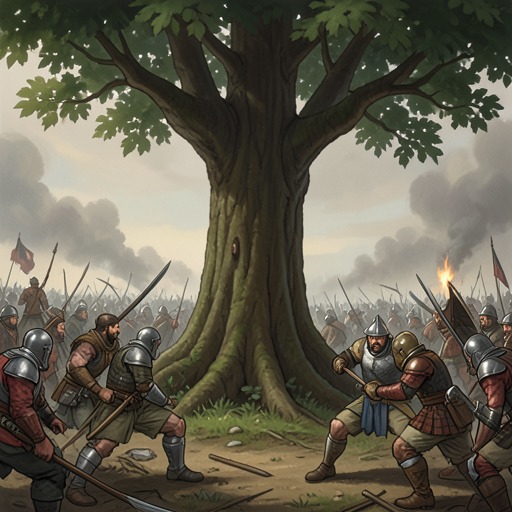
The war’s scale is made visible through images of bodily ruin. In the canto that places Rávaṇ in the field, the plain is spread with bleeding limbs and heaps of the dying and dead. The description makes the king’s presence inseparable from the destructive landscape around him. Later, the fighting is said to continue through the hours of night and day without pause. These details do not reduce the conflict to an effortless triumph for Ráma: the prolonged battle and the field of casualties show what it takes to bring the campaign to its conclusion.
Death and the Transfer of Rule
The poem names Rávaṇ’s death as the decisive outcome of the battle. At the culmination of the fighting, Mátali speaks to Ráma about the arms that will decide the day; the episode’s structure directs attention to the final contest and its resolution. Ráma’s hand strikes Rávaṇ down. The brevity of that outcome contrasts with the extended war that precedes it: the king whose name inspired fear is overcome, and Lanká’s struggle is transformed into a question of succession.
Rávaṇ’s death is followed not by an empty throne but by a transfer of authority. Vibhíshaṇ sees his brother slain and cannot contain his grief; he is nevertheless left to reign over the domain that had belonged to Rávaṇ. The succession binds political consequence to personal loss. The new ruler’s lament does not erase the fact of his accession, and the kingdom passes from one brother to the other in the immediate aftermath of the killing.
Mandodarí’s lament gives the death a further human consequence. Her grief places Rávaṇ’s fall within the household as well as the battlefield, while the language of fate frames his end as an outcome no one can bend. The paired responses of Vibhíshaṇ and Mandodarí keep the victory from appearing emotionally simple: the enemy king is dead, but his death is also a brother’s bereavement and a wife’s loss.
Narrative Role
Rávaṇ’s characterization is built through contrasts between reputation and outcome, royal reach and personal vulnerability, and a vast army and the single blow that ends his life. The narrative first makes him formidable through the fear attached to his name and the size of his forces; it then traces the consequences of his taking Sítá to a war fought across the sea. His defeat resolves Ráma’s pursuit and makes the recovery of Sítá possible, while Vibhíshaṇ’s accession gives the battle a political aftermath. The laments that follow prevent that resolution from being merely triumphant: Rávaṇ’s fall closes his rule, but it leaves grief in the family that survives him.