Sugríva
RamayanaSugríva’s arc joins the experience of a ruler driven from power to that of a steadfast ally who fights beside Ráma. Introduced through the friendship formed at Pampá, he gives voice to the grievance that binds him to Ráma: Báli’s might has dispossessed and humiliated him. Later he appears as a king who assigns work to the Vánar chiefs, confronts an enemy in battle, and remains true to the bond Ráma praises at the war’s close.
Identity and Background
The poem places Sugríva among the Vánar leaders and identifies him as the child of the Sun. In the same account of the leaders’ origins, Báli is named as the child of Indra. Their contrasting divine parentage accompanies a story shaped by their conflict as brothers, but Sugríva’s own account emphasizes earthly consequences: he has lost power and bears the injuries of that loss.
Sugríva enters Ráma’s story after Ráma reaches Pampá on the counsel of Shabari. There he wins the steadfast friendship of Hanuman, the Wind God’s son. Hanuman then counsels him to tell his grief to Sugríva, chief of the Vánars. Sugríva’s first importance is therefore relational: before he acts as a king or warrior, he becomes the person to whom Ráma can disclose his sorrow, and whose own suffering gives the two leaders common ground.
Dispossession and Ráma’s Grief
Sugríva describes himself as oppressed by Báli’s conquering might and dispossessed of both power and kingship. He also says he has been loaded with taunts of scorn and hate. The account makes his conflict more than a change in political fortune: the loss of authority is accompanied by public degradation. His words give the dispossessed brother a hearing, setting out the injury in his own voice rather than leaving it as an unexplained background to the alliance.
The poem frames this exchange alongside Ráma’s grief. Sugríva uses gentle speech to soothe the mourner, and Ráma’s sorrow is not the only suffering disclosed in their meeting: Sugríva later explains the cause of the strife with Báli. Their exchange thus moves between comfort and testimony. Sugríva offers consolation, then tells the story of his own dispossession; the bond between them rests on reciprocal recognition rather than on one man’s need alone.
A King Who Assigns and Fights
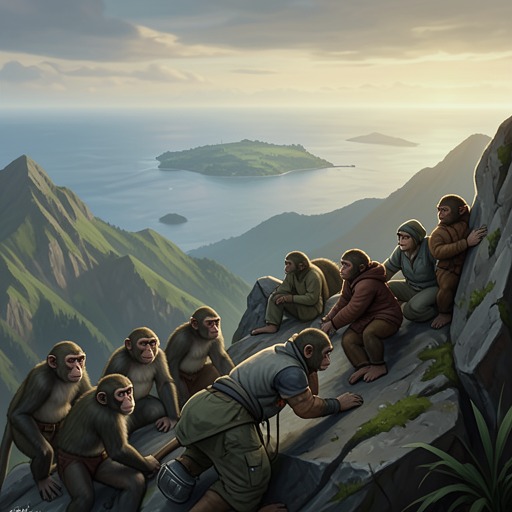
Sugríva’s later appearances show him exercising authority among the Vánars. After assigning tasks, he dismisses the princely leaders with gracious speech, and they depart to carry out their appointed work. The brief scene presents kingship as organization and delegation: the chiefs have distinct tasks, while Sugríva’s role is to direct them and send them on their way.
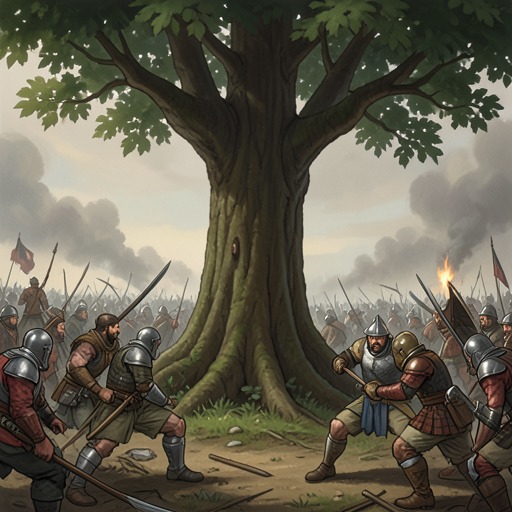
In the fighting at Lanka, his authority is also tested in direct combat. When the chiefs clash in the open field, Angad falls and Dwivid reels. Sugríva sees what is happening and, impelled by rage, crushes the bow held by Kumbha. The action is specific and forceful: rather than remaining apart from the struggle he oversees, Sugríva intervenes against an armed opponent when his fellow leaders are in danger.
The battle account also identifies him as a king when he runs to meet the foe and hurls an uprooted hill, with its trees, as a weapon. These physical acts make his leadership visible on the field. His position among the Vánars is not expressed only through commands or titles; he joins the contest, using overwhelming force against the enemy and responding to the fortunes of the chiefs around him.
Friendship and the Closing Arc
At the war’s end, Ráma throws his arms around Sugríva in rapture and looks with joy and pride upon the Vánar host. The embrace gives personal form to the alliance that began at Pampá. The closing recognition is not simply a reward for Sugríva’s presence in battle: Ráma calls him true to friendship’s bond and duty’s call, bringing together private loyalty and public service in a single judgment.
Ráma then urges Sugríva and his train to leave Lanka’s shore and return to Kishkindhá. The movement homeward completes the arc established by Sugríva’s account of being dispossessed: the man who spoke of lost kingship is addressed at the end as a king, honored for his fidelity and sent back with his people. The poem’s portrait therefore holds together two forms of strength—the force with which Sugríva meets an enemy and the constancy with which he keeps faith with an ally. His importance lies in both: he brings his own grievance into the story, then becomes a leader whose friendship is remembered as an obligation fulfilled.