Nala
RamayanaNala is a Vánara chief, the son of Viśvakarmá, and the builder entrusted with the bridge that carries Ráma’s forces across the sea to Lanká. His importance rests on the meeting of inherited skill and collective need: when the Ocean King identifies him as the one able to build the crossing, Nala turns that assurance into a structure a hundred leagues long. The poem later places him among the warriors fighting for Ráma, making him both the maker of the route into the war and one of its participants.
Identity and Background
Nala’s lineage is stated directly: he is the son of Viśvakarmá. The account associates his ability with his father’s skill, while describing Nala himself as divinely taught and accomplished. A separate passage calls him a mighty Vánara, and the Ocean King’s speech identifies his birth within the Vánara people. These details establish a character whose specialized craft belongs within the epic’s larger community of Vánara chiefs, rather than setting him apart from it.
The poem offers little personal history beyond this lineage, rank, and capacity. It does not develop Nala’s childhood, private motives, or life apart from the expedition and battle. Instead, it introduces him in relation to a task that no other figure in the supplied passages is asked to perform: making a passage across the sea. His identity is therefore defined less by an extended personal arc than by the particular ability that becomes essential to Ráma’s campaign.
The Bridge to Lanká
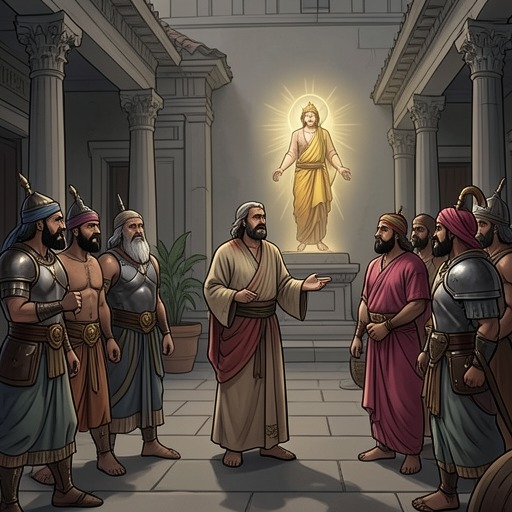
The bridge episode begins with the Ocean King addressing Ráma. He names Nala as Viśvakarmá’s son and says that Nala, divinely taught and skilled, can build a bridge across the sea. Nala then accepts the work, declaring that he will lay a bridge over the deep waters where monsters play. The exchange gives the construction both a source of authority and a human agent: the Ocean King identifies the means, but Nala undertakes the making.
The scale of the result is explicit. The bridge is described as a hundred leagues in length, and the account links its construction to the sea’s violent movement as mountains fall into it. Huge rocks are bound fast in the structure. These details frame the bridge not as a small crossing or a temporary device, but as a vast work that changes the conditions of the journey. The engineering is narrated through weight, distance, and the response of the ocean itself.
A briefer earlier passage likewise credits Nala with throwing a bridge from shore to shore across the narrow sea, after which the forces cross to Lanká’s golden town. Read alongside the fuller account, this recalls the decisive sequence in compressed form: Nala constructs the connection, and the crossing makes the approach to the enemy’s city possible. The bridge’s importance is practical as well as symbolic. It converts a natural barrier into a route for the expedition and gives the assembled army access to the place where the conflict will be fought.
Nala in the War
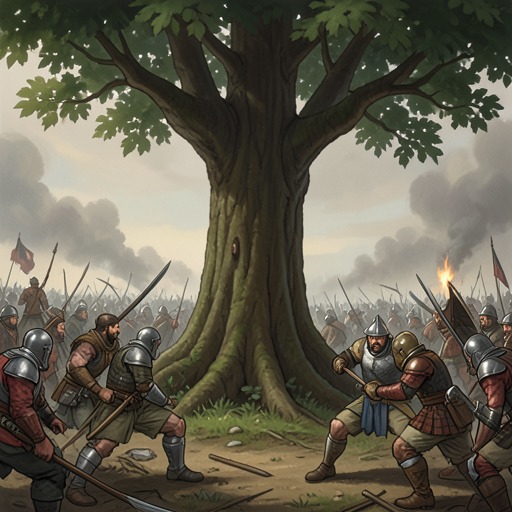
Nala does not disappear from the narrative after the bridge is built. In a battle scene, he stands behind Ráma, equipped for war and surrounded by armed bands. The placement keeps his earlier work in view without reducing him to it: the builder is also one of the chiefs present in the fighting. His service to Ráma thus spans two different demands of the campaign, first enabling passage and then joining the armed force that has crossed.
Another scene records Nala and Susheṇ seeing Sugríva fall. The passage groups them as witnesses to the king’s collapse, while other Vánara chiefs hear the call and charge forward. Nala’s part in this moment is specific but limited: he sees Sugríva fall. The text does not, in the supplied lines, give him a separate speech or describe an individual rescue. Even so, his presence ties him to the army’s immediate response to danger around its leader.
Later, Rávaṇ calls out to Nala, Nila, and other Vánara chiefs, urging them not to abandon their courage. The address places Nala among recognized opponents whom the enemy king confronts by name. It also forms a contrast with the bridge episode: there, Nala’s skill is acknowledged by the Ocean King and directed toward a shared purpose; here, his presence is registered by the opposing commander amid the struggle. Nala is not merely background labor but a named participant in the conflict.
Battle Aftermath and Narrative Significance
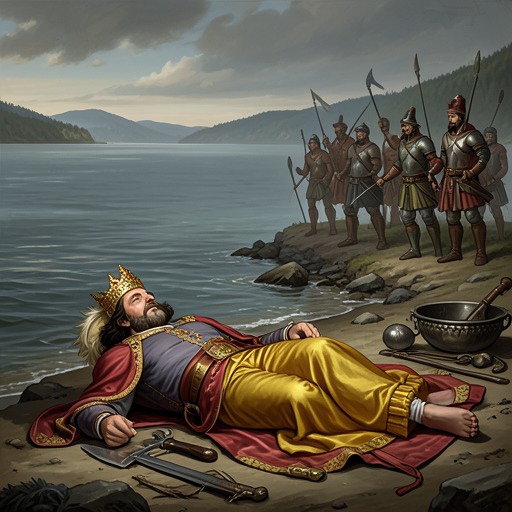
A later battlefield passage places Nala lying in the dust alongside other prominent Vánara warriors. The image belongs to a scene that surveys the fallen across the field, and it gives his wartime role a grave counterweight to the bridge’s achievement. The supplied evidence does not establish Nala’s ultimate fate beyond this appearance, so the scene should not be treated as a definitive account of his death or recovery.
The poem’s lists and indexes reinforce his status as one of the expedition’s notable chiefs. Nala appears in an enumeration of the Vánara leaders and is indexed at several points across the work. Those references confirm recurrence, but do not supply further biographical detail. Taken together, the evidence gives him a sharply defined narrative profile: lineage from Viśvakarmá, exceptional competence as a builder, leadership among the Vánaras, and a place in the fighting at Lanká.
Nala’s bridge also gives his role a structural importance within the campaign. Before it is built, the sea separates Ráma’s force from Lanká; after it is built, the army can cross. The work does not resolve the war by itself, and Nala is not presented as its sole warrior or strategist. Its consequence is more concrete: it makes the next stage possible. In that way, the poem links craft to collective action, giving a builder’s skill a place within the same campaign as the chiefs who fight on the far shore.