Lava
RamayanaLava is the son of Sítá and Ráma, born alongside his twin brother Kuśa after Sítá has been banished from the royal household. Raised at Válmíki’s hermitage, he is trained by the sage to recite the Ramayana. The boys’ performance brings their unknown identity before Ráma: hearing them recount his own deeds at the Aśvamedha, he asks about their history and recognizes them as his sons. Lava’s role is brief but consequential, linking Sítá’s life in exile to Ráma’s public and familial reckoning.
Birth and Upbringing
After Ráma abandons Sítá because of what the people say, she is received with honour by Válmíki. The women of the hermitage are charged with caring for her, and in this retreat she gives birth to two boys. A poetic account marks the birth as occurring that very night, describing the children as royal and divinely fair. Their arrival gives Sítá a life and responsibility beyond the immediate grief of her banishment, though the text does not give Lava a separate birth scene or distinguish his circumstances from Kuśa’s.
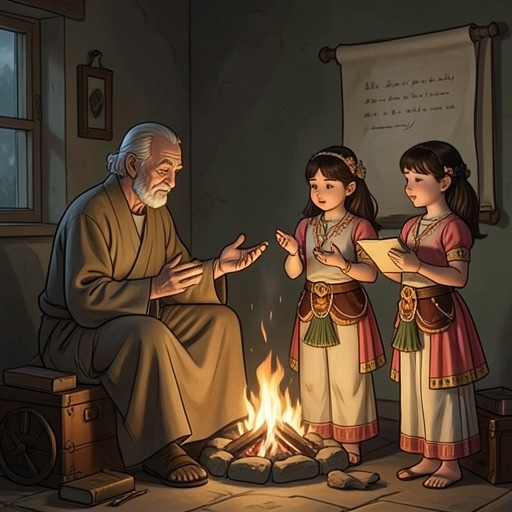
Válmíki performs the boys’ holy rites and brings them up with care. He also teaches them himself to recite the Ramayana. Lava’s early identity is therefore presented through two linked forms of inheritance: he is Ráma’s son by birth, but his first place in the narrative is as a pupil in Válmíki’s hermitage. The account provides no separate description of his appearance, temperament, or individual education; upbringing and instruction belong to the twins together.
The Ramayana Recitation
The boys’ defining public act comes when Ráma decides to hold the Aśvamedha, the Sacrifice of the Steed. Válmíki attends the ceremony with his two young pupils, who are not yet known to the assembly as Ráma’s children. There, Lava and Kuśa recite the poem that recounts Ráma’s deeds before the father whose story it tells. The performance places the exiled household’s history inside a royal ritual: the sons carry that history into the very public setting where Ráma is exercising kingship.
The scene makes recitation more than a display of training. Lava’s part in the performance brings an account of Ráma’s life to Ráma himself, while preserving the boys’ identity as a question rather than announcing it in advance. The father is delighted by the poem, but the reciters remain unknown princes until he asks about their history. Thus the narrative moves from hearing to inquiry, and from inquiry to recognition. Lava’s importance here lies not in an independent speech or deed recorded for him alone, but in his place within the paired performance that makes recognition possible.
Recognition and Family Consequences
Ráma’s inquiry establishes that the two young reciters are his sons. Their appearance at the sacrifice brings together a family separated by Sítá’s banishment: the children raised away from the royal household are now acknowledged by their father in a public ceremonial setting. The episode gives Lava a decisive relation to the larger story without supplying a further individual adventure. He is both a pupil formed in Válmíki’s refuge and a son whose recitation returns Ráma’s own past to him.
After the recognition, Sítá is invited to return and affirm her innocence before the assembly. She cannot bring herself to submit to this second ordeal. She swears that she has never, even in thought, turned from Ráma, and calls upon the Earth goddess to grant her refuge. The Earth opens, a divine throne rises, and Sítá descends with the goddess. This ending makes the boys’ recognition coincide with their mother’s final departure from the human gathering. The account does not specify Lava’s response or describe his later life, so his place in this conclusion is defined by family circumstance rather than by an action attributed to him.
Narrative Role
Lava’s story is shaped by a compact sequence: birth in exile, upbringing and instruction at the hermitage, recitation at the sacrifice, and recognition by Ráma. The sequence gives the child a structural role in bringing separated parts of the family story together. The Ramayana, learned under Válmíki’s care, becomes the means by which Ráma encounters both his own narrated history and the sons he did not raise.
The text consistently presents Lava alongside Kuśa and does not assign him a distinct portion of the recitation or a separate characteristic. His significance therefore rests on the twin pair’s shared actions and on the contrast those actions create: raised beyond the royal household, they enter its central ceremony through the poem of Ráma’s life. Lava is not given a later individual fate in the available account; the last clearly specified developments for him are the recognition of his parentage and Sítá’s departure into the Earth.