Válmíki
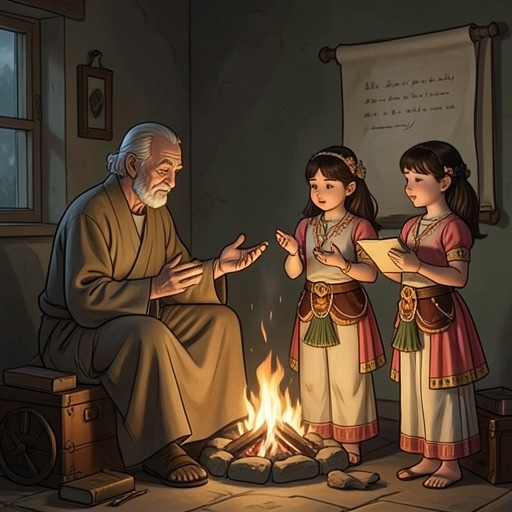
RamayanaVálmíki is presented as both an ascetic sage and the poet who gives the story of Ráma its form. The poem joins his devotion to scripture and ascetic practice with a particular poetic origin: a verse born in grief becomes the meter he chooses for his composition.
Identity and Vocation
The invocation praises Válmíki as a saintly hermit and as a poet whose song rises to the highest reaches of poetry. It calls him the first and best of hermit saints, describing his constant care and chief delight as scripture and ascetic rite. His authority therefore rests in two linked disciplines: the religious life of the hermitage and the shaping of song.
The poem also presents him as a singer of Ráma’s deeds, figured as an inexhaustible sea of nectar. This praise places the subject of his composition at the center of his poetic vocation: his reverence for Ráma is expressed through the act of telling and singing Ráma’s story.
The Charge to Tell Ráma’s Story
Válmíki is addressed as a seer and asked to relate the life of Ráma, specifically the tale that Nárada told. The passage thus frames his work as both composition and transmission: the story comes to him through Nárada, while Válmíki is called upon to render it as poetry. The poem does not reduce his role to a passive retelling, since it later emphasizes his choice of the measure in which the story will be composed.
The Origin of the Poetic Measure
The account connects the formation of the poem’s meter to a verse that bursts forth spontaneously from Válmíki in grief. Those who repeat it marvel at its balanced, four-lined form and recognize it as a Śloka (poetic meter). The scene makes a moment of sorrow the source of an enduring poetic structure: an immediate utterance becomes a form that can be repeated.
Válmíki then chooses that measure for his story. The transition from spontaneous verse to deliberate composition defines his creative role: he takes a form discovered in an outpouring of grief and makes it the vehicle for narrating Ráma’s life. The poem’s account of its own poetic beginnings therefore binds the sage’s ascetic stature, emotional response, and authorship into a single portrait.