Vánar Host
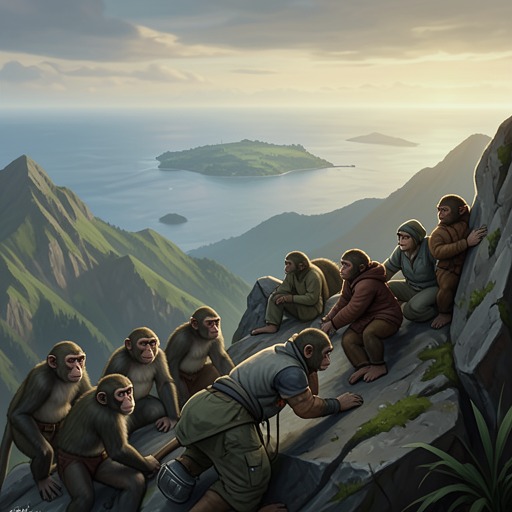
RamayanaThe Vánar Host is an immense company of beings in monkey forms, presented both as a divinely created force and as a body organized under woodland leaders. Its narrative importance lies in the movement from origin to mobilization: a host first described as a creation of the Devas becomes part of the political and military world around Sugríva, where friendship, kingship, envoys, and intelligence make collective action possible.
Origin and Constitution
The account places the Vánar Host’s creation in the wake of Vishṇu’s descent to earth to be born as a son of a great king. The passage then turns to the creation of allies: the Devas obey a high command and produce beings in the thousands. Their defining form is that of monkeys, but they are also described as able to change shape at will, making the host both a numerous population and a company marked by extraordinary powers.
The host is not presented as an ordinary troop assembled by a human ruler. Its beginnings are cosmic: the Devas create it, and its members possess strength beyond ordinary measure. The description stresses their scale as well as their capacity, moving from thousands of powerful individuals to woodland chieftains who swarm in still greater numbers. This origin gives the host a mythic dimension before it enters the narrative’s political and military organization.
Among the leaders named in the account, Báli is identified as the son of Indra and as a figure associated with the woodland hosts. His divine parentage connects the leadership of the host to the same supernatural order responsible for its creation. The text also distinguishes honored chieftains from the mass of the host, suggesting a layered company rather than an entirely anonymous crowd. It does not, however, provide a complete roster or a formal structure for all its leaders.
Friendship, Kingship, and Mobilization
The host’s later narrative setting is prepared by Ráma’s arrival at Pampá. After receiving the counsel of a saintly hermitess, Ráma comes to the lake and gains the steadfast friendship of Hanumán, the son of the Wind-God. This moment supplies a personal connection between Ráma and the Vánar world: the alliance begins through friendship with Hanumán, rather than through a direct encounter with the host as a whole.
The political setting changes when Báli is slain. Ráma then tells Sugríva to reign in Báli’s place, and the newly installed king sends swift envoys east, west, south, and north. The directional sweep makes the search a coordinated undertaking extending across the quarters, while the envoys show that Sugríva’s authority can be put into motion through messengers. The passage emphasizes the breadth and speed of the dispatch, not the individual routes or the outcome of each mission.
A later account describes the gathering of the hosts into one body, alongside the sending of spies and the identification of the regions to be watched. Together, these details distinguish mobilization from mere numerical strength. The host is brought together, while information is gathered and attention is directed across territories. The narrative thus associates its collective power with coordination: the king’s command, messengers moving outward, forces assembling, and spies supplying timely knowledge.
Leadership and Intelligence
The account’s references to secret spies place intelligence within the wider practice of rule and war. Those spies allow rulers to learn what is happening both in foreign lands and in their own, and even what people may do next. The text describes this as knowledge gained in time, making information an instrument of preparation rather than simply a report after events have occurred. In the passage about the Vánar Host, the gathering of forces and the dispatch of spies appear together, linking military concentration with awareness of the regions involved.
This combination gives the host a political dimension as well as a martial one. Sugríva’s succession after Báli’s death is followed by outward-moving envoys; the later gathering of the hosts is paired with surveillance and regional direction. The evidence does not specify the host’s internal ranks beyond its leaders and chieftains, nor does it assign every intelligence task to a particular member. It does show that the host’s place in the story depends on organization under royal authority, not only on its immense numbers or individual strength.
Narrative Significance
The Vánar Host brings together two scales of the narrative. Its origin is told through divine creation, thousands of extraordinary beings, and celebrated woodland chiefs; its later role emerges through the more practical acts of friendship, succession, dispatch, assembly, and intelligence. The contrast makes the host both a mythic company and a force that can be directed within a political order.
The surviving descriptions repeatedly emphasize abundance and movement: multitudes are created, chieftains form and swarm, envoys hurry in all directions, and hosts gather together. Those details establish the scale of the Vánar Host without reducing it to sheer numbers. Its leaders, its connection to Sugríva’s kingship, and the use of messengers and spies show how that scale becomes consequential in the narrative.