Khara
RamayanaKhara is Rávaṇ’s gigantic brother and the ruler associated with Janasthán. His fierce persecution of the hermits living there places him in direct opposition to Ráma, whose home in the sacred forest shade draws the demons’ particular hostility. Khara’s death at Ráma’s hands ends his local power: the poem describes Janasthán, once the seat of his royal state, as desolate. His defeat also becomes a recurring measure of what can happen to those who confront Ráma.
Identity and Authority
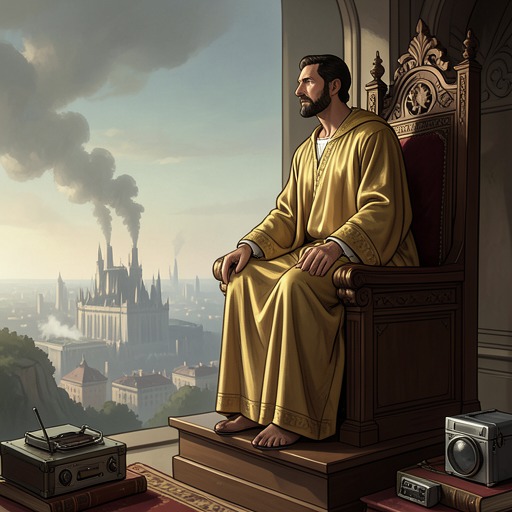
Khara is introduced as Rávaṇ’s brother, a figure of immense size and fierce temperament. The account associates him with Janasthán not merely as a raider passing through the forest but as a ruler: after his death, the place is remembered as the seat of his royal state. That phrasing gives his violence a political setting. He commands a stronghold and a force, and the harm inflicted on the hermits is bound up with the power he exercises there.
The poem’s description makes cruelty central to his public character. The hermits say that he vexes the inhabitants of Janasthán with furious, relentless deeds, and that he bears special hatred toward Ráma. They connect this hostility to Ráma’s having made his home in the holy shade. The danger is therefore not presented as an abstract threat from the forest: it is a persecution carried out by a local ruler against the ascetics, intensified by the arrival of a protector whom Khara particularly opposes.
Conflict in Janasthán
Khara’s military role comes into view when Shurpanakha flees to Janasthán and finds him there with the chieftains of his force. Her arrival places him within the wider conflict surrounding Ráma, while his presence among the commanders establishes that he has an organized body of warriors at his disposal. In a later exchange, Khara addresses Dushana, identified as the leader of his armies, and orders him to summon fighters from the host of giants. Khara thus acts through a subordinate commander, turning his authority into a call to arms.
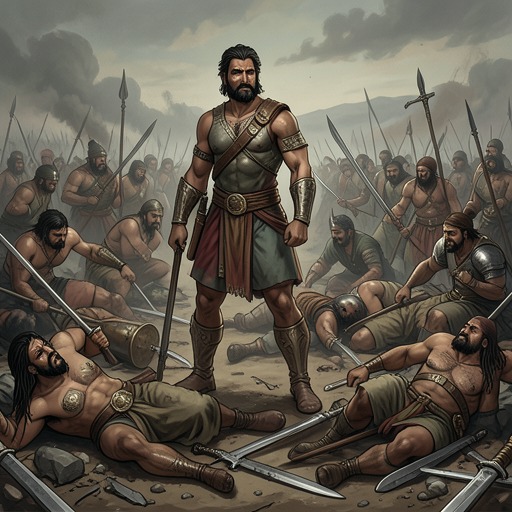
The poem connects that mobilization to the armed confrontation with Ráma. During the fighting, Ráma takes a shaft described as so deadly that no life could withstand its stroke. The account later refers directly to Khara as having fallen, confirming that he does not survive the encounter. The juxtaposition of the commander assembling a force and the deadly weapon taken up against him gives the conflict a decisive reversal: Khara’s military authority cannot secure his survival.
Defeat and Aftermath
Khara’s death is registered not only as the loss of an individual warrior but as the collapse of his local rule. The poem calls Janasthán the place of his royal state and says that it is left desolate after the giants’ bloodshed. His defeat therefore changes the status of the stronghold associated with him. The violence he had directed against the hermits is followed by the destruction of the power from which that violence proceeded.
The poem also makes Khara’s fall a remembered precedent. In a later confrontation, an opponent warns Ráma that he too may fall as Khara did. The comparison gives Khara’s death a continuing place in the narrative: it is invoked as a known outcome against which a new threat is measured. Elsewhere, the image of Khara slain in Janasthán likewise serves as a warning in the struggle over Ráma. These later references keep his defeat present after his own role has ended, turning the ruler’s death into a compact emblem of the danger posed by Ráma’s resistance.
Narrative Role
Khara’s part in the poem links the hermits’ vulnerability in Janasthán to the larger conflict around Ráma. His characterization rests on a small number of forceful details: his kinship with Rávaṇ, his gigantic stature, his fierce treatment of the forest inhabitants, his special hostility toward Ráma, and his command of an army. Together, these establish him as both a personal enemy and a local embodiment of the threat the hermits describe.
His defeat gives that threat a clear consequence. The once-commanded host and the royal seat do not preserve Khara’s power; after he falls, Janasthán is described as desolate. The narrative then carries his name forward through comparisons that recall how he died. Khara’s significance consequently lies not in a long personal development but in the arc formed by his authority, his persecution of the hermits, his armed opposition to Ráma, and the remembered finality of his fall.