Malyavan
RamayanaMalyavan is an elder Rakshasa whose story links the ancient wars between the gods and Rakshasa kings to Ravana’s later conflict with Ráma. Remembered as a formidable ruler who challenged Vishnu, he survives the defeat of his family’s forces and reappears as an experienced counselor. When Lanka faces the threat of Ráma’s army, Malyavan argues that Ravana should acknowledge the danger, restore Sita, and seek peace. His character is defined by this contrast: a warrior from an earlier age who, in the crisis of the present, urges restraint rather than another battle.
Identity and Background
Malyavan also appears under the variant name Malyavat in the account of the ancient Rakshasa kings. The narrative places him among the three sons of Sukeśa—Malyavan, Sumali, and Mali—whose austerities win them invincibility and long life from Brahma. Empowered by that boon, the brothers oppress the gods and sages. Their lineage is presented alongside the separate account of Pulastya and his descendants, whose line includes Viśravas and Kuvera; the distinction matters because the story traces Ravana’s ancestry through more than one branch of Rakshasa history.
The brothers receive Lanka, a city built by Viśvakarmá on Mount Trikúṭa beside the southern ocean. From this fortified home they make war on the gods. When the gods seek aid, Mahadeva directs them to Vishṇu, who promises to defeat their oppressors. The three Rakshasa kings then advance against heaven, where Vishṇu meets them in battle. Their forces are routed, and Mali is killed. Malyavan survives the defeat and addresses Vishṇu as the Rakshasas retreat, objecting to the attack on their rear and offering to renew the fight. The episode establishes him not as a bystander to his brothers’ power but as a combatant willing to challenge even the god who has defeated their army.
From Defeat to Counsel
The account’s perspective shifts from the ancient battle to a later crisis in Lanka. After Ráma’s return to Ayodhyá and accession to the throne, Agastya recounts the history of the Rakshasa kings in response to Ráma’s questions about his former enemies. Malyavan’s earlier defeat therefore belongs to a remembered past, but it also gives the later counselor a history of direct experience with the cost of confronting Vishṇu’s power. The text does not state that this experience is the reason for his advice; rather, the contrast between his former resistance and his later prudence emerges from the events placed beside one another.
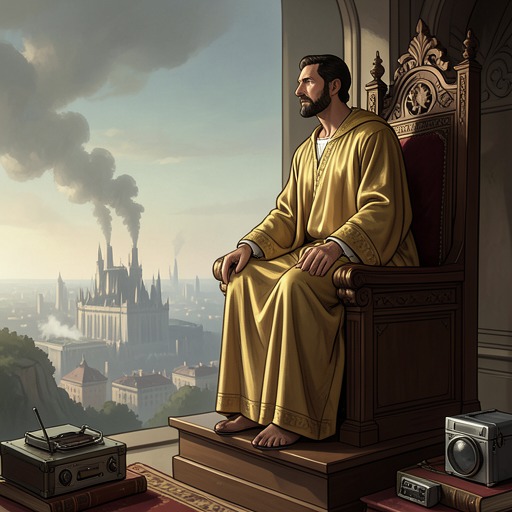
In the later council, Malyavan is identified as Ravana’s maternal grandfather and as a sage and faithful guide, known for wisdom in counsel. His standing within the family gives his intervention particular weight: he speaks not as an outsider to the royal house but as an elder advising its king. He recognizes that Ravana’s security cannot be considered apart from the strength of the opposing force, and he recommends peace when the enemy is stronger rather than persisting in a doubtful conflict.
Counsel During the Conflict with Ráma
Malyavan’s proposal is concrete. He urges Ravana to make peace with Ráma and return the captive Sita. His argument points to the bridge across the ocean: in his judgment, no ordinary mortal hand has spanned that water in such a way. The bridge serves in his speech as evidence of the scale of the threat, not merely as a military obstacle. Malyavan reads the achievement as a reason to reconsider the conflict before Lanka’s danger deepens.
His advice brings together strategic assessment and a specific remedy. He does not counsel a vague pause or a rearrangement of forces; he asks Ravana to release Sita and seek peace from Ráma. The recommendation stands against the expectation that a king must answer every challenge with further force. Instead, Malyavan presents withdrawal from an increasingly perilous conflict as the wiser royal choice. His appeal also recalls the earlier defeat of the Rakshasa kings by Vishṇu: in both episodes, the question is whether pride in the strength of Lanka can overcome the power arrayed against it. The later speech turns his own history of battle into the authority of an elder who can recognize when continued war is dangerous.
Character and Narrative Significance
Malyavan’s two appearances give him a compact but consequential arc across generations. In the ancient account he belongs to a triumvirate of powerful brothers, receives the benefit of austerities and divine favor, and still suffers defeat when Vishṇu answers the gods’ appeal. He survives and protests the manner of the rout, retaining the combative resolve of a king. In the later council, however, that same survivor is remembered for wisdom and counsels Ravana to avoid a doubtful battle. The narrative thus places martial capacity and political judgment in tension without erasing either side of his character.
His advice also makes the consequences of Ravana’s choices legible before the conflict is resolved. Malyavan identifies both the sign of danger—the ocean bridge—and the action that could avert further war: returning Sita and making peace. The evidence establishes him as the voice of caution in Ravana’s council, though it does not make him the decision-maker. His significance lies in the clarity of the alternative he offers. Within a family whose earlier rulers tested their strength against the gods, Malyavan recognizes that inherited power does not guarantee safety, and that wise counsel may require a king to stop fighting.