Bhagiratha
RamayanaBhagiratha is a royal sage remembered for the austerities associated with bringing Ganga down to earth. His story joins royal responsibility and renunciation to a decisive act of ancestral care: when the river reaches the dust of his kinsmen, he pours a funeral libation over it.
Identity and Background
The poem calls Bhagiratha a royal sage and says he had no son to gladden his old age. His account is identified as a legend told at length in Book I, Canto XLIV, the canto devoted to Ganga’s descent. These details place him within a royal line while emphasizing the absence of a child in his own household.
Austerity at Gokarṇa
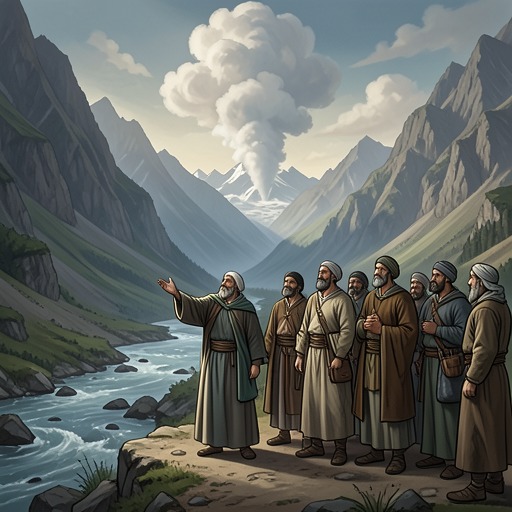
Bhagiratha leaves the care and burden of his state to his ministers and goes to distant Gokarṇa, where he undertakes prolonged austerity. The account depicts him with his senses restrained and his arms raised. His withdrawal is not an abandonment of kingship: the ministers remain responsible for governing while he pursues the austerity associated with the descent of Ganga.
Ganga and the Funeral Libation
The culmination of the legend is a ritual act. Over the dust of his kinsmen, Bhagiratha pours a funeral libation; as the flood reaches and moistens that dust, the waters and the offering meet. The image gives the river’s arrival a familial consequence: its descent is bound to Bhagiratha’s service to the dead, not only to the extraordinary journey of the water itself.
Narrative Significance
Bhagiratha’s story moves from the obligations of a king to the austerities of a sage and back to a duty performed for his kin. His lack of a son is stated, but the poem’s account of his achievement centers instead on the kinsmen for whom he makes the funeral offering. Ganga’s descent thus becomes, in his narrative, both a sacred event and the means by which an ancestral rite is completed.