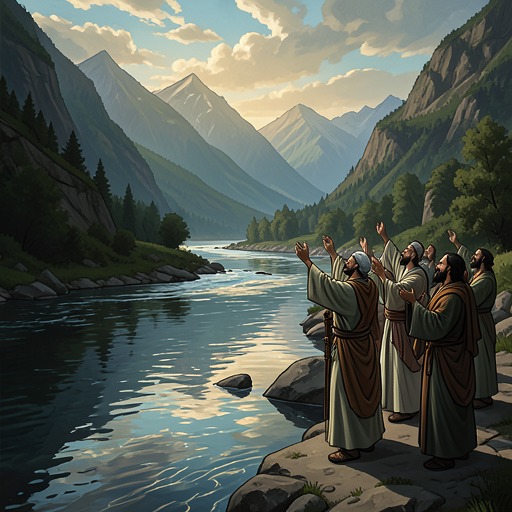
Himalaya
RamayanaHimalaya is both a mighty, metal-rich mountain and a father whose decisions place his daughters within divine affairs. The sage’s account presents him as lord of the mountains and father of Gangá and Umá: the Devas petition him for Gangá’s help, while Umá’s austerities precede her marriage to Shiva. In these episodes, his authority is expressed through granting requests and arranging a divine union.
Identity and Characterization
The narrative introduces Himalaya through grandeur and kinship together. He is described as a mighty hill rich in metals and as the lord of the mountains, a title that makes his household a point of approach for the Devas. Yet the account does not dwell on his rule over a territory or on any contest with other powers. Its attention falls instead on the decisions he makes as father of two daughters whose destinies matter to the gods.
His characterization is conveyed chiefly through these acts of consent. The Devas come to him directly when they need Gangá, and he agrees to yield her; in Umá’s story, he gives his daughter as a bride to Shiva. The scenes thus make paternal authority consequential without supplying a fuller portrait of Himalaya’s inner life or a separate account of his actions beyond the family and divine requests described here.
Gangá and the Devas’ Petition
The sage recounts Gangá’s birth and growth before describing the Devas’ appeal. They need her help to bring their vows to completion, so they approach Himalaya and ask him to give her to them. The request places his parental decision at the hinge between their need and Gangá’s participation: rather than taking her without his assent, they petition the mountain king.
Himalaya grants what they seek. The passage therefore associates his status as lord of the mountains with a specific act of permission, not merely with the scale of his natural domain. The episode gives him a mediating role in the Devas’ undertaking, while the account’s focus remains on Gangá and the purpose for which the gods require her aid.
Umá’s Austerities and Marriage
Umá’s story presents a different path to a divine match. She spends a long time in austere vows and rigid fasting; afterward, Himalaya gives her to Shiva as his bride. Her ascetic practice is the distinctive circumstance attached to this marriage, in contrast with Gangá’s appearance in an episode organized around the Devas’ petition.
The account places Himalaya’s decision after Umá’s sustained austerities, but does not describe a negotiation between father and daughter or explain her response to the marriage. What it does establish is that he gives her to Shiva and that the union follows a period of religious discipline. The two episodes together show his daughters entering divine relationships through distinct narrative circumstances, with Himalaya’s consent or gift marking each transition.
Narrative Role
Himalaya’s appearances connect family relationships to events of wider divine importance. In the account of Gangá, the Devas’ need leads them to the mountain king, whose agreement makes her available to aid their vows. In the account of Umá, her austerities lead into the marriage Himalaya arranges with Shiva. These are concise but consequential interventions: his importance lies less in an extended personal arc than in the authority he exercises at two turning points in his daughters’ stories.
The sage’s telling also shapes how Himalaya is presented. He appears within a recounted account of Gangá’s birth and growth, and the passages about both daughters emphasize decisions and relationships rather than a continuous biography. The result is a figure defined by paired roles: sovereign mountain and father, approached by the Devas in one episode and giving Umá in marriage in another.