Vishṇu
RamayanaVishṇu is the preserver and sovereign of the gods, whose decision to take mortal birth supplies the divine answer to Rávaṇ’s apparent invulnerability. When the gods appeal for help, he does not simply destroy the threat from above: he accepts their request to become the son of Daśaratha, entering human life so that the one kind of opponent Rávaṇ neglected can defeat him. The episode makes incarnation both a strategic response to a loophole and an act of protection for worlds imperiled by tyranny.
Identity and Divine Presence
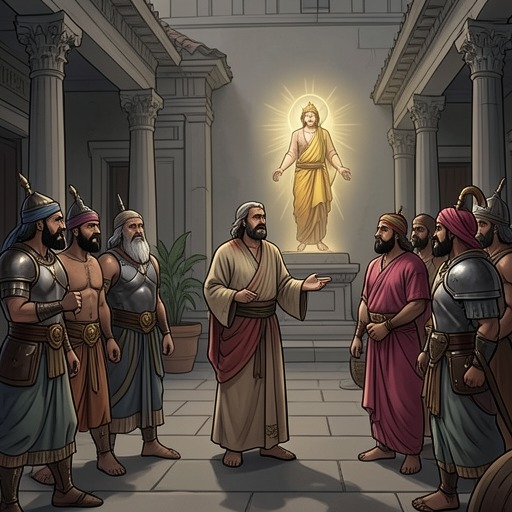
Vishṇu arrives at the gods’ council already marked by unmistakable sovereignty. One account describes him as crowned with glory like a flame; another presents him in yellow, adorned with glowing gold, riding Garuḍa and carrying his conch, discus, and club. The gods welcome and adore him, while Brahmá receives him before the assembled celestials. The regalia and reception establish his rank before he speaks: he is not merely a powerful ally being summoned, but the divine ruler to whom the other gods turn as their refuge.
His authority is also described in explicitly universal terms. Brahmá addresses him as Náráyaṇ, the lord to whom all creatures bow and their saviour. Elsewhere, Vishṇu is identified with Brahmá and Śiva and with each person of the divine triad. This account therefore holds together two scales of identity: Vishṇu is a figure who enters a particular council and answers a particular plea, yet he is also presented as encompassing the divine powers through which the worlds are governed. His appearance in a narrated scene does not limit his reach; it gives that universal power a form capable of intervening in history.
The Crisis and the Gods’ Appeal
The council is convened because Rávaṇ’s violence has made the gods, sages, and other beings unsafe. The account depicts his power as so oppressive that even the movement of the sea’s waves ceases; Viśravas has fled Lanká, and Rávaṇ’s assaults have brought distress across the worlds. The gods ask Vishṇu to devise a way to destroy him, presenting the crisis not as a private dispute but as a danger to the order and security of many kinds of beings.
Brahmá explains why direct divine force has not already solved the problem. Rávaṇ had requested invulnerability against divine sages, Gandharvas, Yakshas, Rākṣasas, and serpents, and Brahmá granted that protection. Rávaṇ’s contempt led him to leave humans out of his request. The omission becomes the decisive weakness in what otherwise appears to be an all-encompassing boon: he protected himself from powerful supernatural opponents but did not account for a human assailant. Vishṇu’s intervention is thus shaped by the terms of the danger. The gods need not overturn Brahmá’s grant; they need a means of acting within the one category it leaves exposed.
The Decision to Take Mortal Birth
The gods ask Vishṇu to become the son of Daśaratha, king of Ayodhyá, who is performing an Aśvamedha in hope of obtaining offspring. They frame the request as service to the good of the universe: Vishṇu is to divide into four portions and assume sonship among Daśaratha’s three consorts. A related prophecy promises the king four sons who will uphold his royal line. The cosmic rescue plan is therefore joined to a royal family’s longing for heirs; the birth that continues Daśaratha’s dynasty also creates the human instrument needed to confront Rávaṇ.
Vishṇu accepts the proposal rather than remaining at a distance as a divine benefactor. He promises to kill Rávaṇ, whose power has made him a terror to the universe, and to protect the earth while living among humans for eleven thousand years. His undertaking extends beyond the defeat of the tyrant: it includes Rávaṇ’s posterity, courtiers, counsellors, relations, and friends. The pledge gives the incarnation a defined purpose and duration, while its breadth makes clear that the promised intervention is directed against the network of power surrounding Rávaṇ as well as against the king himself.
Incarnation, Protection, and Narrative Meaning
Vishṇu’s acceptance makes the human condition the means of deliverance. Rávaṇ’s confidence rests on a list of beings from whom he has secured protection; Vishṇu answers by entering the unprotected category. The reversal is central to the episode’s logic: the supposedly lesser form is precisely the form the tyrant has failed to respect. What Rávaṇ treats as insignificant becomes the opening through which the worlds can be saved.
The text also connects the incarnation to the larger divine order. It identifies Queen Sítá as Lakshmi, Vishṇu’s celestial spouse, and links her presence to the work of freeing the worlds from Rávaṇ. This connection places the human story within a cosmic design without erasing its human form: divine purpose is carried through birth, kinship, and mortal action. Vishṇu’s decisive role is therefore not only that of a god who promises victory. He consents to become present among the people endangered by Rávaṇ, making protection an embodied undertaking and turning an overlooked limit in the tyrant’s boon into the condition of his defeat.