Indra
RamayanaIndra, king of the gods and ruler of the sky, links the epic’s divine council, its account of the Vánara allies, and the decisive battle against Ravana. His appearances show power in several forms: as a god constrained by Ravana’s boon, as the divine father of Bali, as the source of an animal’s distinguishing mark, and as a benefactor who sends aid to Rama. The contrast between his authority and his inability to defeat Ravana directly helps frame the epic’s answer to the demon king’s immunity.
Identity and Divine Standing
Indra is identified by his sovereign titles: monarch of the skies, lord of the gods, and the Thousand-eyed. The poem also refers to him through his relation to Śachí. These names establish him as a prominent figure among the Devas, but his appearances are not limited to ceremonial praise. He participates in the gods’ deliberations, acts in stories that explain features of the natural world, and intervenes in the human conflict that the gods themselves cannot resolve by force.
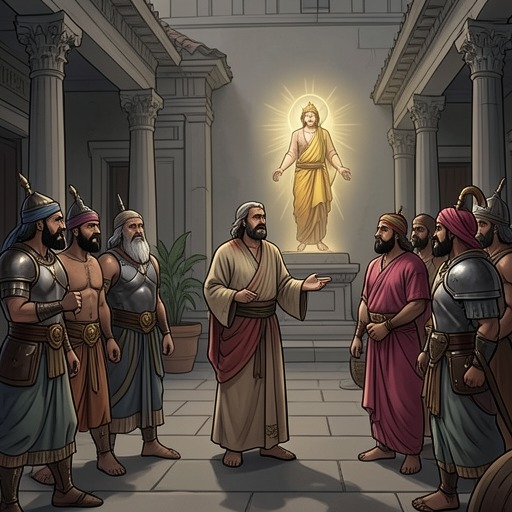
His authority has limits. Ravana’s boon protects him from being killed by gods and other supernatural beings, a protection that leaves human beings outside its terms. When Ravana’s violence becomes intolerable, the gods gather to appeal to Brahma. Indra is named as their leader in this assembly. The resulting solution is not a divine attack: Vishnu undertakes to take human form and defeat Ravana. Indra’s presence at the appeal places him among the powers that recognize the crisis, while the terms of the boon explain why their response must take another form.
Divine Council and the Ravana Crisis
The gods’ appeal describes a threat extending across the worlds. Ravana’s strength intimidates divine and mortal communities, and even the natural powers are said to be stilled in his presence. The gods have tolerated his conduct because Brahma granted the boon that excludes them from killing him; now they ask Brahma to address the danger created by that protection. Indra’s leadership gives the gathering a political shape: the king of the gods speaks from within a collective crisis rather than acting as a solitary champion.
Brahma’s answer directs the solution toward a human life. Vishnu promises to destroy Ravana and his allies in battle while living among mortals and ruling the earth. The arrangement makes Indra’s limitations narratively significant. He can lead the petition and take part in the divine response, but the task must be carried out by a being acting in human form. Divine power does not simply erase the boon; the story turns its omission into the opening through which Ravana can be defeated.
Bali and the Vánara Allies
Indra is also connected to the Vánara forces through Bali, identified as his son. Bali becomes a leader among the woodland hosts, extending Indra’s influence into the earthly coalition that later supports Rama. This ancestry connects the divine world to the army of forest allies without making Indra himself the leader of that army. His importance here is genealogical: one of the Vánara hosts’ formidable figures has a divine father.
That connection belongs to a broader account of divine participation in the creation of allies for the struggle against Ravana. The gods’ role is not confined to the council where they identify the problem; their descendants also enter the world in which the conflict will be fought. Through Bali, Indra’s presence becomes part of the epic’s bridge between divine planning and the strength assembled on earth.
The Peacock and the Tale of Marutta
A separate episode gives Indra an etiological role. Ravana interrupts a sacrifice performed by King Marutta, and the assembled gods flee in terror by assuming different forms. Indra becomes a peacock. Afterward, the gods reward the animals whose shapes they have taken. Indra’s boon accounts for the peacock’s tail, whose markings recall his thousand eyes.
The episode sets Indra’s prestige beside divine vulnerability. The Thousand-eyed king does not confront Ravana in that moment; like the other gods, he escapes by taking an animal form. Yet the flight leaves a lasting sign in the natural world. The peacock’s tail preserves the memory of Indra through a visible transformation, turning a moment of danger into an explanation of the bird’s distinctive appearance. His mythic authority appears here not as victory in battle but as the power to confer a mark that outlives the crisis.
Aid in the War and Narrative Significance
During the war, the gods watch the struggle from above. Indra sends his charioteer Mátali down with a celestial chariot for Rama. This intervention gives Rama support at the point when the conflict with Ravana demands a decisive contest, while preserving the distinction between the human champion and the gods who assist him. Indra does not replace Rama as the fighter; he supplies a means of aid through Mátali and the chariot.
The episode complements the earlier appeal to Brahma. At the outset, Ravana’s boon prevents the gods from solving the crisis by killing him themselves, so Vishnu must act in human form. At the climax, divine assistance becomes possible without displacing that human role: Indra can send the chariot, but Rama remains the one who faces Ravana. Across these scenes, Indra embodies both the reach and the limits of divine authority. His leadership, lineage, mythic boons, and wartime aid connect the gods’ recognition of Ravana’s threat to the earthly alliances and actions through which the threat is finally answered.