Brahmá
RamayanaBrahmá is the creator of earth and sky and a high divine authority whose decisions shape both the poem’s literary frame and its central conflict. He recognizes Válmíki’s unplanned verse, hears the gods’ appeal against Rávaṇ, and identifies the weakness in the protection he once granted the tyrant: it does not include human beings. His presence thus connects poetic creation, divine promises, and the conditions under which Rávaṇ can be overcome.
Identity and Authority
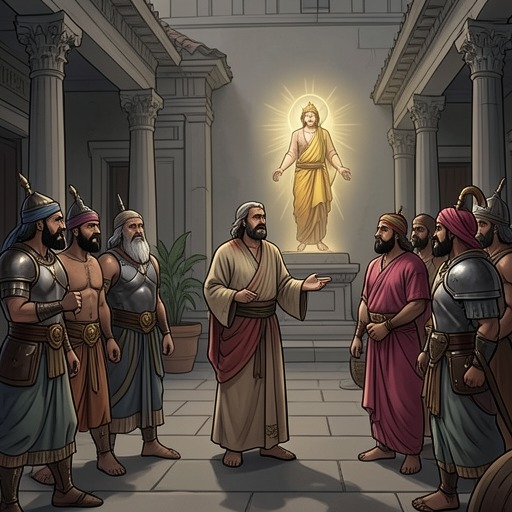
Brahmá is introduced as the creator of earth and sky. This title establishes more than rank: he is the figure to whom other divine beings turn when a crisis exceeds their power to resolve. When Rávaṇ’s oppression becomes intolerable, the gods assemble and address their plea to Brahmá, asking him to devise a way to end it. Their appeal makes his authority practical as well as cosmic; he is expected not merely to hear their distress but to interpret the consequences of his own earlier decision.
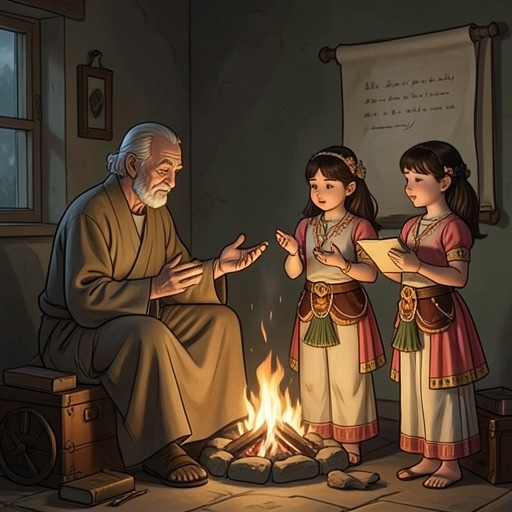
The poem also associates Brahmá with the recognition of verse. After Válmíki’s mind has turned inward in deep thought, Brahmá appears and responds with delight to a verse the hermit has made unconsciously. The scene presents poetic expression as something that can emerge without deliberate composition and then be recognized by a divine listener. Brahmá’s response marks the verse as a meaningful achievement, joining his role as creator to the poem’s concern with the making of poetry.
The Boon and the Gods’ Appeal
The gods explain that Rávaṇ has been granted protection by Brahmá and that, because of this promise, they have endured his oppression. Their account gives the boon a public consequence: Rávaṇ’s security has enabled him to distress the gods and sages, as well as other peoples and beings. The complaint expands beyond personal grievance into a description of disorder affecting the world. Where Rávaṇ remains, the sun loses strength, the winds are afraid to blow, fire ceases to burn, and the ocean’s waves fall still. Even Viśravas, distressed by Rávaṇ’s power, has abandoned Lankā.
Brahmá does not deny the protection or evade responsibility for it. He recalls what Rávaṇ asked for: invulnerability against divine sages, Gandharvas, Yakṣas, Rākṣasas, and serpents. Brahmá had agreed. The decisive omission, however, was humanity. Rávaṇ’s contempt led him not to request protection from human beings, and Brahmá identifies that omission as the opening through which the tyrant can be destroyed. The solution therefore arises not from cancelling the boon, but from its stated limits. A promise that once appeared to secure Rávaṇ’s supremacy also defines the boundary of that supremacy.
This episode makes Brahmá’s authority consequentially double-edged. His grant helps explain why the gods cannot simply overpower Rávaṇ, while his recollection of its terms supplies a way forward. The danger comes not from a new weapon or a reversal of the promise, but from attention to what the promise did not cover. The gods respond with joy when Brahmá announces the method, shifting the scene from helpless complaint to a viable prospect of deliverance.
Rávaṇ and the Human Exception
Rávaṇ’s own recollection confirms that Brahmá’s words remain central to his understanding of his fate. Near his defeat, he remembers too late that Brahmá had spoken of the destiny awaiting him. The earlier terms of the boon thus recur at the point when Rávaṇ can no longer treat his protection as absolute. What he had failed to fear becomes, in retrospect, the condition that exposes him to danger.
The contrast between Rávaṇ’s confidence and the overlooked human exception gives the episode its reversal. His power is immense enough, in the gods’ report, to disturb the elements and drive Viśravas from Lankā; yet its limit is determined by a category he dismissed. Brahmá’s decision supplies the story with a precise causal link between Rávaṇ’s request, his prideful omission, and the means of his eventual destruction. The threat is not made harmless in advance: the gods endure it until the loophole becomes actionable.
Other Encounters and Narrative Role
Brahmá appears again in a scene concerning Ráma, where he answers Ráma’s statement of descent from the line of Ikshváku and identifies him as Lord Náráyaṇ. The exchange places Ráma’s human lineage beside a divine identity, recalling the distinction on which the solution to Rávaṇ’s boon depends. The passage thus brings together two descriptions of Ráma: a prince born in a human royal line and a figure Brahmá names as divine.
Elsewhere, the poem’s headings place Brahmá’s words and decisions at turning points, including the canto titled Rávaṇ Doomed and the cantos surrounding Ráma’s promise and the praises of truth. The headings alone do not make every event in those cantos a direct action by Brahmá, but they frame a narrative in which divine speech, promises, and their consequences recur. Across the scenes that do directly feature him, Brahmá recognizes verse, receives the gods’ appeal, recalls the exact scope of Rávaṇ’s protection, and speaks to Ráma. His importance lies in the way these moments connect authority with limitation: what he creates or grants establishes the conditions within which later action must unfold.