Prahasta
RamayanaPrahasta is one of Rávan’s foremost generals and a principal defender of Lanka during the war against Ráma’s forces. The narrative presents him both as a commander assigned to a specific gate and as a champion expected to take the field when the Rákṣasa army is under pressure. His career in the battle reaches a stark reversal: the warrior who promises to sweep the Vánars away is killed by Nīla after losing his bow and chariot.
Identity and Command
Prahasta’s standing is established through military responsibility rather than an account of his origins. When Ráma’s side describes the defenses of Lanka, Prahasta heads the legions stationed at the eastern gate. This placement makes him part of the city’s organized defense, charged with a major approach while other forces guard the remaining portals. The poem thus situates him within the practical structure of the siege, not merely among Rávan’s named champions.
His command role is also apparent in the way his name recurs alongside Akampan and Kumbhakarṇa. In the course of the fighting, these figures are invoked as measures of Rávan’s remaining military strength. Their names carry weight because they represent formidable forces still available to the king; Prahasta belongs to the group whose presence makes a renewed sortie possible. The narrative offers no comparable personal history for him, keeping attention on his position and actions in the war.
A Champion Sent into the Battle
After Akampan’s defeat, Rávan is seriously alarmed and declares that he himself, Kumbhakarṇa, or Prahasta must go forth. The alternatives convey both the severity of the losses and Prahasta’s rank: he is among the few commanders Rávan considers capable of answering the crisis in person. Prahasta then sallies out at the head of his troops, making the threatened commitment to the defense of Lanka a direct confrontation rather than a distant command.
Before the armies meet, Prahasta boasts that the birds of the air will feast on Vánar flesh. The threat gives his entrance its confident, aggressive tone. It frames the coming combat as one in which he expects to destroy the opposing force, and it raises the contrast with his eventual defeat. His words are not followed by a victory that confirms them; instead, the account turns quickly to the pressure of battle and the loss of his weapons and vehicle.
The Battle and Death
The two armies collide in a fierce exchange of stones and arrows. Nīla meets Prahasta and breaks his bow, a decisive change in the encounter: Prahasta can no longer fight from the advantage of his principal weapon. He leaps from his chariot, and the conflict continues on foot. The scene strips away the distance and equipment associated with the general’s command and sets the two fighters directly against each other.
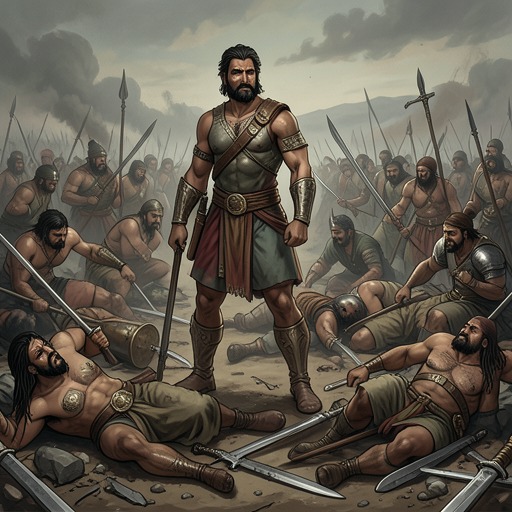
Nīla kills Prahasta with a huge tree. The poem compares the fallen general to a tree whose roots have been cut, turning the image of a forest weapon into an image of abrupt collapse. The manner of his death reverses his earlier boast: the commander who had predicted a feast of Vánar flesh becomes the defeated figure on the battlefield. His death is also part of the repeated pattern of Rávan’s generals going out to stem the Vánar advance and failing to stop it.
Narrative Role and Significance
Prahasta’s role connects the military organization of Lanka to the successive combats that weaken it. His command at the eastern gate gives the city’s defense a concrete structure, while Rávan’s decision to name him as one of the possible champions for a sortie reveals the importance attached to his strength. When he does enter the field, his boast presents the confidence of Lanka’s leadership at a moment of crisis.
The battle then measures that confidence against events. Prahasta loses his bow, leaves his chariot, and is killed in close combat; the sequence makes his defeat a visible reversal rather than a mere report of a commander’s death. His fate contributes to the weakening of Rávan’s military leadership, while the contrast between his promise and his end underscores the growing danger the Vánars pose to Lanka.