Bharat
RamayanaBharat’s defining role is to hold royal authority without treating it as his own. When Ráma remains in exile, Bharat refuses to reign, seeks his brother in the forest, and accepts Ráma’s sandals as the pledge under which he will govern. The sandals make his position visible: he exercises rule, but recognizes Ráma as the rightful king. When Ráma returns, Bharat brings them back and places them at his brother’s feet.
Refusal of the throne
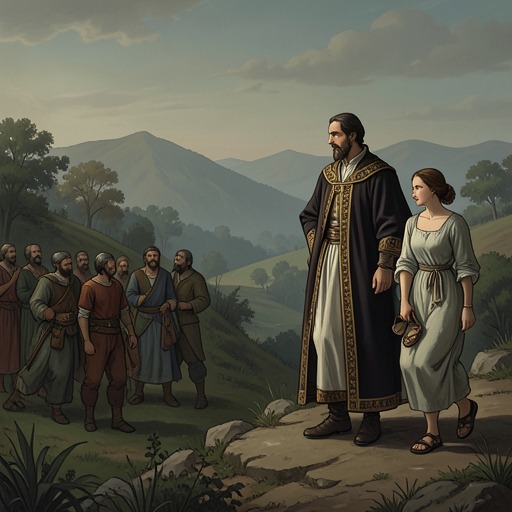
After the aged king dies, Bharat refuses the throne, although the twice-born urge him to accept it. His refusal establishes that the succession dispute will not become a contest between brothers: he does not use the opportunity to make his own claim sovereign, but goes into the woods to meet Ráma. There, he falls at Ráma’s feet and pleads with him to accept the rule that he considers his brother’s due.
The scene gives Bharat’s deference a physical form. He approaches Ráma in the forest and lowers himself at his feet; the gesture makes his appeal more than a political argument. Yet Ráma does not return. He chooses to observe his father’s decree, placing filial obedience ahead of Bharat’s earnest request. Bharat’s rejection of kingship therefore cannot itself end the exile: Ráma’s commitment to the paternal command remains decisive.
The sandals and delegated rule
Ráma places his sandals in Bharat’s hands as a pledge that he will rule the land, then bids him return. The exchange resolves the immediate question of who will govern without undoing Ráma’s decision to remain away. Bharat can take responsibility for the realm, but the pledge identifies the authority behind that responsibility as Ráma’s. The sandals are thus both a concrete object entrusted to Bharat and a sign that his rule is provisional in relation to his brother’s claim.
The poem later describes Bharat as prompt in duty, wise, just, and true, and calls him lord of all. It presents him as ruling the broad earth with wisdom and justice, not simply as a brother waiting for Ráma to return. That account gives substance to the political side of his character: the office he accepts is a real exercise of sovereignty and public responsibility. At the same time, the earlier pledge keeps his authority connected to Ráma rather than to personal ambition.
A ruler who does not claim the crown
The narrative’s praise of Bharat gathers qualities associated with effective rule—duty, wisdom, justice, and truth—while preserving the distinction between governing and possessing the rightful claim. His refusal is not a rejection of public responsibility altogether. Instead, he accepts the task of rule within the limits set by Ráma’s decision and the sandals entrusted to him. In this portrayal, restraint and service accompany political competence.
That arrangement also sharpens the contrast between the brothers’ obligations. Bharat seeks Ráma’s return and regards the kingship as his; Ráma maintains that he must keep his father’s decree. Bharat’s appeal cannot prevail over that promise, but his conduct does not turn the disagreement into rivalry. He asks, then accepts the role that remains to him: ruling while the rightful king is away.
Return of the sandals
When Ráma’s return is at hand, Bharat is found seated before a lonely cell, wearing hermit’s garb and with tangled hair. The description sets his appearance apart from the ordinary image of a triumphant ruler. His years of authority have not erased the austerity and separation associated with Ráma’s absence; the scene places him waiting rather than celebrating possession of the throne.
At the reunion, Bharat places the shoes he had brought at Ráma’s feet and addresses him as “My King.” The movement reverses the earlier transfer: what Ráma had entrusted to Bharat as a pledge now returns to its owner. Bharat’s action closes the constitutional and emotional interval opened by the exile. His stewardship has preserved Ráma’s place rather than replaced it, and the poem’s movement toward Ráma’s reign is completed by the brother who refused to claim that reign for himself.