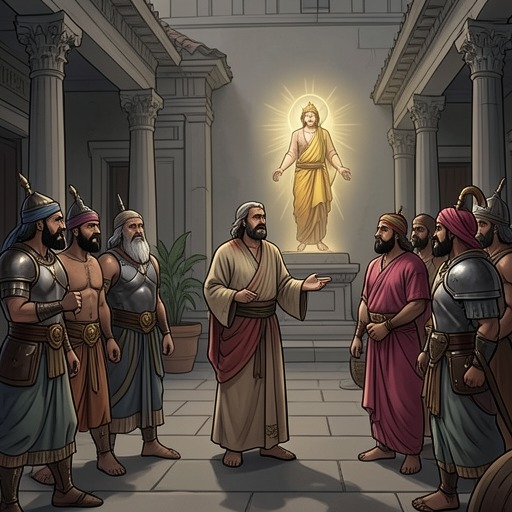
Śatrughna
RamayanaŚatrughna is a son of Sumitrá and a younger prince in the royal family. The account names him alongside Lakshmaṇ as one of Sumitrá’s two sons, among the four brothers Ráma, Bharat, Lakshmaṇ, and Śatrughna. The evidence gives him little independent action in the family’s earlier story; instead, it establishes his place through kinship and the loyalties that shape his characterization.
Identity and Place in the Family
Śatrughna’s identity is introduced within the account of the princes’ births. Sumitrá bears two sons, Lakshmaṇ and Śatrughna, completing the group of four royal brothers. The paired introduction places him within the same immediate branch of the family as Lakshmaṇ, but the narrative’s emphasis is not on a separate succession claim or personal ambition. It is on the bonds among the brothers.
The poem makes those bonds distinct rather than interchangeable. It describes Lakshmaṇ as especially devoted to Ráma, while Śatrughna’s strongest attachment is to Bharat: he prizes Bharat above his own life. This parallel gives each younger prince a particular orientation within the family. Śatrughna’s defining connection is not simply that he is a brother to all three princes, but that his exceptional affection is directed toward Bharat.
Devotion to Bharat
The account presents Śatrughna’s loyalty in the language of profound personal attachment. His love for Bharat is compared to the value of life itself, making their relationship more than a matter of shared rank or household allegiance. The comparison also echoes the poem’s description of Lakshmaṇ’s attachment to Ráma, setting the two younger brothers beside one another as devoted companions, each closely aligned with a different elder brother.
This characterization is borne out when news arrives that Ráma is to be brought home. As the preparations turn toward welcoming the king, Śatrughna is filled with joy and acts in obedience to his brother’s command. The episode gives his loyalty a practical form: affection becomes readiness to serve in a collective effort, rather than remaining only a statement about what he feels for Bharat. The scene’s focus is on the return and the shared celebration, so it does not establish a separate political program or a decision made independently by Śatrughna.
Conduct at Ráma’s Return
The return scene places Śatrughna among those preparing to receive Ráma in triumph. His response is described as rapture, and his obedience to his brother links that emotion to action. The welcome matters to him not as a chance to claim prominence but as the restoration of the family’s rightful center: the absent king is coming home, and Śatrughna participates in the preparations under Bharat’s direction.
The account also records his reverential affection toward both his brothers. That gesture broadens the picture beyond his special bond with Bharat. His attachment has a clear emphasis, but it does not exclude Ráma; the family ties coexist. In the aftermath of the conflict, the narrative thus presents Śatrughna as responsive both to Bharat’s authority and to the standing of his brothers. His conduct at the homecoming gives the earlier description of fraternal love a public, ceremonial setting.
Narrative Role
Śatrughna’s characterization is concise and relational. The evidence does not develop an independent sequence of exploits for him; it locates his importance in the structure of the royal family, his exceptional devotion to Bharat, and his participation in the welcome for Ráma. Those details make him a stabilizing presence in scenes organized around brotherhood and the return of the king.
The contrast among the brothers helps specify his role. Lakshmaṇ’s devotion is directed toward Ráma, while Śatrughna’s is especially directed toward Bharat; at the return, however, Śatrughna’s reverence extends to both. His account therefore moves from a particular attachment to a wider expression of family loyalty. The emphasis remains modest but clear: he rejoices, obeys, and honors his brothers, helping the reunion register as a restoration of kinship as well as kingship.