Devas
RamayanaThe Devas are the poem’s collective community of gods, at once participants in primordial conflicts and petitioners who seek a remedy when divine power alone cannot restore order. Their appeal over Ravana’s oppression supplies the decisive premise for Vishnu’s incarnation as a human prince: Ravana’s boon excludes the very kind of opponent he has dismissed as insignificant. In this way, the Devas do not merely observe the epic’s central struggle; their counsel helps bring its means of resolution into being.
Identity and Collective Presence
The Devas appear chiefly as a gathered body rather than as a set of individually developed characters. The poem nevertheless gives this collective a visible order: Indra stands at its head, while Brahma and Vishnu are addressed as powers able to answer its appeals. Their assemblies turn a widespread disturbance into a formal petition, and their shared speech presents the welfare of the worlds as a common concern.
That collective identity does not mean the Devas are always secure or victorious. In an account of an ancient contest, they and the Asuras are born of sister mothers and become rivals. The Devas’ parentage is associated with Aditi, and the contest belongs to a time before the celebrated Krita Age had passed. In the conflict described around the churning of the Milky Sea, the two groups exert themselves together in the churning, but their rivalry remains consequential: a fratricidal war arises, and the Devas are described as the sons of light. The poem therefore presents divine order not as a condition free of conflict, but as one repeatedly tested by kinship, competition, and changing fortunes.
Rivalry and Vulnerability
The Devas’ struggle with the Asuras gives their collective history a recurring pattern: they can be challenged, pressed into action, and forced to seek help beyond their own assembly. The brief references to ancient battles make defeat part of that history, not an exceptional impossibility. This vulnerability matters to their later appeal concerning Ravana. Though divine beings, they do not claim that their status alone makes them immune to the consequences of disorder.
The churning episode also places the Devas within a shared undertaking with their rivals. Their effort is directed toward the Milky Sea, but cooperation does not dissolve the rivalry between the groups; a fratricidal war follows. The contrast between joint labor and subsequent conflict makes the collective character of the Devas more complex than simple opposition to the Asuras. They can act alongside their rivals in a common enterprise and still become combatants in a struggle over power and its results.
The Appeal over Ravana
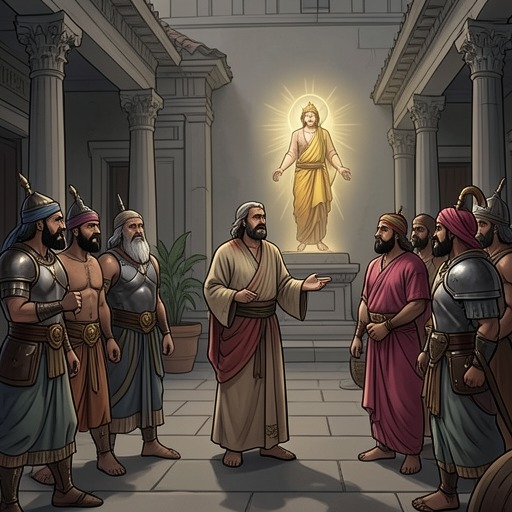
The most consequential assembly gathers the Devas before Brahma. With Indra at their head, they report that Ravana, empowered by a boon, has become an oppressor not only of them but of sages and other peoples. The grievance is described on a cosmic scale: where Ravana is present, the sun loses strength, the winds do not blow freely, fire ceases to burn, and the ocean is affected by fear. The complaint makes his rule a threat to the conditions that sustain life, rather than merely a political challenge to one divine group.
The Devas explain why they have endured this oppression. Brahma previously granted Ravana protection from death at the hands of gods, Danavas, and Yakshas, and they have respected the force of that promise. The account thus gives their suffering a specific cause: the boon constrains the available response. Their petition does not ask Brahma simply to disregard his earlier grant. Instead, it brings the terms of that grant into view and allows its omission to become decisive.
Ravana had not included human beings among the enemies from whom he sought protection. The Devas had likewise been unable to defeat him within the categories covered by the boon, but Brahma identifies a human being as the means by which he can be killed. The opening in Ravana’s security comes from his own underestimation of human power. The Devas’ appeal turns that overlooked possibility into a practical answer to the crisis.
Vishnu’s Incarnation and the Epic’s Turning Point
Vishnu arrives before the assembled gods, carrying his conch, discus, and club and riding Garuda. The Devas ask him to become their refuge and explain that Daśaratha, a virtuous king who has no children, is performing an Aśvamedha in the hope of obtaining offspring. Their request is exact: Vishnu is to become Daśaratha’s son, dividing himself into four portions among the king’s three wives. The divine response is therefore linked to a human succession and to a particular royal sacrifice, rather than being framed as an intervention detached from the poem’s earthly plot.
Vishnu accepts the task. He promises to kill Ravana and his posterity, together with his associates and supporters, and to remain incarnate among human beings for eleven thousand years while protecting the earth. The Devas’ petition consequently sets in motion the birth of the prince who can confront an enemy invulnerable to the gods. Their collective action does not itself defeat Ravana; it secures the conditions under which the conflict can be fought on terms the boon does not forbid.
This episode also establishes a limit on divine power as the narrative represents it. The Devas cannot simply overcome the protection Ravana has obtained, and Brahma’s former promise is treated as binding. Resolution comes through close attention to what the boon does and does not cover, followed by a change of form and scale: Vishnu must enter human life. The Devas’ counsel is thus effective because it recognizes a boundary and finds a route through it, not because it cancels the boundary.
Assemblies, Witnesses, and Narrative Function
The Devas recur as a public body whose assemblies make distress legible and whose responses mark events as consequential beyond the immediate participants. In the Ravana episode, they speak together, identify the reach of the danger, and address the beings whose decisions can change the situation. Their collective voice supplies evidence of the crisis’s extent: oppression reaches sages and other communities, while natural forces themselves are described as disrupted.
Elsewhere, the poem again places Indra and the Devas in scenes of response and observation. Indra is shown rejoicing over a deed said to free the worlds from woe, and Brahma directs him to seek a place. Other brief scenes present the Devas in assemblies, receiving honor, or watching events alongside sages and heavenly bards. These appearances preserve their role as witnesses and commentators without making every divine gathering identical to the council over Ravana.
The distinction between witness and agent is central to their narrative importance. At times the Devas watch, praise, or respond to an action; at the decisive council, they become petitioners whose account prompts a plan. Their collective presence connects local events to the welfare of the worlds, while their inability to bypass Ravana’s boon keeps that connection from becoming effortless omnipotence. The Devas matter most not as a uniformly victorious force, but as a community that recognizes a crisis, brings its cause before the proper authority, and helps transform a limitation into the condition for the poem’s central human struggle.